










Manufacturing has always been an industry that runs on precision, discipline, and the ability to adapt. But the pace of change happening right now is different from anything the industry has seen before. The pressures are not coming from a single direction. They are arriving simultaneously from every angle: global supply chain disruptions, labor shortages, rising energy costs, intensifying competition, shifting customer expectations, and a rapid acceleration of new technologies that are rewriting what is operationally possible.
For manufacturers, the question is no longer whether to pursue digital transformation. It is how fast they can move, how well they can execute, and whether the investments they make today will actually translate into business outcomes tomorrow.
This blog explores digital transformation in manufacturing from the ground up. It covers what digital transformation means, the current state of readiness across the sector, the technologies driving change, the specific areas of the business that need transformation, and how platforms like ServiceNow are helping manufacturers move from aspiration to execution.
What Digital Transformation Means for Manufacturing
Digital transformation in manufacturing means using connected technologies and data to run operations more efficiently and make faster decisions. It affects the entire enterprise, from product design and production to supply chains, service, and customer support.
This shift is closely tied to Industry 4.0, where machines, sensors, and business systems communicate in real time. Data moves between the factory floor and enterprise platforms, giving manufacturers continuous visibility into performance and helping teams respond quickly to issues.
Technologies like IoT, AI, robotics, cloud platforms, and digital twins make this possible. When these technologies work together, manufacturers gain better insight into operations, reduce downtime, and improve productivity while building more resilient and responsive businesses.
Not sure where to start? We’ll help you connect the dots (and the systems)
The Key Challenges Slowing Digital Transformation in Manufacturing
Manufacturing is caught in a readiness paradox. While most leaders express confidence in their current IT infrastructure, far fewer believe it is prepared to manage future risks. The gap between present stability and future readiness is wider in manufacturing than in most industries. Leaders feel secure about today’s environment but recognize it may not be enough for what lies ahead.
1. Lower IT Readiness and Integration Challenges
A significant portion of servers, storage, networks, and operating systems in manufacturing are approaching or at end-of-life. Legacy systems built for a different era are now expected to integrate with IoT platforms, cloud applications, and AI tools. That integration is complex and remains a major modernization barrier.
When manufacturers assess modernization challenges, long-term financial costs rank first, above the cross-industry average. Manufacturers understand what needs to change but struggle to justify and fund transformation while continuing to run daily operations.
2. Technology Skills and Talent Gaps
One in two manufacturing leaders report technology skills gaps that hinder progress. Experienced workers who built legacy systems are retiring, while younger digital talent often lacks exposure to operational technology environments.
Hybrid and remote work models further complicate training and skills development, especially in a sector where critical work happens on physical factory floors.
3. Modernization Driving Sustainability and Security
Manufacturers are seeing sustainability gains from modernization. IoT-enabled energy monitoring, predictive maintenance, supply chain optimization, and production planning tools are reducing waste and emissions while improving efficiency.
At the same time, security has become a top priority. Manufacturing remains one of the most targeted sectors for cyberattacks. As IT and OT systems converge, the attack surface expands, making security both a compliance requirement and a business continuity imperative.
4. Strong ROI on AI, Enabled by Connectivity
Despite readiness challenges, manufacturers are reporting strong ROI from AI investments. Where AI has been deployed effectively, it is delivering measurable value.
Connectivity is the foundation. Investments in 5G, Wi-Fi, and hybrid networks are enabling real-time data flow from machines and sensors. Without reliable connectivity, AI systems cannot operate at scale.
5. Downtime and Operational Inefficiency
Unplanned downtime remains one of the most expensive issues in manufacturing, with large production stoppages costing up to one million dollars per hour. Yet many manufacturers still rely on reactive maintenance models.
Operational inefficiencies add to the cost. Manual processes, paper-based workflows, and delayed reporting limit real-time decision-making and reduce overall productivity.
6. Supply Chain Volatility
Recent disruptions exposed fragility in global supply chains. Most manufacturing leaders perceive a high risk of future supply chain disruption, yet relatively few have made significant progress in reducing that risk.
Communication with suppliers remains heavily manual, relying on email and phone calls. Limited use of supplier portals or self-service tools creates bottlenecks and blind spots, making supply chains less resilient when conditions change.
If you had to prioritize one investment area today, where would you focus?
For most manufacturers, the real advantage comes from combining these investments on a unified platform rather than treating them as separate initiatives.
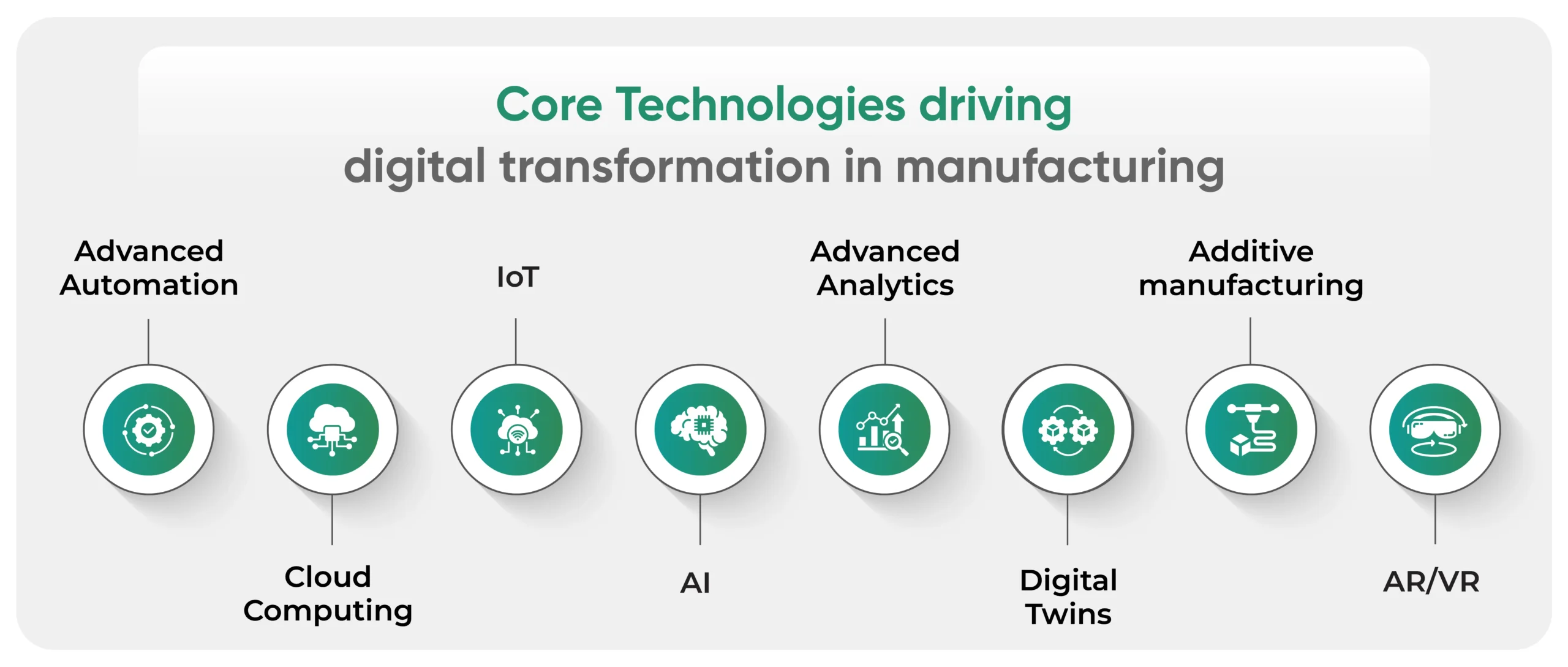
Core Technologies driving digital transformation in manufacturing
Digital transformation in manufacturing is powered by a core set of technologies. On their own, they deliver incremental gains. When connected and operationalized together, they reshape how the entire enterprise runs.
 1. Internet of Things (IoT)
 1. Internet of Things (IoT)
Manufacturers are installing sensors on CNC machines, presses, conveyors, and HVAC systems to track temperature, vibration, cycle time, and output. Maintenance teams use this data for predictive maintenance. Quality teams monitor yield in real time. Plant heads get dashboards showing OEE across lines.
2. AI
AI models predict equipment failure before breakdowns occur. Computer vision systems inspect products for micro-defects faster than human inspectors. AI-driven demand forecasting helps align production plans with market shifts.
How it can be better: AI often operates in isolated use cases. Leading manufacturers are embedding AI directly into operations, allowing systems to automatically adjust production schedules, optimize energy usage, or rebalance workloads. The competitive gap will widen between companies that experiment with AI and those that operationalize it at scale.
3. Advanced Automation
Collaborative robots assist workers in assembly. Autonomous guided vehicles (AGVs) move materials across warehouses. Automated inspection systems reduce human error. Data capture is increasingly automated instead of manually recorded.
How it can be better: Automation is most powerful when combined with AI. Instead of fixed, rule-based automation, manufacturers can deploy adaptive systems that learn from data and adjust in real time. The goal is not just faster execution, but smarter execution.
4. Cloud Computing
Manufacturers with multiple plants use cloud platforms to centralize data and standardize applications across locations. Cloud-based MES and analytics tools allow corporate leaders to compare performance globally.
How it can be better: Cloud adoption often focuses on cost and scalability. The real value comes from enabling advanced analytics, AI training, and cross-functional collaboration. Integrating OT and IT environments securely in the cloud will unlock enterprise-wide intelligence rather than plant-level insights.
5. Advanced Analytics
Manufacturers track KPIs such as downtime, scrap rates, throughput, and supplier performance. Predictive analytics forecasts maintenance events or delivery delays.
How it can be better: Moving from dashboards to decision automation is the next step. Prescriptive analytics should not only show what might happen but automatically recommend or execute corrective actions. Real-time analytics at the edge can further reduce reaction time on critical production lines.
6. Digital Twins
Engineering teams simulate new production layouts before implementation. Maintenance teams monitor digital replicas of critical assets to track performance deviations.
How it can be better: Digital twins should evolve static simulations into continuous learning systems powered by live IoT data and AI. A fully integrated digital twin can optimize throughput, energy usage, and maintenance schedules dynamically, and during planning stages too.
7. Additive manufacturing (3D printing)
Companies use 3D printing for rapid prototyping and to produce low-volume, complex components. Some plants print spare parts on demand to reduce downtime.
How it can be better: When integrated with digital inventory systems, additive manufacturing can become a strategic supply chain lever. Instead of storing physical stock, manufacturers can maintain digital part libraries and produce components closer to demand, reducing logistics costs and improving resilience.
8. Augmented reality and Virtual Reality
Technicians use AR headsets for guided maintenance. New employees train in VR simulations before handling live equipment. Field service teams receive remote support through AR overlays.
How it can be better: AR and VR should be integrated with real-time operational data. Imagine a technician seeing live sensor data overlaid on equipment while AI recommends corrective steps. The combination of immersive technology, IoT, and AI will significantly reduce errors and training time.
Where Manufacturers Are Prioritizing Investment Today
1. Manufacturing Operations (Plant + Production)
The factory floor is where transformation makes the fastest difference. Many plants still rely on manual reporting and delayed performance data. When systems are digitally connected, managers gain real-time visibility. Machines report health automatically. Quality data is captured instantly. Supervisors track performance without waiting for end-of-shift reports. The result is better decisions and higher overall equipment effectiveness.
2. Asset and Maintenance Management
Reactive or fixed-schedule maintenance wastes time and money. With connected sensors and predictive analytics, asset health can be monitored continuously. If abnormal patterns appear, work orders are triggered automatically, technicians are assigned, and parts availability is confirmed. Even small reductions in unplanned downtime significantly improve profitability.
3. Supply Chain and Logistics
Supply chains are increasingly volatile. Without real-time visibility, manufacturers react too late. Digital supply chain systems provide clear insight into inventory, shipments, and supplier performance. Advanced analytics highlight risks early, enabling proactive adjustments instead of reactive firefighting.
4. IT Transformation
Many manufacturing environments still run on disconnected legacy systems. ERP, MES, quality platforms, and operational systems often operate separately. Modern IT transformation creates a connected digital backbone where business and factory systems work together securely. Without this foundation, AI and analytics initiatives cannot scale effectively.
5. HR and Workforce Transformation
The workforce is evolving. Experienced employees are retiring, and new workers expect modern digital tools. Digital workflows, accessible knowledge systems, and structured training platforms improve productivity and accelerate adoption of new technologies. Capturing institutional knowledge before it leaves the organization is critical.
6. Customer and Field Service
Manufacturers increasingly compete on service quality. Digital service platforms enable faster issue logging, real-time tracking, and AI-guided diagnostics. When service insights feed back into production and engineering, recurring problems are resolved at the source, strengthening customer loyalty and recurring revenue.
7. Risk, Compliance, and Security
As IT and operational systems converge, cybersecurity exposure increases. Digital risk management brings visibility across environments. Security monitoring, compliance tracking, and audit documentation can be automated, reducing manual effort and lowering the risk of costly disruptions.
The Business Impact of Digital Transformation in Manufacturing
1. Improved OEE and productivity
Overall Equipment Effectiveness, or OEE, shows how well a plant is using its capacity. It looks at three things: availability, performance, and quality. Digital transformation improves all three. Predictive maintenance reduces unexpected breakdowns, which improves availability. Real-time production monitoring helps teams spot slowdowns or inefficiencies quickly, which improves performance.
2. Reduced downtime and costs
Unplanned downtime is expensive as it disrupts schedules, delays customer orders, increases overtime, and often leads to higher repair costs. Digital transformation reduces both how often breakdowns happen and how long they last. Predictive maintenance helps prevent failures before they occur. Real-time alerts help teams respond faster when issues arise. Connected workflows make it easier to assign technicians, check parts availability, and close work orders quickly.
3. Faster innovation cycles
Digital tools help manufacturers move faster when improving products or processes. Digital twins allow engineers to test changes in a virtual environment before making them on the factory floor. Advanced analytics help teams understand how small process changes affect product quality. Shared digital platforms make it easier to roll out improvements across multiple plants instead of solving the same problem repeatedly.
4. Enhanced workforce enablement
Digital transformation also makes daily work easier and more efficient for employees. Workers can access instructions, maintenance history, and performance data instantly instead of searching through paper files or separate systems. Service requests and approvals move through digital workflows instead of manual forms. AI tools can guide employees through complex tasks and help them make better decisions. When workers have better tools and clearer information, they make fewer mistakes, save time, and feel more confident in their roles. That leads to higher productivity and stronger engagement across the organization.
Key strategies for a successful Digital Transformation in manufacturing
The benefits of digital transformation are clear. But results do not happen automatically. Many manufacturers invest in technology and still struggle to see impact. The difference usually comes down to how the transformation is planned and executed.
1. Outcome-first transformation roadmaps:
- Many digital transformation efforts fail because companies start by buying new technology and then try to figure out where to use it.
- A better approach is to begin with clear business goals. First, define what success looks like. It could be fewer production delays, better delivery performance, higher customer retention, or stronger margins.
- Once the goal is clear, identify what is currently preventing that outcome. Then invest in the tools and process changes that directly address those gaps.
- When every initiative is tied to a specific business result, it becomes easier to prioritize, measure progress, and avoid unnecessary spending.
2. IT-OT convergence
- In many manufacturing organizations, IT and operations have worked separately for years. But as systems become more connected, that separation creates friction and risk.
- Bringing IT and operational technology together starts with visibility. Companies need a clear understanding of all systems and assets across the enterprise.
- From there, security, data sharing, and integration should be managed as one coordinated effort instead of two parallel tracks.
- This alignment reduces blind spots, improves decision-making, and ensures that business systems and plant systems support each other instead of operating in isolation.
3. Strong data foundations
- Advanced tools like AI and analytics depend on reliable data. If data is incomplete, inconsistent, or scattered across disconnected systems, results will be limited.
- A strong data foundation means agreeing on common standards for how information is captured and stored. It means connecting systems so that data flows smoothly across departments.
- It also requires clear ownership, so teams know who is responsible for maintaining accuracy and access. When data is clean, connected, and trusted, better decisions follow naturally.
4. Change management at scale
- Technology alone does not create transformation. People do. Employees need to understand why changes are happening and how those changes help them and the business.
- Involving teams early builds trust and reduces resistance. Training should be practical and delivered when people actually need it.
- Early successes should be highlighted to build momentum. Most importantly, leaders must visibly support the change.
- When leadership actively uses new systems and reinforces new behaviors, the rest of the organization follows.
The mindset shift behind modern manufacturing for business transformation
- From reactive operations to predictive enterprises
- From siloed plants to connected ecosystems
- From automation to autonomy
Why Platforms Matter in Modern Manufacturing
All the technologies, investments, and strategies discussed so far depend on one thing: how well everything works together. That is where platforms matter.
1. Transformation fails without orchestration
Many manufacturers invest in good technology. The tools work, but they often work separately. A system may detect a maintenance issue, but if it does not automatically create a work order or notify the right team, the value stops at the alert. A platform connects systems, data, and workflows so that insights lead directly to action. Without orchestration, companies end up with disconnected solutions instead of a truly digital enterprise.
2. Need for Connected Workflows Across Plants, Teams, and Systems
Manufacturing environments are complex. There are multiple plants, different equipment, distributed teams, and many systems that need to share information. A unified platform connects these workflows. When a machine alert fires, the system can automatically pull maintenance history, generate a work order, assign a technician, check parts availability, and notify managers. This reduces manual coordination and speeds up response.
3. Platforms as the Backbone of Scalable Transformation
The manufacturers moving fastest are building on unified platforms rather than adding isolated tools. Once systems are connected and data flows consistently, adding new capabilities becomes easier and more cost-effective. Data builds over time, security stays consistent, and AI becomes more accurate. Point solutions solve single problems. Platforms create a foundation that allows transformation to grow and scale.
The next question is practical: what platform can actually bring all of this together? This is where ServiceNow comes in.
How ServiceNow Supports Digital Manufacturing
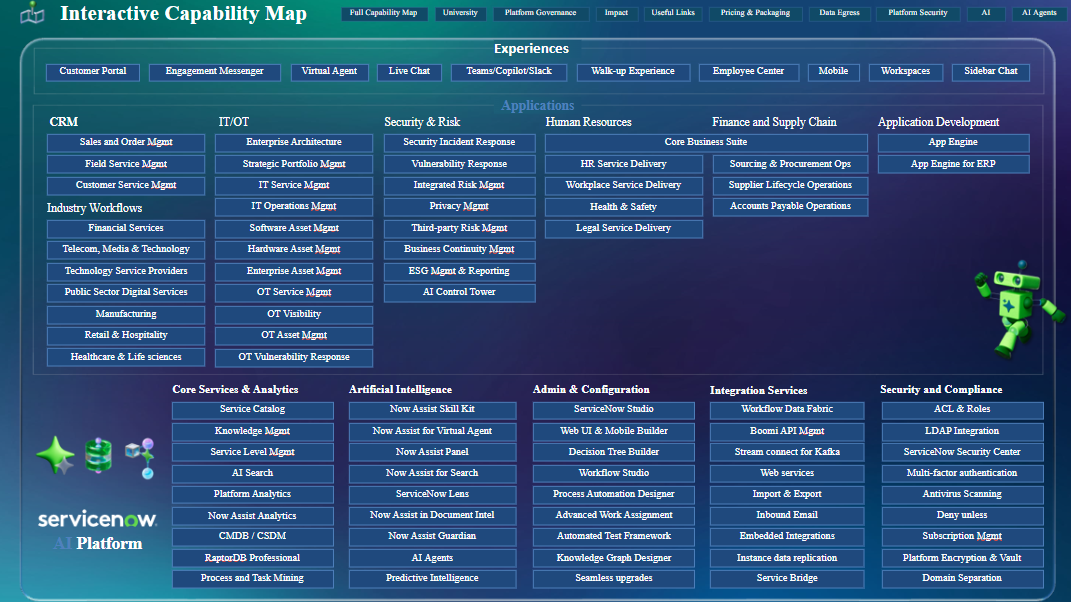
ServiceNow provides a unified, AI-powered platform that connects manufacturing operations, IT, supply chain, customer service, and workforce management into a single system of action. Unlike systems of record that store data or systems of analysis that report on it, ServiceNow is designed to drive action: automating workflows, connecting teams, and resolving issues across the enterprise with minimal manual intervention.
1. Manufacturing Operations
From the factory floor to field teams, ServiceNow gives manufacturers the visibility and workflow structure needed to keep production running without interruption.
- Remote Monitoring: ServiceNow integrates with IoT platforms and OT systems to provide real-time visibility into equipment health and production status. Alerts and anomalies are surfaced automatically, with context that helps operators and engineers understand their significance and respond appropriately.
- Smart Maintenance: Predictive maintenance workflows connect sensor-generated alerts to the full maintenance process, including work order creation, parts verification, technician assignment, and scheduling. The result is faster response times, better-coordinated maintenance activities, and lower unplanned downtime.
- Operations Incidents: When production incidents occur, structured workflows ensure that the right people are notified, the right information is gathered, and the right escalation paths are followed. Incident data is captured for analysis, enabling continuous improvement.
- Field Services: ServiceNow Field Service Management connects field technicians to the information and workflows they need to resolve issues efficiently. Technicians receive work orders with complete equipment history, access troubleshooting guides and knowledge articles, and can update status and capture notes from mobile devices.
2. Servitization
As manufacturers shift toward service-based business models, ServiceNow provides the connected infrastructure needed to deliver proactive, consistent service at scale.
- IIoT Enablement: ServiceNow connects to Industrial IoT platforms, enabling manufacturers to collect and act on data from connected equipment and products in the field. This is the data foundation for service-based business models.
- Proactive Service Delivery: When connected equipment sends alerts indicating potential issues, ServiceNow workflows can automatically create service cases, notify customers, and dispatch technicians, all before the customer experiences a problem. This proactive approach transforms the customer relationship.
- Customer Service Integration: ServiceNow connects field service operations to customer service workflows, ensuring that customers receive consistent, informed communication throughout the service process and that service outcomes are captured in customer records.
- Process Automation: Complex servitization processes, including contract management, subscription billing, entitlement verification, and warranty claims, can be automated through ServiceNow workflows, reducing administrative burden and accelerating resolution.
3. IT Services
Managing IT in a manufacturing environment means keeping complex, interconnected systems running without disruption to production, and ServiceNow makes that manageable at enterprise scale.
- Service Automation: ServiceNow IT Service Management automates the full lifecycle of IT services in manufacturing, from request through fulfillment. Common requests can be fulfilled automatically, reducing response times and freeing IT staff for higher-value work.
- Digital Asset Management: Complete visibility into all IT assets, including hardware, software, and licenses, enables better planning, cost management, and risk assessment. Asset records are kept current automatically as devices are deployed, moved, and retired.
- Planning and Operations: IT Operations Management provides real-time visibility into the health and performance of IT infrastructure, enabling proactive identification and resolution of issues before they affect production or business systems.
4. Customer Services
When customer experience is a competitive differentiator, manufacturers need more than a help desk. ServiceNow turns customer service into a structured, proactive, and scalable operation.
- Case Management: Structured case management workflows ensure that customer issues are captured, routed, prioritized, and resolved consistently, with full visibility into status at every stage.
- Field Service Management: Optimized dispatching, mobile enablement, and knowledge support for field technicians ensure that customer equipment issues are resolved efficiently and completely.
- Predictive Operations: By connecting customer equipment data to service workflows, ServiceNow enables manufacturers to identify and address potential issues before customers experience them.
- Self-Service: Customer-facing portals and conversational AI allow customers to report issues, check status, access documentation, and resolve common problems on their own, reducing the volume of inbound service requests and improving the customer experience.
5. Enterprise Systems and Supply Chain
Supply chains only perform as well as the systems connecting them, and ServiceNow ensures that data, decisions, and actions move across the enterprise without friction.
- Application Integration: ServiceNow connects to ERP systems, CRM platforms, procurement tools, and other enterprise applications, enabling data to flow across systems and workflows to span organizational boundaries.
- Resource Planning: Production plans, material requirements, and capacity constraints are reflected in operational workflows in real time, and exceptions are managed in a coordinated way.
- Predictive Intelligence: AI models applied to supply chain data identify risks, predict disruptions, and recommend actions before problems materialize.
- Compliance: GRC workflows automate compliance processes, from regulatory requirements to supplier audits to internal policy adherence, reducing manual effort and improving consistency.
6. HR and Workforce Management
A productive manufacturing workforce needs more than good management. It needs systems that remove friction from everyday work, and ServiceNow delivers that from day one. ServiceNow HR Service Delivery connects employees to the information, services, and processes they need throughout their career, from onboarding through development to transitions. Workforce Service Delivery supports the scheduling, communications, and operational workflows that keep manufacturing workforces productive.
The Role of AI in the Future of Manufacturing
AI is becoming part of daily operations in manufacturing. It supports decisions, automates tasks, and improves performance across plants, supply chains, and customer operations.
Two Ways AI Is Showing Up: Generative AI and AI Agents
Generative AI helps people work faster. Employees can ask questions in plain language and get clear answers drawn from manuals, historical data, and internal systems. Engineers can troubleshoot issues, planners can test scheduling options, and technicians can get guided diagnostics in seconds.
AI agents take action. They monitor systems continuously, detect issues early, identify likely causes, generate work orders, notify teams, and recommend next steps. In advanced environments, they can adjust process parameters within defined limits. This reduces delays and removes manual handoffs.
Where AI Delivers Value
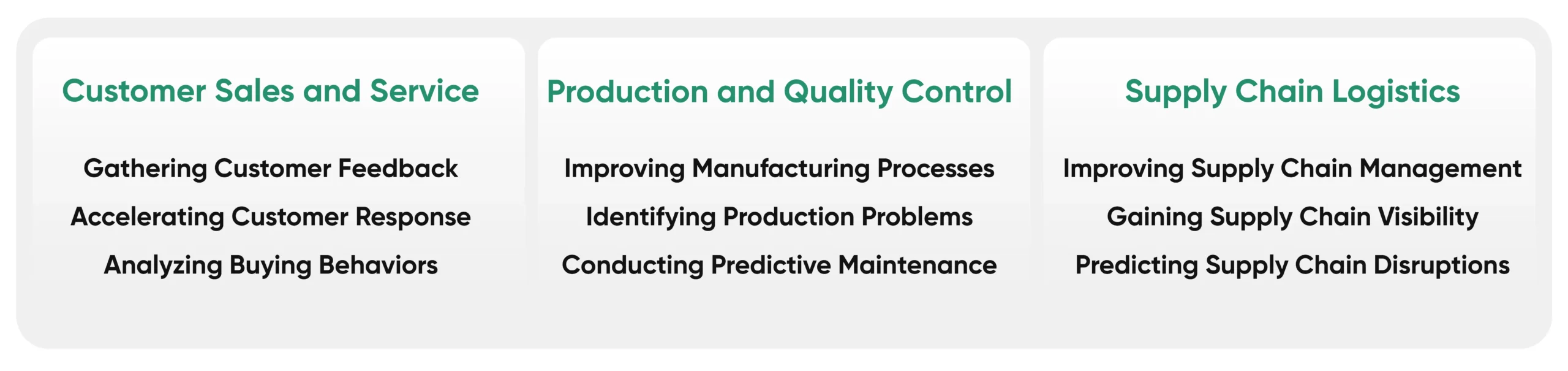
- Production and quality: AI analyzes process data to identify patterns that affect output. Computer vision systems inspect products at line speed and detect defects in real time. When issues appear, AI helps trace them back to the source quickly.
- Maintenance and asset performance: Machine learning models track equipment behavior and flag early signs of failure. Teams can fix problems before breakdowns happen, reducing downtime and cost.
- Supply chain and logistics: AI evaluates demand, inventory, supplier capacity, and logistics constraints to improve planning accuracy. It also uses external signals to anticipate disruptions and support faster adjustments.
- Customer sales and service: AI analyzes customer interactions, supports 24/7 responses to common inquiries, and identifies cross-sell and service opportunities based on usage patterns and history.
- The Business Impact: Manufacturers using AI are reporting gains in productivity, cost efficiency, quality, and customer satisfaction. Organizations that embed AI into core workflows are seeing stronger margin performance and greater operational resilience.
How Digital Transformation Looks Across Manufacturing Segments
Digital transformation shows up differently in each manufacturing segment, but the goal is the same: better visibility, faster decisions, and fewer disruptions.
Automotive
Automotive companies are using AI and digital twins to design and test vehicles virtually before anything is built. Generative AI helps speed up design cycles by factoring in engineering constraints early. On the factory floor, robotics, simulation, and advanced automation are improving precision and throughput. Many are also building next-gen autonomous platforms that depend on strong digital foundations.
Read Case Study: How a Global Automotive Manufacturer Simplified EX with ServiceNow HRSD, Workday Integration & AI Search
Electronics
Electronics manufacturers deal with short product lifecycles and extreme precision. AI-powered optical inspection catches defects in real time. Predictive analytics helps manage yield and reduce scrap. Digital traceability systems track every component and process step, which is critical for quality control and compliance.
Read Case Study: A Leading Electronics Manufacturer Enhanced IT Support and Operational Efficiency with ServiceNow ITSM
Chemical
Chemical plants rely on real-time monitoring and advanced analytics to optimize complex, continuous processes. AI models in chemical manufacturing improve asset management, reaction efficiency, reduce energy consumption, and support predictive maintenance for critical equipment. The result is safer operations, lower costs, and improved sustainability performance.
Heavy Industries
In sectors like steel, mining, and heavy equipment, remote monitoring and predictive maintenance are key. IoT sensors track asset performance in harsh environments. AI-powered planning systems improve uptime and reduce unplanned shutdowns. Robotics and simulation tools help operations adapt to demand shifts and layout changes.
Food and Beverage
Food manufacturers focus heavily on safety, traceability, and waste reduction. Computer vision systems inspect products at line speed. AI improves demand forecasting to reduce overproduction. End-to-end traceability platforms help respond quickly to quality or safety concerns.
Pharmaceuticals
Pharma manufacturers are digitizing batch records, automating compliance workflows, and using real-time process verification to ensure product quality. AI supports faster process development and more efficient supply chain planning, helping bring therapies to market faster while maintaining strict regulatory standards.
Read Case Study: A Leading Biopharma Company Enhanced Efficiency and Centralized Control with ServiceNow
The Factory Is Changing. The Playbook Has to Change Too.
Manufacturing has always evolved through technology. Today the shift is happening faster than ever. Machines produce continuous data, supply chains change quickly, and customers expect faster response and service. Running operations through disconnected systems and manual coordination makes it harder for manufacturers to keep up with this pace.
Manufacturers moving forward are building connected enterprises where machines, systems, and teams work together through shared data and automated workflows. This is where Aelum helps organizations move from digital plans to real operational impact. As a ServiceNow partner, Aelum helps manufacturers connect manufacturing operations, IT services, field service, customer support, supply chain workflows, and workforce management on a single platform. By designing integrated workflows, enabling predictive maintenance, automating service operations, and connecting enterprise systems, Aelum helps manufacturers run more resilient, efficient, and responsive operations as the factory of the future takes shape.
Frequently Asked Questions (FAQs)
1. What is the primary goal of digital transformation?
The primary goal of digital transformation is to improve how a business operates and delivers value by using technology, data, and connected systems. In manufacturing, this usually means reducing downtime, improving efficiency, enabling faster decisions, and building more resilient operations.
2. What are the 5 Ps of digital transformation?
The 5 Ps provide a simple way to think about transformation are people, processes, platforms, products, performance.
3. How is smart technology being used in manufacturing?
Smart technology is used to connect machines, monitor performance in real time, and automate decisions. For example, IoT sensors track equipment health, AI predicts failures, and automation systems improve production speed and quality. Together, these technologies help manufacturers reduce downtime, improve output, and respond faster to changes.
4. What should I include in a digital transformation roadmap for manufacturing?
A strong roadmap should include clear business goals, key use cases (like predictive maintenance or supply chain visibility), technology priorities, data strategy, and a phased implementation plan. It should also cover change management, governance, and how success will be measured over time.
5. How do I measure ROI from a manufacturing digital transformation strategy?
ROI can be measured through both operational and financial outcomes. Common metrics include reduced downtime, improved OEE, lower maintenance costs, faster production cycles, better quality, and increased customer satisfaction. The key is to link each initiative to a specific, measurable business outcome.
6. How do I align IT, finance, and operations in a digital transformation effort?
Alignment starts with shared goals and clear business outcomes. IT focuses on enabling technology, operations focus on execution, and finance evaluates value and investment. Bringing these teams together early, using a common roadmap, and tracking shared KPIs helps ensure everyone moves in the same direction.
7. What role does automation play in manufacturing digital transformation?
Automation helps reduce manual work, improve consistency, and speed up operations. In digital transformation, it goes beyond basic tasks. When combined with AI and data, automation can trigger actions, optimize processes in real time, and support more intelligent, self-correcting operations.