Walk into most manufacturing facilities today, and you’ll see the future and the past running side by side. Over the past decade, factory floors have transformed dramatically. You’ve invested in IoT sensors that monitor equipment in real time, AI models that predict demand, automation systems that accelerate production, and cybersecurity layers that protect it all. Each investment was the right call. Each solved a real problem.
But here’s where most manufacturers find themselves today: sitting on a goldmine of technology that doesn’t talk to each other. Data lives in silos, teams operate in silos, and when a supply chain disruption hits or a critical machine goes down, the response is still largely manual, slow, reactive, and costly.
The missing piece is the connective tissue that ties everything together. That’s precisely what ServiceNow for manufacturing delivers. Built as an AI-powered workflow platform, ServiceNow sits as a single operational layer across your systems, teams, and processes, turning fragmented data into automated decisions and disconnected departments into collaborative, high-performing units. So, you have a smart factory that reacts to change and is built to anticipate it.
Challenges Slowing Manufacturing Growth in 2026
Manufacturing in 2026 is operating under a new kind of pressure. The technology exists to build smarter, faster, and more resilient operations, but most manufacturers are still wrestling with foundational challenges that limit what that technology can actually deliver. Here are the key barriers holding the industry back.
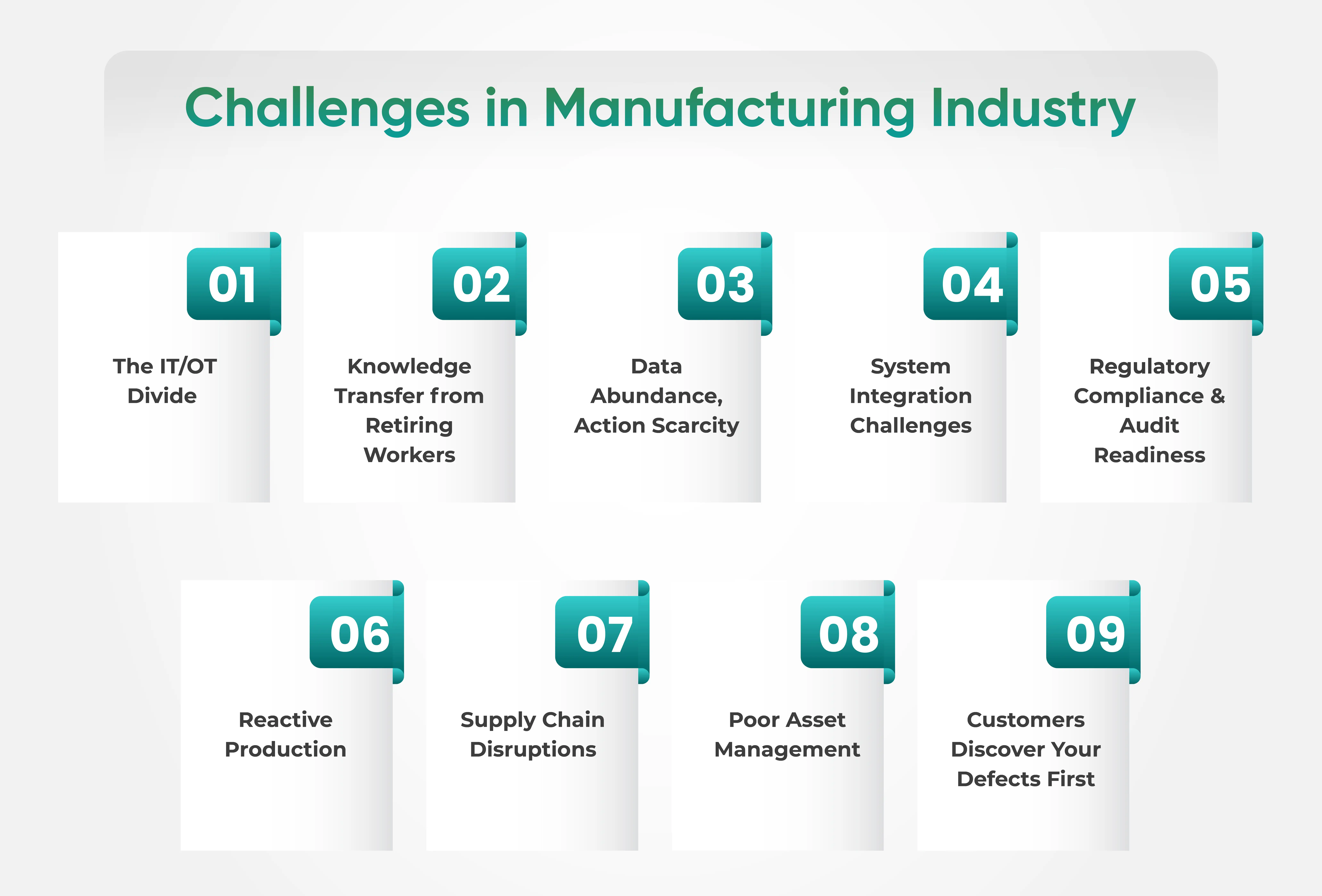
1. The IT/OT Divide
In many manufacturing environments, IT and OT systems still operate in parallel worlds, different technologies, different communication protocols, and often different leadership structures. This separation limits operational visibility and slows decision-making at every level. Convergence is no longer optional, but closing the gap comes with its own set of challenges: expanded cybersecurity attack surfaces, complex system integration work, and legacy infrastructure that wasn’t designed to connect with modern platforms.
Convergence is no longer optional, but closing the gap comes with its own set of challenges: expanded cybersecurity attack surfaces, complex system integration work, and legacy infrastructure that wasn’t designed to connect with modern platforms.
2. Knowledge Transfer from Retiring Workers
It’s expected that four years from now, around 2.1 million unfilled manufacturing positions will cost the US economy as much as $1 trillion. When experienced workers leave, decades of troubleshooting wisdom disappear with them. Paper SOPs and exit interviews can’t capture this expertise. Digital knowledge transfer solutions are now survival tools for workforce continuity.
3. Data Abundance, Action Scarcity
Modern factories generate enormous volumes of data from sensors, IoT devices, MES, ERP, SCADA, and PLCs. The infrastructure to collect it exists. What’s missing is the ability to act on it. Most of this data never leaves the system it was born in. IT and OT teams lack the shared context to bridge it, and valuable operational intelligence stays locked in silos, unable to surface the insights that could drive smarter, faster enterprise-level decisions.
4. System Integration Challenges
Most manufacturers run PLM, MES, and ERP systems from different vendors, each functional on its own, but rarely designed to work together. The result is a web of point-to-point integrations that break every time a system is upgraded. Shop floor feedback rarely reaches engineering; legacy systems block modern API connectivity, and when data can’t move automatically between systems, it moves manually, introducing delays, errors, and gaps in visibility that plant owners can’t afford.
5. Regulatory Compliance & Audit Readiness
Regulations from OSHA, EPA, and sector-specific agencies don’t stand still, and neither does the documentation required to meet them. When compliance records are spread across disconnected systems, audit preparation becomes a time-consuming, high-risk scramble. Failed audits mean more than fines; they trigger production delays, reputational damage, and in serious cases, workplace safety failures and environmental violations. Audit-ready traceability needs to be embedded in daily workflows.
6. Reactive Production
When a machine breaks down, production halts. When a supplier misses a delivery, schedules fall apart. When a quality issue surfaces, the defect has already moved down the line. This is the reactive production cycle, and it’s a failure of visibility. Without predictive monitoring and automated preventive workflows, manufacturers are left absorbing the full cost of problems that could have been caught earlier: unplanned downtime, emergency repairs, schedule disruptions, and teams stretched thin from constant damage control.
7. Supply Chain Disruptions
Supply chain disruptions can come from many directions: equipment failure, inaccurate forecasting, poor supplier communication, geopolitical instability, or natural disasters. But the impact is direct: delayed logistics, increased costs, strained supplier relationships, and missed customer commitments. Manufacturers without real-time supply chain visibility have limited ability to anticipate these disruptions or respond to them quickly, making recovery slower and more expensive than it needs to be.
8. Poor Asset Management
When physical assets are spread across multiple facilities, maintaining an accurate and up-to-date overview is difficult. This leads to ghost assets on books, underutilized equipment, and poor resource allocation across sites. Relying on reactive maintenance makes the problem worse: unplanned downtime, costly emergency repairs, and shorter asset lifespans all follow. Manufacturers need live visibility into asset health and automated workflows that flag issues before they escalate into failures.
9. Customers Discover Your Defects First
When production, quality, and service systems do not communicate, manufacturers are often the last to know when something has gone wrong. Defective products ship because no system connects the quality flag to the outbound order. Late supplier deliveries miss customer windows because procurement and fulfillment are not in sync. By the time the issue is identified internally, the customer has already experienced it, and the damage to satisfaction and trust is already done.
Ready to Connect Your Shop Floor to Every System That Runs It?
Why ServiceNow for Manufacturing?
ServiceNow, the platform of platforms for manufacturing, connects your people, processes, and technologies from your supplier’s supplier to your customer’s customer. It’s a single cloud-based orchestration engine that makes your entire tech stack work together: ERP, MES, QMS, supply chain systems, HR, CRM, and more.
What sets ServiceNow apart from other platforms is the combination of breadth and depth. It covers operational technology, procurement, HR, field service, asset management, and customer operations, all on one platform, with AI embedded across every layer.
Think of it this way:
On the best factory floors, an experienced supervisor sees everything: which machines need attention, which workers need support, and which materials are running low. ServiceNow is that supervisor, but for your entire digital ecosystem. It sees when your ERP flags low inventory, your MES reports a quality deviation, and your supplier system shows delays, then coordinates the response instantly across all systems.
Plant managers get the tools to monitor production, manage resources, and make data-driven decisions. Manufacturing leaders streamline workflows, control quality, replace manual supply chain processes with end-to-end digital visibility, and ensure compliance.
Digital transformation in manufacturing now comes down to one question: how do you get every system, team, and process working from the same operational layer? ServiceNow answers that.
The ServiceNow Manufacturing Ecosystem
ServiceNow addresses the challenges of slowing factories with its interconnected manufacturing-specific solutions. Each tackle specific operational needs while integrating seamlessly with the others. Here’s what each module enables:
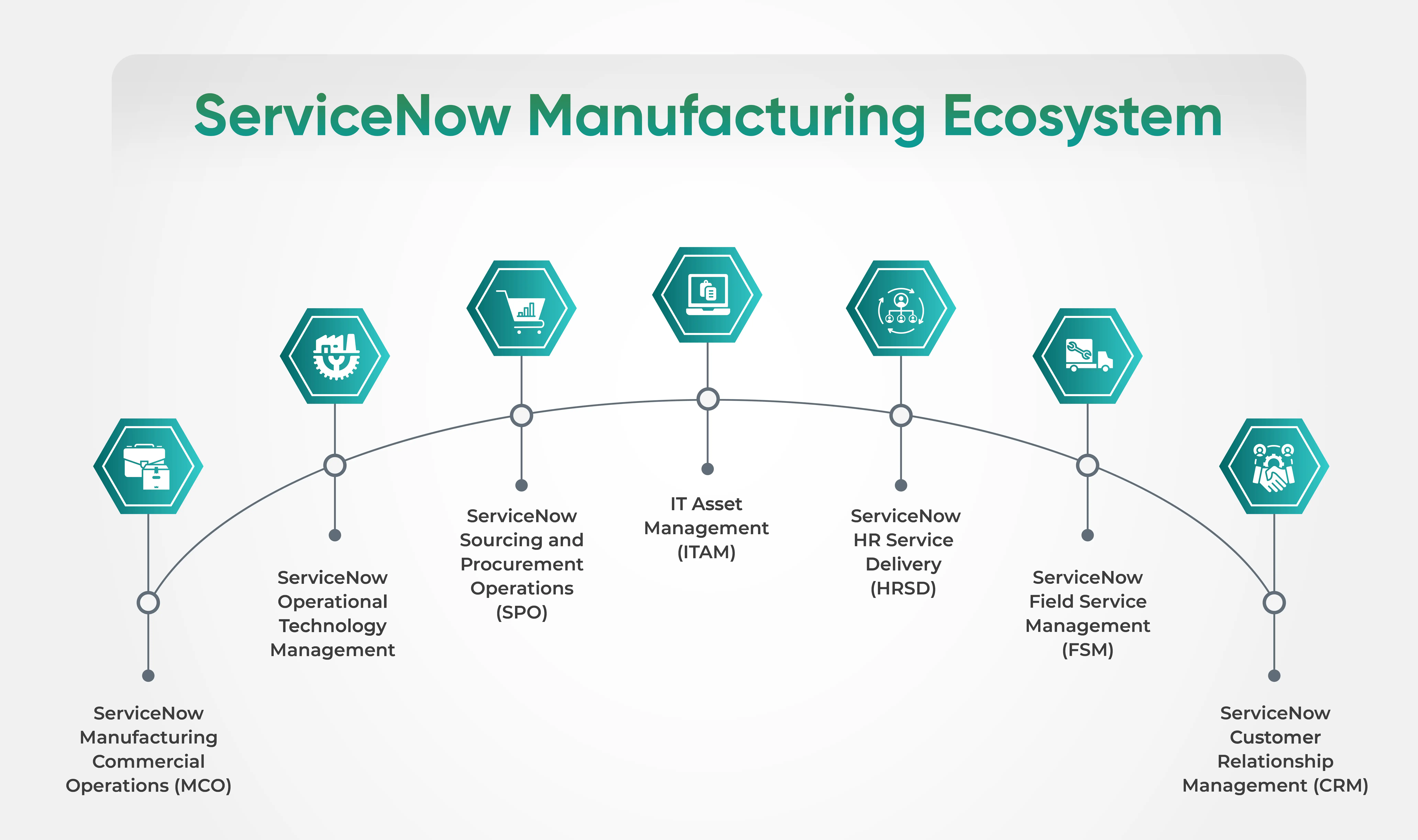
1. ServiceNow Operational Technology Management (OTM)
ServiceNow OTM helps manufacturers automate OT management processes, map OT devices, assess risks, and bring IT and OT operations under a single, unified view.
-
- OT Asset Management: ServiceNow OTM gives you centralized control over OT devices & equipment. This includes managing asset maintenance plans, tracking part requisitions, and linking production context to work orders, so criticality is prioritized based on equipment impact. It automates inventory management, tracks lifecycle status of each asset, and handles obsolescence management. Manufacturers see a 4% reduction in unplanned asset downtime, lower MTTR, streamlined asset transfers, and optimized inventory levels.
-
- End-to-End Visibility Across IT & OT: Get complete visibility into OT assets across the plant floor. This unified view across IT and OT systems improves cybersecurity posture by making it easier to detect anomalies and potential threats early. It also helps operations teams pinpoint the root cause of issues faster, reducing the time between identifying a problem and resolving it.
-
- OT Vulnerability Response: ServiceNow OTM enables manufacturers to identify vulnerabilities across OT environments, prioritize them based on urgency and operational impact, and automate alerts so teams act before issues escalate. Vulnerabilities can be visualized clearly, making it straightforward to assign and track resolution without manual follow-up.
-
- OT Service Management: ServiceNow OTM connects IT, OT, and production processes on a single service management layer. This reduces the gap between a detected issue and a resolved one, supporting operational continuity. Manufacturers get improved Overall Equipment Effectiveness (OEE) through proactive service management rather than responding to failures after they occur.
Did You Know?
92% of downtime events last more than an hour, costing up to $700,000.
(Source: ServiceNow)
2. ServiceNow Manufacturing Commercial Operations (MCO)
ServiceNow MCO helps manufacturers optimize sales, support, and service operations; automating order-to-cash workflows, reducing operational costs, and improving end customer experience across the commercial lifecycle.
-
- Launch & Manage Products, Services from One Platform: ServiceNow MCO brings together a commercial and technical catalog, a product and service configurator, agent workspace, and contracts and entitlements into one platform. Manufacturers can launch, sell, activate, track, and resolve issues without switching between systems. It also allows teams to monitor customer and channel subscriptions proactively, flagging issues and surfacing recommendations before customers need to reach out.
-
- Real-Time Order Visibility Across ERP & Inventory Systems: ServiceNow MCO integrates with ERP, inventory, and other systems to give teams real-time visibility into customer and channel orders. This allows manufacturers to fulfill orders faster, reduce manual intervention, and automate approvals and work orchestration. When orders fail, teams can quickly identify the cause, reprocess failed orders, and move through remediation using configurable task workflows, reducing the time and cost of exception handling.
-
- Structured Workflows for Product Quality Resolution: ServiceNow MCO gives agents out-of-the-box workspaces and configurable workflows to manage product issues end to end. Agents can log complex issues with relevant details: machine model, part number, VIN, usage data, and connect with the right internal and external teams to identify both temporary fixes and permanent resolutions. Quality resolution processes such as DMAIC can be built directly into workflows, with automatic routing for root cause analysis. OEMs can then communicate resolutions proactively to channel partners and customers, reducing resolution times and minimizing downtime.
-
- Streamline Post-Sales Services Management: ServiceNow MCO enables manufacturers to handle customer and channel enquiries, disputes, and service requests quickly through a combination of self-service, omnichannel engagement, and assisted support. Customers can find information and raise requests from any channel, at any time. AI-based search and intelligent query features help surface relevant content faster. For vendor-facing operations, the Vendor Manager Workspace gives vendor managers a consolidated view of risk and performance data across all vendors they oversee.
3. ServiceNow Sourcing and Procurement Operations (SPO)
ServiceNow SPO creates a single engagement layer across procurement systems, connecting teams and automating end-to-end workflows to simplify procurement delivery and improve spend control across manufacturing operations.
-
- Procurement Case Management: ServiceNow SPO manages the full procurement request lifecycle, from intake to fulfillment, across your existing systems in one place. Procurement chatbots handle routine requests, while specialist workspaces and configurable playbooks guide complex cases. Performance dashboards monitor request volumes and task completion progress, helping procurement teams balance workloads, automate fulfillment, and continuously improve processes without replacing existing technology investments.
-
- Smarter Buying with ShoppingHub: Gives manufacturing employees a guided, compliant buying experience for goods and services from approved suppliers. Guided workflows reduce the risk of rogue spending, while automated purchase requests eliminate manual processing. Teams get real-time visibility into request status at every stage, keeping purchasing compliant, traceable, and within managed spend, without adding friction to the buying experience.
-
- Procurement Work Team Efficiency: Intelligent automation handles low-value procurement tasks, freeing specialists for higher-priority work. Workflows connect stakeholders, disparate technologies, and systems of record in one centralized place, accelerating procurement processes and reducing coordination delays. Risk controls are embedded directly into workflows, ensuring third-party risks are consistently assessed and addressed without requiring separate review cycles.
-
- Real-Time Visibility Across Source-to-Pay Processes: Real-time SLA tracking at both task and process levels helps procurement teams stay on schedule. Embedded analytics and behavioral insights help procurement leaders identify bottlenecks, flag non-compliant purchasing behavior, and course-correct early. Configurable playbooks guide decision-making at key stages, giving manufacturing procurement teams the oversight needed to keep operations on track and spend under control.
4. ServiceNow HR Service Delivery (HRSD)
Manufacturing workforces are large, shift-based, and spread across multiple plant locations, making consistent HR service delivery a real operational challenge. ServiceNow HRSD gives HR teams the tools to deliver faster, more consistent employee experiences while reducing the administrative burden on HR staff across facilities.
-
- Employee Center: Provide a unified portal where employees access HR, IT, workplace services, and legal support. AI-driven content recommendations surface relevant resources based on the employee’s role and location, and mobile access ensures shift workers can get support without being tied to a desk.
-
- Manager Hub: Equips plant managers and team leaders with a centralized view of their workforce, covering pending action items, important dates, team insights, and alerts that need immediate attention. In a manufacturing environment where supervisors are managing large shift teams across rotating schedules, this keeps people leaders informed and responsive without relying on manual reporting or email chains.
-
- Employee Journey Management: Automates workflows for key career moments that are particularly frequent in manufacturing, onboarding new hires onto the plant floor, managing role transitions, handling site relocations, and processing offboarding. Proactive prompts ensure nothing falls through the cracks; surveys capture feedback at each stage, and every employee gets a consistent experience regardless of facility or shift.
-
- AI-Powered HR Service Delivery: Virtual agents provide round-the-clock HR support, important in manufacturing environments that run multiple shifts with no HR staff physically present after hours. Routine requests are resolved automatically; complex cases are routed to the right HR specialist with full context, and knowledge bases help employees find answers to common questions instantly without waiting for a response.
5. ServiceNow Field Service Management (FSM)
ServiceNow FSM connects scheduling, maintenance, inventory, and technician operations into one platform, helping manufacturers deliver faster, more reliable field service across every facility and customer site.
-
- AI-Powered Scheduling & Dispatch: ServiceNow FSM uses AI to match every field job to the right technician, crew, or contractor based on skill set, location, and availability. Routes are optimized in real time; workloads are balanced across teams, and dispatchers get clear visibility into schedules to handle exceptions quickly. In manufacturing environments, where managing high volumes of service requests across multiple sites is an everyday task, this reduces response times and keeps operations running without manual scheduling bottlenecks.
-
- Predictive Asset Maintenance: Monitor asset health continuously and trigger maintenance before problems occur. For manufacturers, this means fewer unplanned shutdowns, more predictable maintenance schedules, and technicians who arrive prepared. Early issue detection reduces emergency repair costs and directly supports higher equipment uptime and OEE.
-
- Mobile Workforce Enablement: Field technicians get real-time job updates, step-by-step work instructions, and full job context through mobile app, without returning to a central office or waiting on dispatchers. Multi-technician workflows support larger crew jobs, and an AI-powered virtual agent helps resolve queries on the go, reducing mid-job delays.
-
- Inventory & Parts Management: ServiceNow FSM tracks parts, inventory, and assets in real time across locations and service vehicles. Technicians arrive at every job with the right components, reducing first-time fix failures and eliminating delays caused by missing parts or unplanned procurement.
-
- Workforce Analytics & Optimization: AI-powered analytics give operations leaders visibility into field service performance. Workloads are balanced across territories, capacity is plaxnned ahead of demand peaks, and process mining surfaces inefficiencies. For manufacturers managing large field teams across regions, this drives continuous improvement in productivity, service costs, and customer satisfaction.
6. ServiceNow IT Asset Management (ITAM)
Manufacturing environments run on a complex mix of hardware, software, and cloud infrastructure, spread across plant floors, offices, and remote sites. ServiceNow ITAM gives manufacturers complete visibility into IT asset costs, usage, and compliance, while automating lifecycles and reducing financial and operational risk across the technology portfolio.
-
- Asset Lifecycle Management: Automate the full asset lifecycle, from procurement through retirement, across hardware, software, and consumables. Digital workflows streamline employee onboarding and offboarding, ensuring assets are allocated and recovered without manual tracking. Manufacturers can manage both CapEx and OpEx from one platform, reducing administrative overhead and improving financial control across multiple facilities.
-
- SaaS License Management: Manufacturers often run large, fragmented software portfolios across departments and sites. ServiceNow ITAM identifies underutilized licenses, flags redundant subscriptions, and tracks renewal dates, giving procurement and IT teams the insight needed to consolidate spend and avoid paying for software that isn’t being used.
-
- Asset Management Executive Dashboard: Manufacturing leaders get a consolidated view of software, hardware, and cloud assets, including total cost of ownership, compliance status, and shadow IT exposure. This enables data-driven investment decisions without relying on manually compiled reports from IT teams.
-
- Contract and Renewal Management: ServiceNow ITAM tracks hardware and software contract expiration dates, automates renewal notifications, and guides teams through renewal workflows. For manufacturers managing large vendor portfolios across multiple sites, this reduces the risk of missed renewals, compliance lapses, and unfavorable contract terms.
-
- Cloud Cost Management: Track multi-cloud usage, identify cost anomalies, and optimize resource allocation, helping IT and finance teams prevent budget overruns and maintain control over a growing and often distributed cloud footprint.
7. ServiceNow Customer Relationship Management (CRM)
Customer relationships extend well beyond the initial sale, covering order management, product support, warranties, and long-term service agreements. ServiceNow CRM unifies customer data across departments, automates complex workflows, and manages the full customer lifecycle to improve responsiveness, reduce friction, and protect revenue.
-
- ServiceNow Self-Service: ServiceNow CRM enables manufacturers to offer customers and channel partners instant, AI-powered self-service through portals, knowledge bases, and virtual agents. Customers can resolve common queries: order status, product documentation, and warranty information without agent involvement, reducing support volume while maintaining a consistent service experience.
-
- Agent Workspace: Agents get a unified, AI-powered workspace that consolidates all customer interactions and history across channels. Guided playbooks and live recommendations help agents resolve manufacturing-specific queries, such as product defects, order issues, and warranty claims, faster and more consistently.
-
- Automate Lead-to-Cash Process: ServiceNow CRM accelerates the lead-to-cash cycle for manufacturers dealing with complex, configurable products. Dynamic catalogs map customer eligibility and product availability, enabling faster and more accurate quoting. The entire process, from opportunity creation through order conversion and fulfillment, is automated, reducing manual handoffs and delays.
-
- Order Fulfillment: Reduce fulfillment time by automating order workflows across departments. Post-sale changes are managed seamlessly, order exceptions are handled through configurable playbooks, and customers receive live updates on order status, reducing inbound enquiries and improving satisfaction at a stage where manufacturing customers are most likely to disengage.
How ServiceNow AI Works Across Manufacturing Operations
ServiceNow embeds AI directly into manufacturing workflows as a capability that works across scheduling, maintenance, procurement, quality, and service. Here is how each type of ServiceNow AI puts that into practice on the factory floor:
1. ServiceNow AI Agents
ServiceNow AI Agents monitor operational data and act autonomously, reducing manual workload on plant teams and closing the gap between a detected issue and its resolution. For example, an AI agent can analyze machine temperature and vibration data, detect early signs of failure, automatically order the required spare parts, and schedule a maintenance visit, all before the line goes down. In quality control, agents can analyze images from the assembly line, flag defective units, and trigger containment workflows before affected products reach distribution.
For manufacturers managing specific production scenarios, such as EV battery lines, pre-built AI agents can be activated directly for that use case, without building from scratch, significantly reducing time to value.
2. ServiceNow Now Assist
ServiceNow Now Assist combines generative AI with workflow automation to help manufacturing teams work faster and with greater accuracy. On the plant floor, when a patch to a MES causes barcode misreads, Now Assist can automatically capture the resolution process, including rollback and calibration steps as a draft knowledge article, which shift supervisors can later find through AI Search, significantly reducing future incident resolution time.
For procurement teams, it generates instant summaries of supplier cases. For service agents, it drafts resolution notes and surfaces relevant product documentation, reducing the time spent on administrative work and keeping the focus on resolving the issue.
3. ServiceNow Virtual Agent
ServiceNow Virtual Agent gives manufacturers a conversational AI interface that handles routine requests across HR, IT, maintenance, and customer service without requiring human intervention. Frontline teams can interact with the Virtual Agent to instantly check machine status, log issues, or trigger repair workflows without switching tools or raising manual tickets. This results in reduced downtime, fewer production delays, and higher asset utilization.
Virtual Agent manages supply chain inquiries, maintenance requests, and IT service queries across shifts, including when no HR or support staff are physically on site. For customers and channel partners, it handles order status queries, warranty questions, and service requests through the same interface, reducing inbound support volume.
4. ServiceNow AIOps
ServiceNow AIOps applies AI to detect anomalies, correlate events across systems, and identify root causes before they escalate into production-impacting incidents. In manufacturing, this extends beyond traditional IT environments into OT, covering PLCs, industrial sensors, and plant floor systems. Rather than waiting for an alarm to trigger a response, AIOps continuously monitors the operational environment, surfaces potential disruptions early, and helps teams act before the factory floor feels the impact.
For example, if a network anomaly is detected on a shared IT/OT environment, such as unusual traffic patterns across a PLC network, AIOps can isolate the affected segment and alert the right teams before the issue affects production output or creates a cybersecurity exposure. This is particularly valuable in environments where a single undetected anomaly can affect both operational continuity and network security simultaneously.
Impact of ServiceNow Across Manufacturing Segments
1. Automotive
ServiceNow helps automotive manufacturers maintain real-time asset visibility, reduce production downtime, streamline dealer operations, and improve quality management. Predictive maintenance for production lines, unified dealer and customer service portals, and optimized warranty workflows give manufacturers the operational control needed to keep complex, multi-site production running reliably.
Example:
A global automotive OEM struggled with disconnected systems, limited visibility and field teams working without the tools they needed. After implementing ServiceNow, the company achieved:
-
- Complete lifecycle visibility
-
- 60% faster claim processing time
-
- 40% reduction in dealer support tickets
-
- 35% increase in dealer satisfaction scores
-
- Reduced compliance risk & support burden across dealer networks
2. Life Sciences & Pharmaceutical
In an environment as heavily regulated as pharmaceuticals, FDA and GxP compliance requires organizations to know the entire history of each piece of equipment across their processes, maintained in secure, auditable, and traceable environments. ServiceNow helps life sciences manufacturers meet these requirements without relying on manual tracking or disconnected systems. It maintains equipment traceability, automates deviation and CAPA workflows, accelerates drug development processes, and produces audit records as a natural output of daily operations.
Example:
A mid-sized pharmaceutical manufacturer operating across 3 production sites struggled with manual audit preparation, inconsistent maintenance logs, and compliance gaps that exposed them to FDA inspection risk. After implementing ServiceNow, the company achieved:
-
- Automated CAPA workflows triggered directly from equipment deviation records
-
- Full equipment history and audit trail accessible from a single platform
-
- Significant reduction in time spent preparing for regulatory inspections
-
- Standardized maintenance schedules across all sites, reducing unplanned downtime
-
- Compliance documentation generated automatically as part of daily operational workflows
3. Electronics
Manage complex supply chains, optimize inventory for components with short lifecycles, and coordinate global production. ServiceNow empowers semiconductors consumer electronics manufacturers to increase operational efficiency and reduce costs through intelligent workflow-based applications. You get rapid product lifecycle management and supplier collaboration for fast-changing electronics markets.
Example:
A leading electronics manufacturer faced disjointed processes, overloaded teams, and no visibility into IT support operations, making resolution slow and unpredictable. After implementing ServiceNow, the company achieved:
-
- 120x more cases handled per agent
-
- A unified IT support portal
-
- 400+ cases managed monthly in ServiceNow
-
- Centralized tracking and real-time visibility
-
- Automated routing and standardized workflows
Read Full Case Study: A Leading Electronics Manufacturer Enhanced IT Support and Operational Efficiency with ServiceNow ITSM
4. Food & Beverage
Food and beverage manufacturers operate under strict traceability and safety regulations, from FSMA and HACCP to retailer-specific quality standards across supply chains that span multiple suppliers, processing facilities, and distribution networks. ServiceNow streamlines order management, automates compliance documentation, and accelerates recall response by connecting quality, procurement, and operations teams on a single platform. When a safety issue is detected, the right teams are notified, and containment workflows are triggered immediately without manual coordination.
Example:
A large food manufacturer with production facilities across multiple regions struggled with fragmented supplier data, manual compliance tracking, and slow recall response processes that created both safety risk and regulatory exposure. After implementing ServiceNow, the company achieved:
-
- End-to-end supply chain traceability linked directly to batch and lot records
-
- Automated compliance documentation aligned with FSMA and audit requirements
-
- Recall response time reduced significantly through automated containment workflows
-
- Supplier onboarding and quality compliance managed from a single portal
-
- Real-time visibility into order status across procurement, production & fulfillment teams
See How Manufacturers Are Running Smarter Operations
The Next Step for Smarter Manufacturing Operations with ServiceNow
In manufacturing, the pressure remains to keep doing more, faster, with fewer resources across complex operations. And manufacturers who are leading with these demands are the ones building the operational infrastructure to handle whatever comes next.
ServiceNow gives manufacturers that infrastructure, connecting systems, automating workflows, and embedding AI across assets, procurement, field service, HR, and customer operations. But the platform’s potential is fully realized with the right implementation and a clear understanding of your specific workflows, systems, and operational demands.
That’s where Aelum comes in. As a boutique ServiceNow partner with 300+ successful implementations, we work closely with manufacturing organizations to configure ServiceNow around the way your operations actually run. Whether you’re starting from scratch or optimizing an existing implementation, we bring the technical depth and industry experience to make it work.
If you are ready to turn ServiceNow into a competitive advantage for your manufacturing operations, connect with our ServiceNow experts to get started.