The shift in car buyer behavior has changed because information is now easily available online. Completely changing what it means to run a dealership and what software a dealership needs to keep up.
Today’s automotive retailers aren’t just managing a lot full of cars and a service bay. They’re orchestrating a complex, multi-channel operation that spans digital marketing, live inventory, OEM relationships, after-sales service, financing, and long-term customer relationships.
Doing all of that well consistently, profitably, at scale requires software that’s a far cry from the clunky systems most dealerships grew up on.
This guide breaks down what modern automotive dealer software looks like, what it needs to do, where the industry is heading, and how platforms like ServiceNow are changing the game for forward-thinking dealerships.
What Does an Automotive Dealer Management System Actually Do in 2026? The Legacy DMS: Built for a Different Era
A typical Dealer Management System has historically addressed diverse requirements encompassing pivotal areas like pre-sales, sales, purchasing, service/after sales, inventory management, financial accounting, HR, and CRM, connecting OEMs, distributors, dealers, and customers to provide an enriched operational experience. In essence, it was a dealer’s ERP.
But legacy DMS platforms were built on premises-hosted infrastructure, thick-client architectures, and siloed databases. These systems often came with on-site servers requiring costly maintenance and manual updates, fragmented data silos across departments, and outdated interfaces. The result was higher operational costs, slower decision-making, and reduced visibility across the business.
The Modern Automotive Dealer Management Solution
The next era of dealer management software solutions is cloud-native and AI-native designed with real-time connectivity, intelligence, and scalability. These platforms are fully cloud-native, unified and real-time, AI-native, intuitive and modern, and built for seamless integration of DMS, CRM, and more in one platform.
Core Functions of a Modern Automotive Dealer Management Solution
1. Lead Management & Multi-Channel Sales Tracking:
- Effective lead management within a DMS centralizes all inbound inquiries, assigns them intelligently to sales teams, tracks follow-up activities, and measures conversion rates at every stage of the funnel.
- Marketing and lead generation within the dealer management system goes beyond traditional approaches, strengthening businesses by developing finely tuned campaigns that resonate with their target audience, while the lead generation capability ensures that companies connect with potential customers who align with their offerings.
- Multi-channel sales tracking gives sales managers a single, unified view of pipeline health enabling coaching, forecasting, and resource allocation decisions grounded in live data rather than gut feeling.
2. Real-Time Vehicle Inventory Management:
- Modern inventory management goes far beyond simple stock counts. It encompasses vehicle aging analysis, configuration-level tracking, pricing optimization, and integration with online listings platforms.
- DMS provides a single, consolidated view of inventory across all locations, allowing companies to track stock levels, identify potential shortages, and optimize allocation in real-time.
- For multi-location dealer groups, this capability is transformative enabling inter-branch stock transfers, group-level procurement decisions, and consistent customer-facing inventory visibility across digital and physical touchpoints.
3. OEM Order & Allocation Management:
- Dealer Management Systems serve as a critical entity in the supply chain landscape, connecting OEMs, distributors, dealers, and customers and as the industry evolves toward tighter supply chain integration, this connectivity becomes even more strategically important.
- Effective OEM integration within a DMS eliminates manual data re-entry, reduces order errors, and enables dealers to manage allocation fairly and efficiently. It also supports vehicle configuration visibility, delivery scheduling, and compliance with OEM-mandated reporting requirements.
4. Service & After-Sales Operations:
- A modern DMS must support the full service lifecycle: online appointment booking, service advisor job card creation, technician work assignment, parts sourcing, warranty management, and multi-channel payment processing.
- Effective service and maintenance tracking capabilities enable dealer management systems to schedule appointments, track work orders, manage warranties, and ensure timely servicing of vehicles with integration with parts inventory to streamline operations further.
- Advanced systems increasingly leverage IoT connectivity to receive vehicle health data before the customer even arrives, allowing service teams to prepare the right parts and allocate the right technicians proactively dramatically reducing bay time and improving customer satisfaction.
Think About It
According to a McKinsey survey, service experience is more influential than purchase experience for customer satisfaction, underscoring that what happens after the sale matters more than the sale itself.
5. Finance & Insurance (F&I) Integration:
DMS in the auto industry enables to efficiently manage financial aspects as well as navigate the complexities of insurance transactions, ensuring compliance and providing transparent documentation. This includes integration with lenders for real-time credit decisioning, digital contract generation, e-signature capabilities, and automated compliance checks.
6. Executive Analytics & Performance Dashboards:
Modern DMS platforms go beyond standard reports to offer role-based dashboards giving the dealer principal a group-wide view, sales managers a pipeline view, service managers a bay utilization view, and parts managers an inventory turn view. All of it drawing from the same live data pool, eliminating the version-of-truth problem that plagues spreadsheet-driven dealerships.
7. CRM & Customer Experience Layer:
- The CRM capability within a dealer management solution is the connective tissue between all other functions. It stores the full relationship history of every customer their purchases, their service visits, their communication preferences, their finance status, and their lifecycle stage.
- CRM within DMS centralizes customer interactions, tracks preferences, and facilitates targeted communications, making it easy to segment customers and safeguard customer data, helping the dealership know the customer better.
A best-in-class CRM layer enables proactive outreach at the right moments, a service due reminder, a trade-in opportunity when a customer’s loan nears maturity, a loyalty reward trigger, or a personalized EV upgrade offer. This is where data transforms from an operational byproduct into a strategic asset.
Running a dealership shouldn’t feel this hard
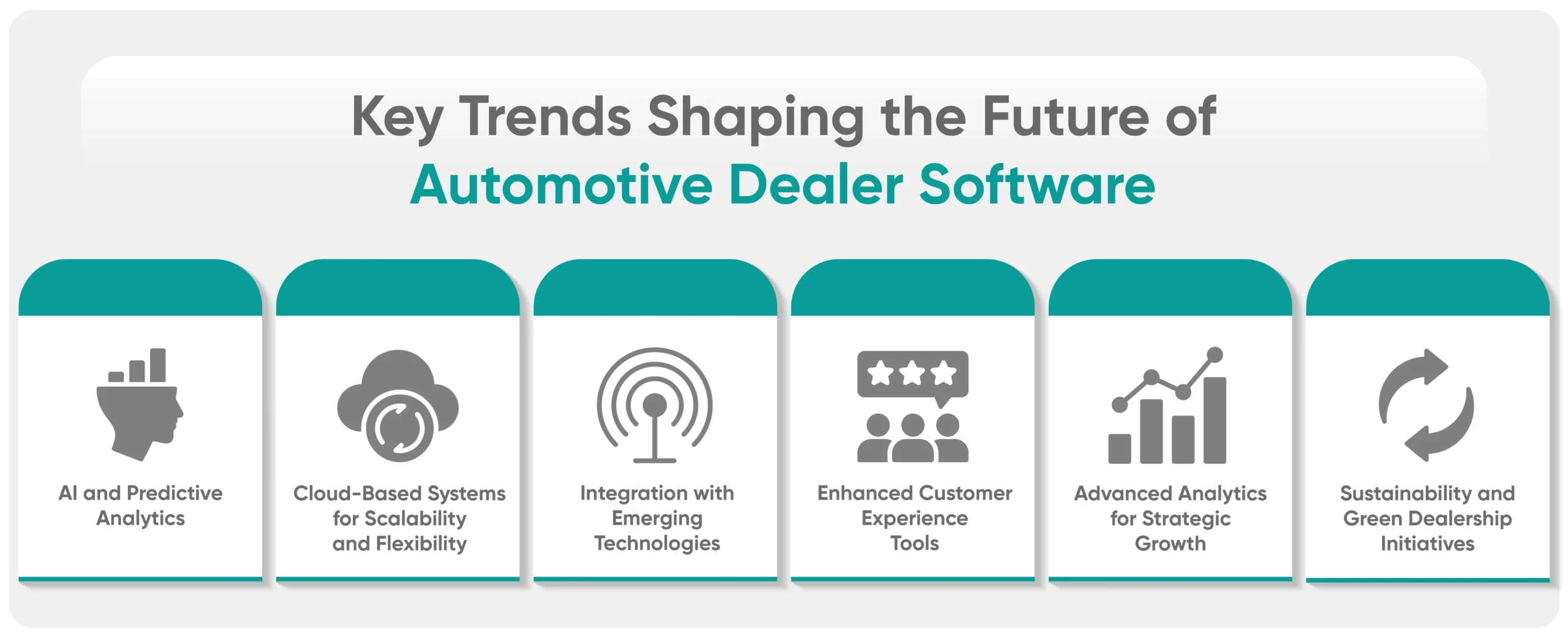
Key Trends Shaping the Future of Automotive Dealer Software
 1. AI and Predictive Analytics
AI is now a clear performance driver in dealerships. It identifies demand trends, predicts repurchase windows, and flags service risks that are easy to miss. It also automates follow ups and scheduling, reducing manual work. The result is better decisions, higher conversions, and more relevant customer interactions on a scale.
2. Cloud Based Systems for Scalability and Flexibility
Cloud is no longer optional. It gives teams access to systems from anywhere and improves coordination across functions. It removes infrastructure costs and reduces IT effort with a predictable expense model. Continuous updates keep systems current without downtime, so operations stay uninterrupted.
3. Integration with Emerging Technologies
Dealership systems are expanding through integration with IoT, EV platforms, and blockchain. Real time vehicle data improves diagnostics and service speed. EV capabilities support new workflows around batteries and charging. Blockchain strengthens trust with secure vehicle records. These integrations extend what dealerships can deliver.
4. Enhanced Customer Experience Tools
Customer experience is now digital first. Omnichannel engagement ensures continuity across every touchpoint. Self-service options reduce friction and save time. Real-time updates keep customers informed at every step. This leads to higher satisfaction and stronger trust.
5. Advanced Analytics for Strategic Growth
Analytics is shifting from reporting to foresight. Dealerships can forecast demand, optimize pricing, and plan capacity more accurately. Real time dashboards provide instant visibility for faster decisions. External market data adds context and sharpens competitive positioning.
6. Sustainability and Green Dealership Initiatives
Sustainability is becoming a business requirement. Digital workflows cut paper use and improve efficiency. Energy monitoring helps reduce operational waste. As EV adoption grows, dealerships need systems that manage battery data, incentives, and compliance. This supports both regulatory needs and customer expectations.
Dealer App with ServiceNow: Transforming Dealership Operations Through Platform Intelligence
One of the most significant developments in automotive dealer software in recent years has been the integration of enterprise workflow platforms, one such is ServiceNow.
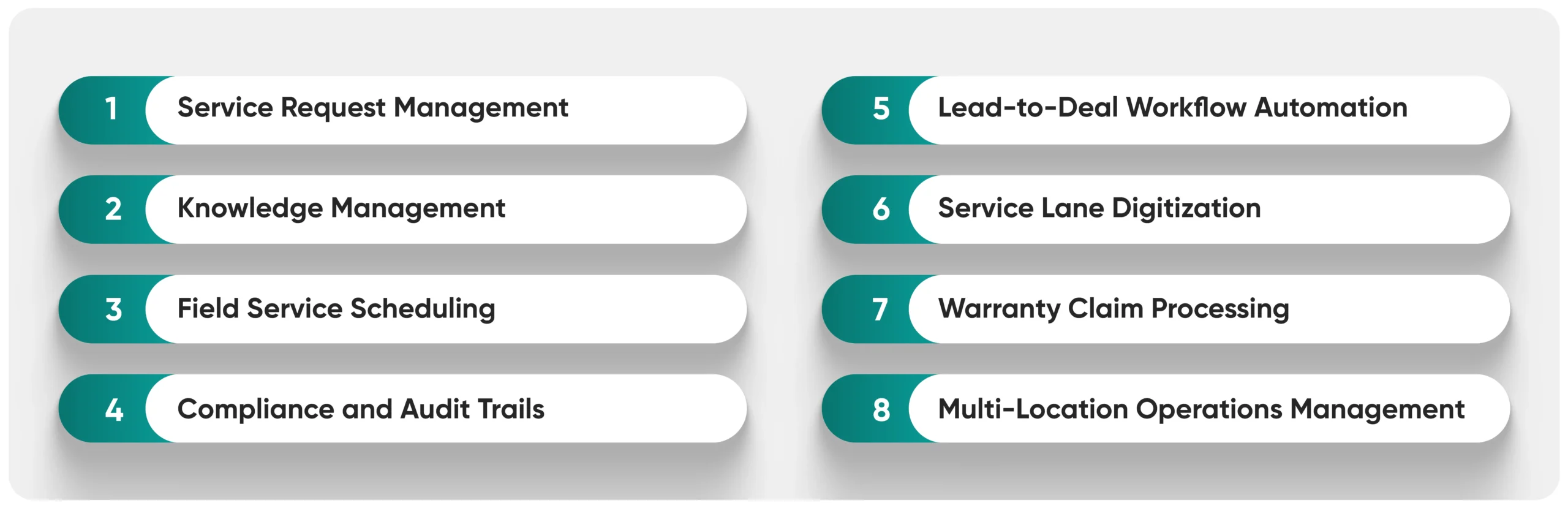
Where traditional DMS platforms are purpose-built for automotive functions, ServiceNow brings a broader enterprise-grade workflow engine that excels at connecting people, processes, and systems across complex organizations. ServiceNow’s platform-native capabilities address several longstanding pain points in dealership operations:
 Dealer App Use Cases in Automotive: Beyond Just Dealer Engagement
Below are two high-impact use cases that show how dealer apps evolve from engagement tools to transformation platforms.
1. Digitizing Dealer Interactions, Sales Tracking, and Support
For a global automotive manufacturer, fragmented dealer ecosystems led to limited visibility, inconsistent communication, and slower decision-making. Aelum implemented a connected, mobile-first Dealer App to unify dealer interactions, sales tracking, and support on a single platform. With a centralized Dealer App:
- Dealers gained real-time access to sales data, inventory, and service requests
- Warranty claims and service scheduling were automated and streamlined
- Self-service support was enabled through knowledge bases and case management
- Field teams could track pipelines and customer interactions on the go
- Leadership achieved complete visibility into dealer performance and service quality
The result was a connected dealer ecosystem with faster decisions, seamless communication, and improved dealer satisfaction.
Read Full Case Study: See how Aelum unified dealer operations on ServiceNow
2. Transforming Dealer Liability Management and Financial Workflows
Aelum also implemented a dealer liability management solution for Maruti Suzuki India Limited, where processes were previously manual, fragmented, and prone to delays and audit risks. By extending ServiceNow, Aelum digitized and standardized the entire workflow:
- Established a centralized system of record for dealer liabilities
- Enabled departments to update data within structured workflows
- Introduced automated reminders, validations, and escalations
- Built audit trails to improve compliance and accountability
- Delivered real-time dashboards for instant financial visibility
This transformed a complex, error-prone process into a controlled, transparent, and scalable system.
Read Full Case Study: How Aelum digitized Maruti Suzuki India Limited liability management at scale
Your dealership, but finally in sync
Build Your Dealer App with Aelum
Modern dealerships are genuinely complex businesses. They’re managing digital and physical customer journeys simultaneously, navigating tightening OEM requirements, handling the operational shift toward EVs, and trying to build lasting customer relationships in a market where switching costs are low and expectations are high.
As dealerships evolve, success will depend on how well they leverage cloud, AI, and integrated workflows to drive efficiency, visibility, and customer satisfaction.
By combining deep automotive expertise with platforms like ServiceNow, Aelum helps Automobile industry move beyond legacy limitations and build connected, scalable, and future-ready dealer ecosystems. From digitizing dealer interactions to transforming workflows, the focus remains on delivering measurable business outcomes.