Whether you’re a P&C carrier, life insurer, or specialty lines provider, you’ve probably invested in chatbots, revamped portals, and standalone digital claims tools. But experience goes far beyond standing up a front-end tool like a CRM or chatbot. It’s about delivering a connected insurance experience, unifying systems, teams, and processes that run the entire value chain, not just the parts customers can see.
That’s what ServiceNow uniquely offers. Not another tool layered on top of the chaos, but a platform that connects your front, middle, and back office into one intelligent platform, bringing transparency to customer interactions and automation to the operations that power them: claims, servicing, underwriting, and more.
Below, we talk in detail about the benefits insurers are achieving with ServiceNow, modules for insurance, and how AI is now supercharging all of it.
Benefits of ServiceNow for Insurance Companies
Before getting into ServiceNow modules and AI, it’s important to understand what changes operationally when an insurer runs on ServiceNow. Let’s have a look at the outcomes carriers see after moving from disconnected, manual operations to a single connected platform.
- End-to-End Process Automation: From claims intake to policy renewals, ServiceNow automates the full operational lifecycle, eliminating manual touchpoints and handoff errors that slow carriers down and inflate costs.
- Faster Claims Management: Intelligent routing, automated assignment, and structured resolution workflows mean claims move faster, adjusters stay focused, and policyholders aren’t left waiting.
- Superior Customer & Agent Experience: Omnichannel support, AI-powered self-service, and real-time case visibility meet the customer’s expectation that insurance should be as easy to navigate as any other digital service.
- Smarter Agent Onboarding: A connected, centralized onboarding experience means agents get up and running faster, stay longer, and spend more time selling.
- Regulatory Compliance & Risk Management: Audit trails, policy controls, and compliance monitoring run continuously, so insurers are always ready (and not only during audit time).
- Data-Driven Decision Making: Leadership gets live visibility into workflow status, SLA slippage, and operational bottlenecks in real time.
- Resilience Against Cyber Risk: Automated, business-impact-aware threat response means security keeps pace with the sophistication of modern cyber-attacks, protecting the sensitive policyholder data insurers are trusted to hold.
Did You Know?
ProAssurance, a leading national specialty P&C insurance provider, was operating on fragmented, legacy workflows with no single platform connecting workflows.
After implementing ServiceNow, they achieved:
- 75% of digital support team allocated to higher-impact roles, enabled by AI
- 10.3K hours saved across the organization over 8-months with agentic AI
- 59% reduction in compute time for user-initiated transactions.
Where ServiceNow Does Its Best Work in Insurance
Every insurer has a different breaking point. For some, it’s claims leakage, for others it’s a compliance team buried in manual audits, or agents stuck in a fragmented onboarding maze. ServiceNow offers a module for each pain point. Here’s how it solves the problems that trouble carriers the most:
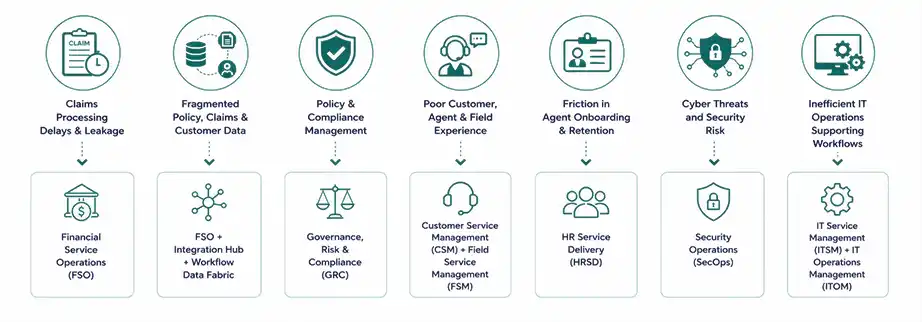
1. Claims Processing Delays & Leakage
Solution: ServiceNow Financial Service Operations (FSO)
Claims leakage is driven by manual errors, missed fraud signals, and disconnected adjuster workflows. Beyond financial loss, slow claims resolution damages policyholder trust, the one moment an insurer must get right. ServiceNow FSO replaces fragmented, manual claims handling with an end-to-end automated workflow, from FNOL to final settlement, giving adjusters, managers, and processors a single connected system to work from.
- FNOL-to-Settlement Automation: Every claim enters a structured, automated flow the moment it’s filed, eliminating manual triage, inbox queues, and the silent delays that erode policyholder trust.
- Intelligent Work Assignment: Claims route automatically based on adjuster workload, line of business, and claim complexity, so the right person picks up the right claim, every time, without a manager manually redistributing work.
- Role-Based Workspaces: Adjusters, claims managers, and processors each get a persona-specific workspace that surfaces only what’s relevant to their role, reducing errors that come from information overload or missing context.
- Embedded Audit Trails & SLA Tracking: Every action on a claim is logged and tracked against defined service levels, making anomalies easier to catch, flag unusual settlement patterns, and stay audit-ready without manual effort.
- Performance Dashboards & Analytics: Real-time visibility into cycle times, adjuster workloads, and bottlenecks allows claims leadership to intervene early, before a delay becomes a complaint or a leakage point becomes a loss.
Ready to modernize your insurance operations with ServiceNow?
2. Fragmented Policy, Claims & Customer Data
Solution: ServiceNow FSO + Integration Hub + Workflow Data Fabric
Most insurers have a data location problem. The information exists, but it’s scattered across systems that don’t talk to each other, creating an inability to recognize the same customer across products or at various stages of a policy lifecycle, causing agency and direct channels to end up in competition for the same customer. ServiceNow solves this not by replacing those systems, but by weaving a live, intelligent data layer across all of them.
- Prebuilt Integration Spokes (Integration Hub): Instead of building custom connectors to every legacy platform, insurers can plug into hundreds of pre-built integrations out of the box, linking policy admin systems, claims platforms, and CRMs into unified workflows within days.
- Zero Copy Connectors (Workflow Data Fabric): Access and update remote data in real time without duplicating it with Workflow Data Fabric. So, insurers can query their policy, claims, and CRM data live without building costly data pipelines or creating stale copies across systems.
- Unified Data Customer Context: A unified data catalog gives AI the business context it needs to deliver a single, consistent customer view across every line of business.
- Built-In Data Governance: Every data connection includes lineage tracking and policy-based controls, so insurers always know where data came from, how it’s being used, and whether it meets standards.
- Faster Data Connections: Prebuilt connectors and integration partners enable faster data connections, slash integration costs, making consolidation practical even for carriers with decades of legacy infrastructure.
3. Policy & Compliance Management
Solution: ServiceNow Governance, Risk & Compliance (GRC)
Carriers must comply with frameworks spanning data privacy, financial reporting, consumer protection, and line-of-business-specific mandates, all varying by geography and change frequently. Regulatory mandates, from Solvency II to state-level insurance codes, are always shifting, and carriers operating on manual compliance processes are perpetually behind. ServiceNow GRC makes compliance a live, embedded function across every workflow.
- Automated Policy Lifecycle Management: Policies are authored, versioned, and tracked on a single platform, with automated alerts when a policy nears expiry or drifts out of alignment with a new regulatory requirement.
- Continuous Control Monitoring: Controls are monitored in real-time, surfacing failures the moment they occur, so remediation happens before an examiner finds it first.
- Scheduled Risk Self-Assessments: Structured, repeatable assessments build a documented compliance program that holds up under regulatory scrutiny.
- Real-Time Risk Dashboards: Leadership sees a live view of their risk posture, segmented by line of business, geography, or regulatory framework, at any point in time.
- Cross-Functional Risk Visibility: ServiceNow connects risk data from underwriting, claims, IT, and operations into a unified GRC program, so when a new NAIC guideline drops or a state mandate changes, the impact is understood enterprise-wide.
4. Poor Customer, Agent & Field Experience
Solution: ServiceNow Customer Service Management (CSM) + ServiceNow Field Service Management (FSM)
Policyholders today compare their claims experience to Amazon and their banking app. But where does insurance lack? The problem lies within the disconnected systems and manual handoffs operating beneath. And for P&C carriers, experience doesn’t end at the contact centre, it extends to the field adjuster arriving at a loss site. Delayed dispatch, poor route optimisation, and disconnected field reporting create a second layer of failure that directly impacts claims cycle times and policyholder satisfaction. ServiceNow CSM and ServiceNow FSM fix both layers on the same platform, so what happens on-site is instantly visible to the back-office team managing the claim.
- AI-Powered Self-Service Portals: Policyholders check FNOL status, submit endorsement requests, and get coverage answers without calling the contact centre; deflection goes up, handle time goes down.
- Omnichannel Case Routing: Requests from web, email, chat, or broker call enter a single workflow and route to the right team, no manual triage, no SLA-killing handoffs.
- AI-Assisted Agent Workspace: Case summaries, recommended actions, and relevant policy data surface automatically, so agents walk into every interaction informed.
- NPS & Feedback Loop Automation: When feedback flags a problem, follow-up workflows trigger automatically, turning a dissatisfied policyholder into a resolved case.
- Intelligent Field Dispatch: Claims requiring on-site inspection are automatically assigned to the nearest available adjuster based on location, workload, and expertise, with no manual scheduling or phone coordination.
- Mobile-First Adjuster Workspace: Field adjusters access claim details, capture photos, complete inspections, and submit reports from a mobile device, feeding data directly into the claim record in real time.
- Real-Time Field Visibility: Claims managers see where every field adjuster is, which inspections are in progress, and which are overdue from the same workspace managing the full claims lifecycle.
- Automated SLA Tracking for Field Tasks: On-site inspection deadlines are tracked the same way digital tasks are, so field delays get flagged and escalated before they breach service commitments.
5. Friction in Agent Onboarding & Retention
Solution: ServiceNow HR Service Delivery (HRSD)
Many insurance agents consider multiple insurance companies for doing business, so the carrier that onboards and supports agents best wins their loyalty. Yet most carriers put agents through fragmented onboarding journeys that span disconnected HR, IT, licensing, and training systems, with no unified experience or visibility. ServiceNow HRSD replaces these fragmented, multi-system onboarding maze with a single, intelligent journey that gets agents in the field faster.
- Unified Onboarding Workflows: E&O verification, IT provisioning, licensing checks, and compliance training run through one connected workflow, visible to HR, IT, and compliance simultaneously, with no step waiting on an email that hasn’t been answered.
- Single Employee Portal: Agents access HR policies, IT support, training modules, and service requests from one portal on any device.
- AI-Powered HR Case Resolution: Routine agent queries such as benefits enrolment, policy clarifications, and credential resets are resolved instantly by AI, without requiring HR or IT intervention. Escalations happen only when they genuinely need a human, keeping support queues manageable at scale.
- 24/7 Virtual HR Assistant: Agents don’t operate on a 9-to-5 schedule. With ServiceNow Virtual Agent, agents get their licensing questions, appointment status, and onboarding queries answered 24/7.
- Automated Lifecycle Task Management: From appointment to role change to contract termination, ServiceNow automatically triggers the right tasks, approvals, and system updates at each stage of agent lifecycle, keeping HR, compliance, and IT aligned without manual coordination.
6. Cyber Threats and Security Risk
Solution: ServiceNow Security Operations (SecOps)
Insurers hold some of the richest personally identifiable information in any industry: claims histories, medical records, financial data, and beneficiary details. This makes them high-value targets. The issue most carriers face is that their SIEM, vulnerability scanners, and endpoint tools don’t talk to each other, creating blind spots that threat actors actively exploit. ServiceNow SecOps closes that gap.
- Automated Security Incident Response: When a threat is detected, whether it’s a phishing attempt targeting an underwriter or suspicious access to a claims system, a structured SOAR workflow fires immediately. The right analysts are assigned, containment actions are triggered, and every step is tracked in real time.
- Business-Impact-Based Vulnerability Prioritisation: ServiceNow ranks vulnerabilities by their potential operational and regulatory impact, so remediation resources go where the actual exposure is, not just where the CVSS score is highest.
- Continuous Vulnerability Scanning: ServiceNow continuously scans infrastructure, flags newly identified vulnerabilities, and initiates remediation workflows before threat actors get there.
- Role-Based Security Posture Dashboards: CISOs get executive-level visibility. Security analysts get operational details. Each role sees what it needs: live risk exposure, open incidents, and remediation status without manually consolidating data.
- Complete IT Asset Visibility: Every asset, including legacy policy platforms and end-of-life systems, is mapped and monitored, leaving no part of the infrastructure in an unmonitored blind spot.
7. Inefficient IT Operations Supporting Insurance Workflows
Solution: ServiceNow IT Service Management (ITSM) + ServiceNow IT Operations Management (ITOM)
Insurance IT teams must keep core systems available and performant while simultaneously delivering digital transformation on stretched budgets and headcount. When a claims portal goes down or a policy integration breaks, it’s not just an IT problem; it’s a customer experience failure. ServiceNow ITSM and ITOM give IT teams the visibility and automation to stop reacting and start operating proactively.
- AIOps-Powered Incident Prevention: ServiceNow ingests signals across IT estate: infrastructure, applications, integrations, and uses AIOps to identify patterns that precede incidents. Issues in claims systems or underwriting platforms get flagged and addressed before they cause a business disruption, not after policyholders start calling.
- Dynamic Service Mapping: A live, auto-updated map shows how every CI connects to every business service, so when something breaks, impact is visible immediately.
- Policy-Driven Automated Remediation: Recurring incidents are handled by pre-built automated playbooks, resolving without human intervention and freeing IT staff to focus on work that requires their expertise.
- Unified ITSM + ITOM on One Platform: Change management, incident response, problem management, and infrastructure visibility run from a shared data model. There’s no version-of-truth conflict between the ITSM team and the ops team.
- Intelligent Alert Correlation: ServiceNow’s AI correlates related events, suppresses duplicates, and surfaces only the signals that represent genuine risk, so IT teams are responding to real problems.
Not sure which ServiceNow module answers your biggest challenge?
ServiceNow AI for Insurance & Use Case Example
Your adjusters shouldn’t be reading 40-page loss reports.
Your compliance team shouldn’t be manually cross-referencing policy controls.
Your agents shouldn’t be waiting 10 minutes for a case summary.
ServiceNow AI is built to remove exactly that kind of friction, across every function, all at once.
1. ServiceNow AI Agents
AI Agents work across your insurance workflows to reduce response times, improve adjuster productivity, and bring consistency to your customer interactions. They instantly pull policy details, assess coverage eligibility, identify required documentation, and flag potential fraud indicators. So, with AI Agents, you get automated claims lifecycle, accelerated underwriting operations, fraud detection, seamless policy servicing, intelligent agent assistance, and document intelligence and processing.
- ServiceNow AI Agent Studio lets your team create and customize AI Agents using natural language (build them without coding).
- ServiceNow AI Agent Fabric unifies your policy administration systems, claims management tools, CRM systems, document repositories, and legacy applications.
Use Case: A P&C carrier receives 1,200 claims weekly. The moment each claim is filed, a ServiceNow AI Agent validates coverage, checks fraud indicators, and routes straightforward claims for straight-through processing, all in under 30 seconds. Adjusters receive only the complex cases, with fraud flags and coverage gaps already surfaced.
2. Generative AI (ServiceNow Now Assist)
ServiceNow Now Assist summarizes large claims documents in a clear and succinct way, saving claims employees, such as adjusters and managers, significant time. It can also be used for real-time monitoring of claims and transactions, helping mitigate fraud. Customer service representatives benefit from AI-assisted conversational tools that handle routine policyholder queries, from coverage questions to mid-term changes, with greater speed and accuracy.
Across underwriting, FNOL intake, and compliance workflows, ServiceNow Now Assist’s content generation and knowledge base capabilities help teams resolve cases faster, close knowledge gaps, and maintain consistent service quality at scale.
Use Case: A senior adjuster picks up a complex liability claim with a 60-page loss report, three years of correspondence, and multiple coverage endorsements. Instead of spending 45 minutes reading through it, Now Assist generates a structured summary in seconds, flagging coverage gaps, outstanding documentation, and recommended next steps.
Create Your Personalized Insurance Transformation Roadmap with Aelum
Insurance operations fail because the systems, teams, and processes that should work together are operating in isolation. At Aelum, we’ve seen what that fragmentation actually looks like on the ground:
- Claims stall because an adjuster is waiting on data from a system that doesn’t integrate
- Onboarding journeys that lose agents before they’ve written their first policy
- Compliance teams run manual checks because no one built the workflow to automate them
We’re a certified boutique ServiceNow partner, and we help you close those gaps, not only with promises, but with workflows that are live in production across carriers, managing millions of policies. And we bring a deep understanding of how insurance actually operates, where the edge cases live, and what implementation decisions will matter 18 months after go-live.
If you’re evaluating ServiceNow for your business, or if you’re already on the platform and not getting the value you expected, we’d like to have that conversation. Schedule a 1:1 with our ServiceNow experts today.