You’ve made smart investments in your tech stack.
But without alignment across your software, the ROI you expected never fully shows up. Imagine hiring a world-class team but never letting them meet. That’s what disconnected systems do to your business: keep brilliant tools working in isolation.
And this is exactly where ServiceNow stands out, as a single platform built to connect teams, systems, and processes across the enterprise. But unifying workflows is only the beginning. The real transformation happens when ServiceNow integrates seamlessly with existing legacy systems, current enterprise applications, and the digital tools organizations rely on every day, from ERP and CRM platforms to cloud services and industry-specific solutions.
In this blog, we’ll explore the most impactful ServiceNow integration use cases and how enterprises are connecting systems, eliminating silos, and building end-to-end workflows that deliver smarter service, faster operations, and better outcomes.
Identify your highest-impact integration opportunities
Benefits of ServiceNow Integrations
The enterprises getting measurable ROI from ServiceNow choose a path where they let the team meet, collaborate, and operate as one. They’ve integrated ServiceNow into the fabric of how work gets done across sales, HR, security, and operations. Here’s what changes when you connect ServiceNow to the tools your organization already depends on:
- Silos stops being your default: Your departments work from the same data, eliminating friction, so teams work from connected workflows.
- Move work faster with automation: Automate repetitive tasks such as ticket creation, onboarding flows, data syncs so your people focus on work that actually needs them.
- Make decisions with complete context: Every stakeholder works from the same truth with real-time, unified data across every connected system.
- Deliver experiences your customers expect: End-to-end visibility across the customer journey lets your team deliver service that’s proactive.
- Manage risk from a central control point: Centralized security and compliance workflows enforce policies consistently while reducing complexity.
If you could fix one thing about how your systems work together, what would it be?
ServiceNow Integration Use Cases
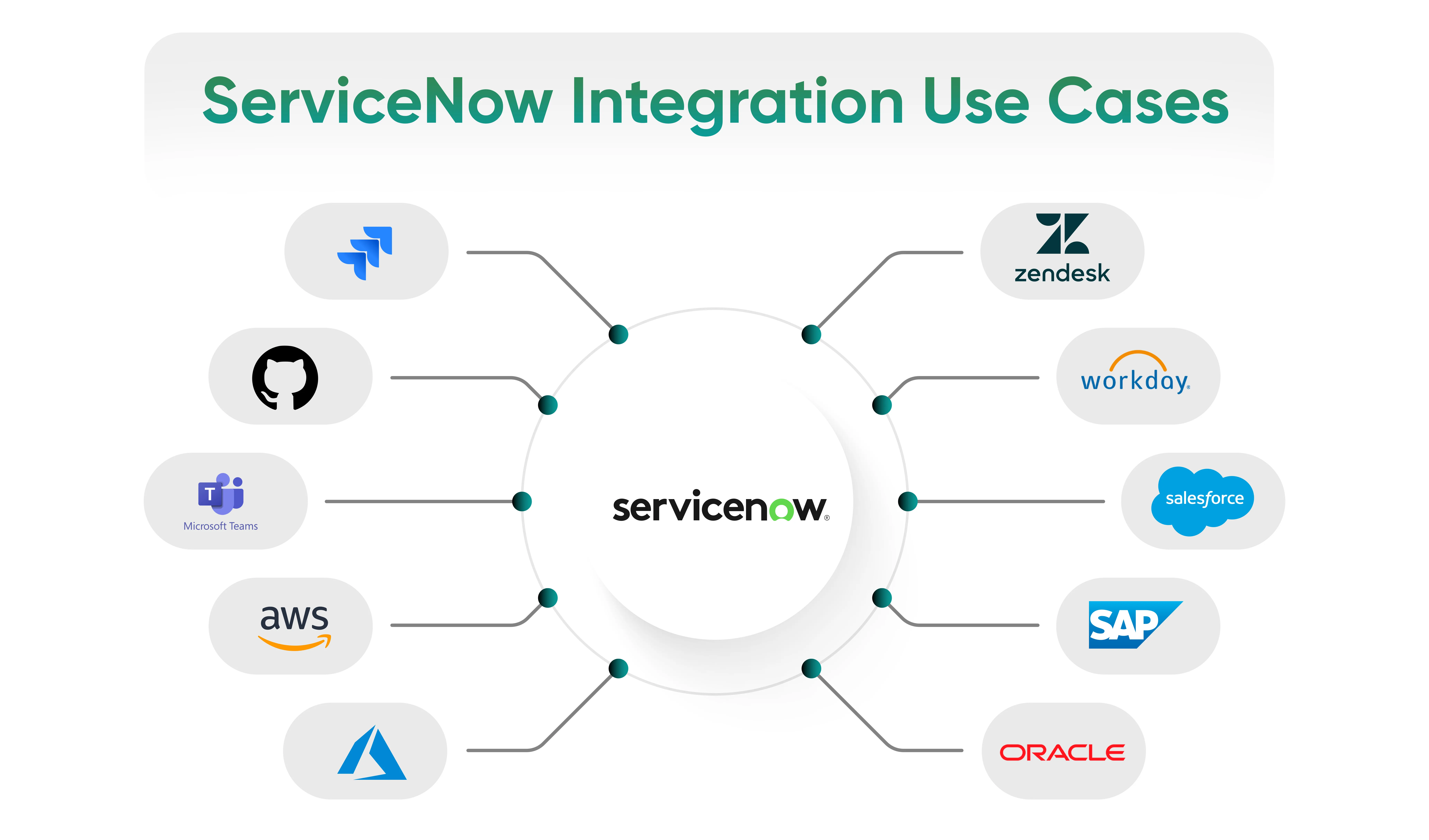
Below, we explore high-impact integrations, from development tools to customer platforms, showing exactly how each connection streamlines operations, reduces friction, and transforms isolated systems into unified workflows.
The ServiceNow integrations list is organized by function, making it easier to see which integrations deliver the highest value for each team
IT & DEVELOPMENT
IT and development teams often operate in parallel but rarely in sync. The integrations below change that, connecting your service workflows directly to the tools where your developers spend their day.
ServiceNow Jira Integration
Sync tickets, comments, and status updates between your service and development teams with ServiceNow Jira integration. Incidents logged in ServiceNow automatically appear in Jira with full context, so your developers can take action without waiting on manual handoffs.
Business Benefits:
- Give both teams real-time visibility into progress without switching tools
- Reduce back-and-forth with automated task creation across both platforms
- Trace every action, comment, and change with a complete audit trail
- Seamless communication between IT and development teams
ServiceNow GitHub Integration
ServiceNow GitHub integration links every commit and pull request directly to its originating ServiceNow record. Your teams get end-to-end traceability across source control and service operations, while automated CI/CD workflows keep development velocity aligned with your governance requirements.
Business Benefits:
- Track GitHub license usage inside ServiceNow to optimize spend.
- Reduce audit preparation time with automatically linked change records.
- Enforce change approval policies before code moves to production.
- Minimize release risk with governance checkpoints built into your pipeline.
COMMUNICATION
Beyond development workflows, integration has an equally significant impact on how your teams communicate and collaborate day to day.
ServiceNow Teams Integration
Create a unified experience for everyday interactions and get accessible AI-powered support. ServiceNow Teams integration enables you to drive faster, in-context decisions and enable conversational ticketing and real-time support without leaving Teams.
Business Benefits:
- Instant self-service with ServiceNow Virtual Agent
- Centralize conversations, requests, and service actions
- Get updates, approvals, clarifications within Teams
- Improve alignment between employees, agents, and stakeholders
ServiceNow Slack Integration
Keep your teams instantly informed with real-time ticket updates delivered directly in Slack. ServiceNow Slack integration allows you to create tickets, route alerts based on urgency, and let your virtual agent handle routine tasks.
Business Benefits:
- Accelerated response handling
- Strengthen IT governance with complete audit trails
- Request catalog items directly from Slack channels
- Automate routing based on urgency and SLAs
CLOUD & INFRASTRUCTURE
With internal teams connected, the next layer is your cloud environment, where visibility gaps and manual processes create the most operational risk.
ServiceNow AWS Integration
ServiceNow AWS integration gives you real-time, bi-directional connectivity between both platforms. Manage cloud resources, monitor compliance, and automatically convert AWS events into actionable ServiceNow incidents, all from one unified operational view.
Business Benefits:
- Accelerate cloud resource delivery with self-service provisioning portals
- Maintain up-to-date asset inventory without manual discovery efforts
- Enforce governance policies with continuous configuration compliance checks
- Track cloud resource dependencies for more accurate impact analysis
ServiceNow Azure Integration
ServiceNow Azure integration synchronizes incidents, changes, and requests between both platforms automatically. Your teams get real-time deployment visibility, policy-backed compliance checks, and a consolidated view of cloud and ITSM data to support faster decisions.
Business Benefits:
- Reduce manual errors by eliminating duplicate data entry across platforms
- Improve audit readiness with a complete log of all cloud changes
- Accelerate incident response with automated cross-platform ticket creation
- Scale infrastructure operations without increasing administrative overhead
SECURITY & MONITORING
For leadership, security risk is business risk. Give your security and IT teams the shared visibility and automated workflows they need to detect, respond, and report, without the delays that come from working in separate tools.
ServiceNow Splunk Integration
ServiceNow Splunk integration automatically converts qualified Splunk alerts into ServiceNow incidents, removing the need for manual ticket creation. Your security and IT teams work from a single synchronized workflow with full context and faster root cause analysis.
Business Benefits:
- Use customizable field mapping to control how alert data populates records
- Reduce mean time to resolve with automated cross-team incident assignment
- Eliminate tool-switching by managing security response inside ServiceNow
- Improve post-incident reporting with unified logs from both platforms
CRM & CUSTOMER EXPERIENCE
Operational efficiency matters internally, but integration’s impact on your customer-facing teams is where it directly affects revenue.
ServiceNow Salesforce Integration
Equip your sales and support teams to work with accurate, up-to-date records with ServiceNow Salesforce integration. Integrate your CRM data with your Help Desk, Asset Management, and IT Service Management systems. Sync cases, accounts, and tasks between the two seamlessly.
Business Benefits:
- Automatically import and export data when opportunities are opened or closed
- Keep CPQ product information consistent across both platforms at all times
- Reduce duplicate record creation with automated account and contact syncing
- Improve handoff quality between sales and support with shared case history
ServiceNow Zendesk Integration
ServiceNow Zendesk integration connects both platforms while handling data transformation automatically, so your teams always have accurate, contextually formatted information. Ticket escalations, SLA tracking, and priority changes stay visible on both sides without requiring platform switching.
Business Benefits:
- Let both teams retain full workflow autonomy while staying connected
- Standardize data formatting automatically across both platforms’ APIs
- Reduce escalation response delays with automated cross-platform notifications
- Improve SLA adherence by surfacing overdue tickets to the right teams instantly
HR & WORKFORCE MANAGEMENT
Customer experience is only as strong as the internal teams supporting it, and that starts with how well HR and IT work together.
ServiceNow Workday Integration
ServiceNow Workday integration connects your HR and IT systems on a unified workspace, automating cross-functional handoffs like account provisioning and equipment requests. Your teams get centralized employee data, stronger compliance controls, and faster onboarding and offboarding.
Business Benefits:
- Reduce onboarding errors with automated, policy-driven provisioning workflows
- Maintain a centralized audit trail for every employee data change
- Eliminate delays caused by manual HR-to-IT request handoffs
- Improve offboarding accuracy by automatically triggering access revocation workflows
ERP & ENTERPRISE OPERATIONS
Enterprise-wide transformation requires your core business systems to be part of the same connected fabric.
ServiceNow SAP Integration
ServiceNow SAP integration keeps your customer, asset, product, and incident data automatically synced across both platforms. Your IT and business teams always have accurate records to act on, with no manual updates and lower customization risk during SAP upgrades.
Business Benefits:
- Break down silos between IT, finance, and supply chain operations
- Simplify SAP upgrades by orchestrating processes through ServiceNow instead
- Visualize asset dependencies by linking SAP records to ServiceNow workflows
- Scale your integration without heavy custom development as business needs evolve
ServiceNow Oracle Integration
ServiceNow Oracle integration connects Oracle Cloud Infrastructure, Oracle EBS, and identity management workflows directly with ServiceNow. Operational data, access requests, and cloud resource changes flow automatically between both platforms, giving your IT and operations teams a single, unified view without manual intervention.
Business Benefits:
- Speed up user access provisioning with policy-based automated approval workflows
- Improve transparency with real-time access request status updates for users
- Detect and correlate issues early through automated event analysis across systems
- Reduce IT overhead by consolidating cloud visibility into one operational hub
Connect your systems and capture real ROI with ServiceNow
You’ve Got the Tools. Make Them Work Together on ServiceNow with Aelum
Disconnected systems slow your teams down and quietly erode productivity, visibility, and customer and employee experience every single day.
Leading enterprises use ServiceNow integrations not as add-ons, but as a strategic lever to drive adoption, consistency, and measurable business outcomes.
At Aelum, we specialize in designing, implementing, and optimizing ServiceNow integrations that align with your business goals. From pre-built connectors to custom workflows, our team ensures your integrations deliver measurable value, reflecting in faster resolution times, reduced manual work, and seamless employee and customer experiences.
We connect systems and architect solutions that scale with your growth, establishing a sustainable integration strategy that grows with your business needs. Talk to our experts and discover which integrations will drive the most value for your company.