Every outage tells three stories at once: downtime for the business, an incident for the service desk, and a trail of alerts and dependencies for IT operations to untangle.
But connecting these stories is what makes the difference between spotting a problem and resolving it effectively. Teams need to understand what went wrong, which services are affected, and how to coordinate the response to restore normal operations.
That’s where ServiceNow ITOM and ITSM play distinct yet complementary roles. IT Operations Management (ITOM) helps teams gain visibility into their infrastructure, map service dependencies, and investigate technical issues. IT Service Management (ITSM) provides the workflows to manage incidents, coordinate teams, communicate updates, and drive resolution.
One helps teams understand what’s happening across the technology environment; the other helps manage the response. Understanding how these capabilities differ, overlap, and work together is key to determining what your organization needs.
ServiceNow ITSM vs. ITOM: Understanding What Each Solution Does
ServiceNow ITSM and ITOM address two closely connected aspects of IT service reliability, but each approaches the challenge from a different angle.
ServiceNow ITSM focuses on managing the workflows around IT services, helping teams handle incidents, fulfil service requests, control changes, and address recurring issues. Its core capabilities include Incident Management, Problem Management, Change Management, Request Management, and Knowledge Management.
ServiceNow ITOM, on the other hand, focuses on the technology infrastructure that supports those services. Through capabilities such as Discovery, Service Mapping, and Event Management, it helps teams identify infrastructure components, understand service dependencies, and detect potential issues across their IT environment.
Put simply, ITSM helps teams manage the response, while ITOM provides the technical visibility and context needed to understand what is happening behind the scenes. Together, they connect operational insights with structured service workflows, helping teams respond to disruptions more effectively.
ServiceNow ITSM vs. ITOM: Key Differences Explained
While ServiceNow ITSM and ITOM both contribute to reliable IT services, they differ in what they manage and how they help teams address operational challenges. The following comparison breaks down their key differences.
| Comparison Factor | ServiceNow ITSM | ServiceNow ITOM |
| Primary Focus | Managing IT service delivery, support, and service-related workflows. | Maintaining visibility into and control over IT infrastructure and service dependencies. |
| Primary Objective | Resolve service disruptions, fulfil requests, manage changes, and improve the service experience. | Identify technical issues, understand their impact, and maintain the health and availability of IT services. |
| What It Manages | Incidents, service requests, recurring problems, changes, and associated service workflows. | Infrastructure components, applications, cloud resources, service dependencies, operational events, and related signals. |
| Core Capabilities | Incident Management, Problem Management, Change Management, Request Management, and Knowledge Management. | Discovery, Service Mapping, Event Management, AIOps, and relevant cloud operations and observability capabilities, depending on the products deployed. |
| Typical Starting Point | A reported issue, service request, recurring incident, or planned IT change. | An infrastructure alert, monitoring signal, discovered component, service dependency, or indication of degraded service health. |
| Key Question It Answers | What needs attention, who should handle it, and how do we restore or improve the service? | What is happening in the technology environment, why might it be happening, and which services could be affected? |
| Role of the CMDB | Uses configuration item (CI) and service data to support incident investigation, change impact assessment, and service management workflows. | Uses Discovery and Service Mapping to identify infrastructure components and establish their relationships, helping maintain a more accurate, service-aware CMDB. |
| Approach to Incidents | Prioritizes incidents, assigns ownership, coordinates investigation, manages communication, and tracks resolution. | Correlates events, reduces alert noise, identifies affected components, and provides technical and service context. Configured integrations can create or enrich ITSM incidents. |
| Primary Users | Service desk teams, IT service managers, incident and problem managers, and change managers. | IT operations teams, infrastructure and cloud engineers, platform teams, and operations or observability specialists. |
| How Success Is Measured | Metrics such as mean time to resolve (MTTR), SLA compliance, incident recurrence, request fulfilment, and user satisfaction. | Metrics such as alert noise reduction, service availability, infrastructure visibility, service health, and time to detect or investigate issues. |
| Business Value | More consistent service delivery, better support experiences, clearer accountability, and controlled IT changes. | Better operational visibility, faster technical investigation, stronger impact assessment, and fewer avoidable service disruptions. |
| Typical Use Case | Managing an employee-reported application outage from incident logging through resolution and follow-up. | Detecting an application or infrastructure anomaly, tracing dependencies, and identifying the services potentially affected. |
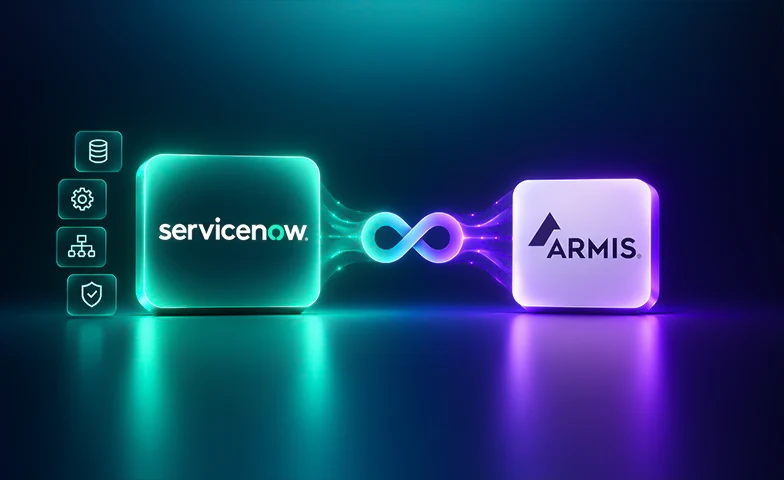
The distinction is clear: ITSM manages the service response, while ITOM provides visibility into the technology and dependencies behind that response. ServiceNow brings the two together through connected data and workflows, allowing teams to combine technical context with structured incident and change management.

Where Do ServiceNow ITSM & ServiceNow ITOM Overlap?
ITSM and ITOM may have different responsibilities, but they intersect wherever technical issues need to be translated into service-level action. Their biggest area of overlap is the shared data and workflows that help teams understand a disruption, assess its impact, and coordinate a response.
Here’s where the two come together:
- Shared CMDB and service visibility: ITOM Discovery and Service Mapping identify infrastructure components and map their relationships. ITSM uses this information to understand which configuration items and services are involved in an incident or affected by a planned change.
- Event-to-incident workflows: ITOM Event Management collects and correlates operational events to generate actionable alerts. With the appropriate rules and configuration, these alerts can trigger ITSM incidents, helping teams move from detecting a technical issue to managing its resolution.
- Service impact and change management: Dependency information from ITOM helps teams understand how an infrastructure issue or proposed change could affect connected services. ITSM uses this context to support incident prioritization, change impact assessment, and coordinated response.
Key Takeaway: ITOM provides the technical context; ITSM provides the service-management workflows. When connected effectively, they help teams move from isolated alerts and tickets to a more coordinated approach to service reliability. This integration depends on accurate service data, appropriate configuration, and the relevant product capabilities.
ITOM & ITSM in Practice: A Real-World Scenario
It’s 10 AM on a Monday, and the company’s CRM is running painfully slow just as the sales team begins processing customer orders. Within minutes, complaints start pouring in.
Emma, the IT service desk lead, logs the issue in ServiceNow ITSM, prioritizes the incident, and brings the relevant teams together to investigate. Meanwhile, James, an IT operations engineer, spots correlated alerts pointing to unusual database latency. Using ServiceNow ITOM, he traces the CRM’s dependencies and identifies the underlying technical issue.
With the appropriate integration in place, the operational alert creates or enriches the ITSM incident, giving Priya’s team valuable technical context. Arjun’s team addresses the database issue while Priya coordinates the response, keeps stakeholders informed, and tracks the incident through resolution.
Once the CRM is back to normal, the team can use ITSM’s Problem Management workflows to investigate why the issue occurred and reduce the risk of recurrence.
That’s ITOM and ITSM working together: one helps uncover what’s happening behind the scenes; the other coordinates the response that gets the business moving again.
ITSM, ITOM, or Both? How to Make the Right Choice
The right choice depends on where your IT environment faces the biggest challenges and what you need to improve.
- Choose ITSM if incident backlogs, manual service requests, inconsistent workflows, or change-related risks are affecting service delivery. Its focus is to bring structure, accountability, and consistency to IT service management.
- Choose ITOM if limited infrastructure visibility, complex service dependencies, alert overload, or slow technical investigations make it difficult to understand and manage operational issues.
- Consider both when technical teams can detect issues but struggle to connect them with business impact, or service desk teams lack the technical context needed to coordinate an effective response. Integrating ITOM with ITSM can bridge this gap, connecting operational insights with service workflows.
Before implementing either solution, assess your CMDB and service data quality, existing monitoring tools, integration requirements, and team readiness. Define measurable goals, such as reducing resolution times, improving service availability, or preventing recurring incidents.
The key is to start with your most pressing operational gap, then expand your capabilities as your needs evolve. ITSM and ITOM deliver greater value when their roles are clear and their workflows work together.
Ready to Get More from Your ServiceNow ITSM & ITOM Investment?
The next step is turning your priorities into a well-defined roadmap, with the right capabilities, implementation approach, and platform strategy aligned to your operational goals.
As a Certified ServiceNow Partner, Aelum brings consulting and implementation expertise to help organizations plan, deploy, and optimize their ServiceNow capabilities.
Let’s put the right ServiceNow strategy in motion. Connect with Aelum.