Drowning in the growing digital noise, employees often struggle with fragmented workflows, disconnected systems, and information overload, creating friction in everyday work. This has made proactive, intelligent IT support essential for a seamless digital workplace.
According to Gartner, 47% of digital workers struggle to find the information they need to perform their jobs effectively, while 66% believe better business outcomes are possible with standardized, IT-supported tools and devices.
ServiceNow ITSM helps organizations close this gap. As a cloud-based, AI-powered solution, it modernizes IT service delivery through intelligent automation, unified workflows, self-service experiences, and streamlined incident, problem, change, and request management. Built on the ServiceNow AI Platform, it helps IT teams accelerate resolutions, improve employee experiences, increase operational efficiency, and transform IT from a support function into a strategic business enabler.
This shift marks a new era of ITSM, where AI, automation, and unified workflows are transforming how organizations deliver and manage IT services.
The Evolution of ServiceNow ITSM and Why It Matters
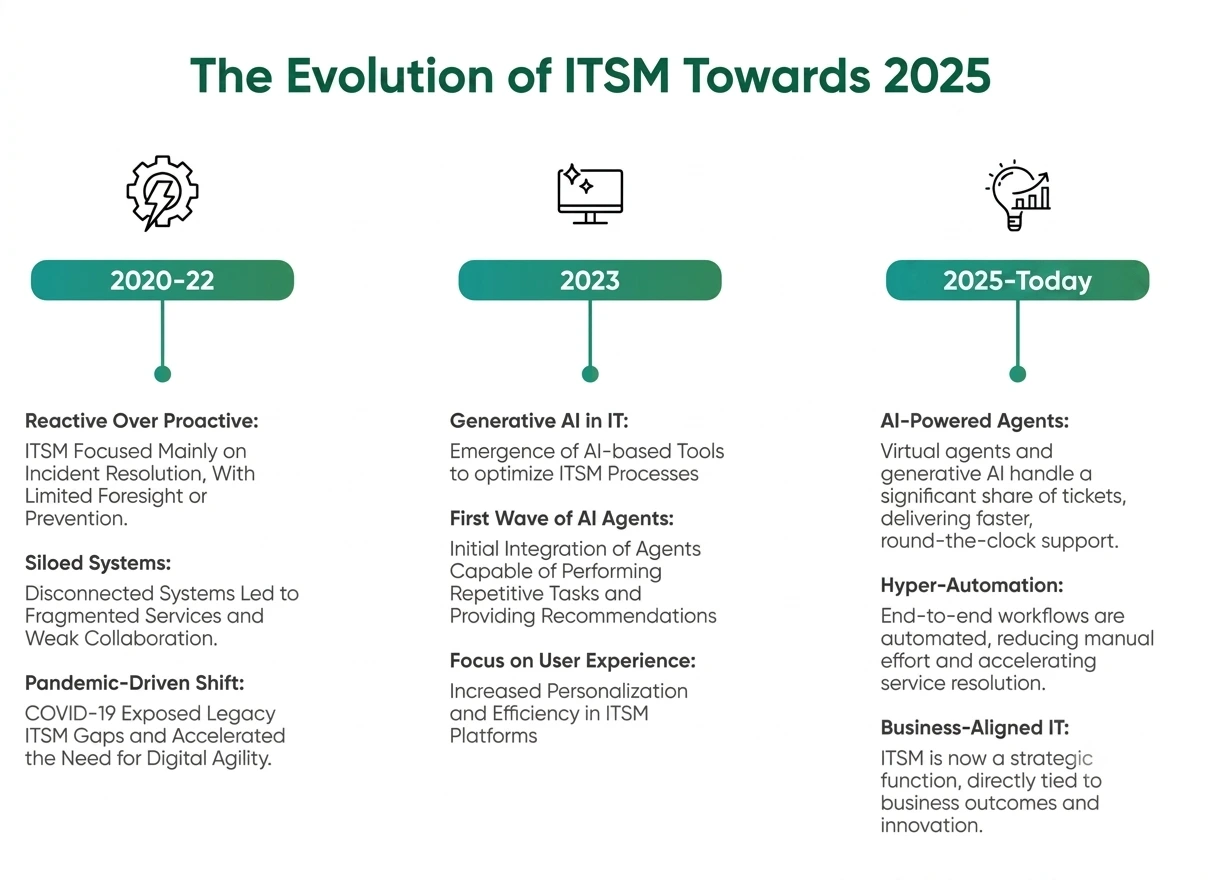
IT Service Management (ITSM) has undergone a significant transformation over the past few years. What began as a reactive function focused on resolving incidents has evolved into an AI-powered, business-aligned capability. As digital operations expanded and employee expectations increased, organizations needed a smarter approach to service management; one that is proactive, automated, and built for enterprise-wide transformation.
Turn IT into a Competitive Advantage with ServiceNow ITSM
Today, ITSM extends far beyond ticket resolution. Modern IT organizations use AI, automation, and unified workflows to predict issues, improve employee experiences, and drive measurable business outcomes. ServiceNow ITSM sits at the center of this transformation. Here’s what changed:
- Intelligent, Proactive IT — One intelligent platform, fueled by a unified AI ecosystem, delivers a forward-thinking approach to all operations, proactively catching issues before they escalate.
- Security is built-in, not added later — Resilience is now a core element of everyday processes.
- Sustainability matters — ServiceNow helps track and reduce IT environmental footprint.
Why it matters?
The shift from reactive, siloed ITSM to a modern, AI-driven approach isn’t just a technical upgrade—it’s a strategic move. As IT becomes deeply embedded in every aspect of business, the ability to resolve issues faster, predict problems before they occur, and deliver seamless service experiences is now a competitive advantage. Modern ServiceNow ITSM helps organizations cut costs through automation, improve employee productivity, and ensure consistent service quality—driving real business value while staying agile in a fast-changing digital ecosystem.
ServiceNow ITSM: Core Capabilities That Set it Apart
ServiceNow ITSM stands out to empower your IT teams delivering exceptional service and performance.
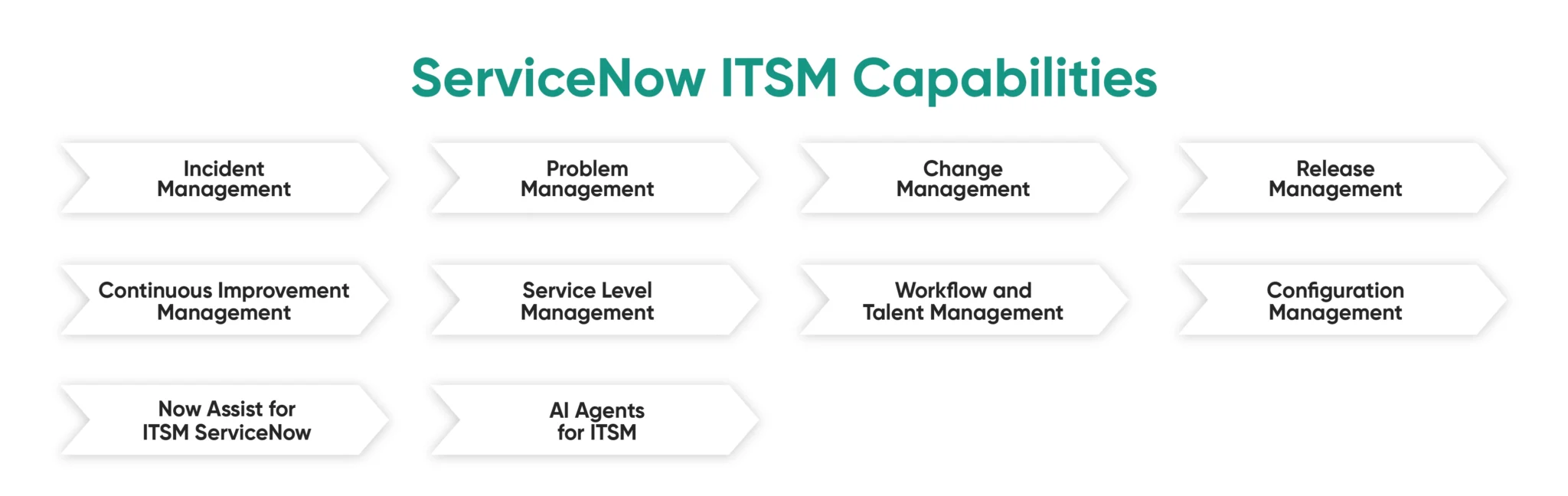
- Incident Management: Swiftly address IT disruptions using automated incident detection, classification, and resolution processes. By reducing manual effort and accelerating response times, organizations can minimize downtime, improve user satisfaction, and free IT teams to focus on strategic initiatives.
- Problem Management: Go beyond incident resolution by identifying root causes of recurring issues. ServiceNow helps proactively prevent future issues through trend analysis, root cause investigations, and structured problem resolution, ensuring long-term IT stability and operational efficiency.
- Change Management: Implement IT changes with confidence using a structured, risk-aware approach. ServiceNow streamlines the planning, approval, and execution of changes, reducing unplanned outages and ensuring continuous service delivery with minimal disruption.
- Release Management: Deliver new features and updates seamlessly with automated release workflows. From planning, testing to deployment and validation, ServiceNow ensures efficient coordination across teams while minimizing service interruptions and business impact.
- Request Management: Simplify and automate the handling of service requests, from password resets to software installations and hardware upgrades. With intuitive self-service portals and automated workflows, ServiceNow ensures faster fulfillment and increased user satisfaction.
- Knowledge Management: Empower employees and service teams with a centralized knowledge base that captures, organizes, and shares accurate information. ServiceNow enables faster issue resolution through AI-powered knowledge recommendations, self-service access, and continuous article improvement, reducing repetitive requests and improving service efficiency.
- Service Level Management: Ensure IT services meet or exceed expectations by setting, tracking, and managing SLAs. With real-time performance monitoring and automated alerts, ServiceNow helps maintain service consistency, avoid SLA breaches, and drive accountability.
- Configuration Management (CMDB & Service Mapping): Gain real-time visibility into IT assets, services, and their relationships through an accurate Configuration Management Database (CMDB) and automated Service Mapping. This enables faster incident resolution, informed change planning, accurate impact analysis, and better decision-making across the IT environment.
- Continuous Improvement Management: Foster a culture of innovation with tools that continuously assess and enhance ITSM performance. Leverage real-time data and analytics to identify improvement areas, prioritize initiatives, and align IT services with evolving business goals.
Did you know?
ServiceNow ITSM can reduce incident resolution time by up to 50% and 20% reduction in service requests with automation, streamlining workflows and enabling IT teams to resolve issues faster.
Driving Results with ServiceNow ITSM: Benefits for Every Role
ServiceNow ITSM creates value beyond the IT department by delivering faster services, smarter operations, and better experiences across the organization. From business leaders to end users and service desk teams, every stakeholder benefits from intelligent, AI-powered service management.
Business Stakeholders
ServiceNow ITSM helps align IT with business goals while cutting down on operational costs. It offers real-time insights into service performance, making it easier to take smart, data-driven decisions. With faster service delivery and better risk management, businesses stay competitive and launch new capabilities more quickly.
End Users
Employees get smooth and consistent experience—no matter where they are or which department they belong to. With round the clock availability of VAs and self-service portals users are able to quickly find answers from knowledge articles, track their requests, and resolve issues faster. This results in fewer disruptions, improved productivity, and higher satisfaction.
Service Desk Staff
IT teams are able to move past ticket overload thanks to AI-powered tools, sort and route issues based on priority. ServiceNow’s unified platform minimizes the need to switch between tools to automate day-to-day tasks and let agents deal with more complex problems. Built-in knowledge resources further help in preventing repeated issues and ensure consistent service quality.
Breaking Industry Barriers with ServiceNow ITSM
| Industry | Challenge | How ServiceNow ITSM Helps |
| Financial Services | Complex compliance requirements and risk management | Automates regulatory tracking, enhances compliance reporting, and ensures audit trails |
| Healthcare | Service downtime and inefficient incident resolution | Centralized incident management and AI-powered ticket prioritization for faster response |
| Manufacturing | Unplanned downtime and inefficient system monitoring | Proactive monitoring with predictive analytics to reduce disruptions |
| Telecommunication | Service disruptions and network performance issues | Real-time monitoring and automated incident management for improved network uptime |
| Public Sector | Legacy IT systems causing inefficiencies | Modernizes workflows through cloud-based solutions and automation for streamlined operations |
ServiceNow ITSM is not limited to just these industries—it continues to transform operations across many other sectors. By streamlining workflows and improving service management, it empowers organizations to achieve greater efficiency.
Success Snapshot: Elevating Digital Customer Experiences with Virgin Mobile UAE
Faced with fragmented customer service processes and growing expectations for seamless digital experiences, Virgin Mobile UAE partnered with Aelum. By implementing ServiceNow ITSM and CSM, we unified service operations, enabled intelligent self-service, and automated critical workflows. The result was a faster, more connected service experience with quicker resolutions, improved customer satisfaction, and a scalable foundation for future innovation
Read the full success story here.
AI-powered ServiceNow ITSM
As the future of IT Service Management is redefined by AI, ServiceNow is leading the charge. By embedding AI across ITSM workflows, it helps organizations move from reactive support to intelligent, proactive service delivery.
From automating routine tasks to accelerating issue resolution with predictive insights and GenAI-powered virtual agents, AI enhances every stage of the service lifecycle. The result is faster response times, reduced manual effort, and seamless service experiences for both IT teams and end users.
With AI-powered ITSM, ServiceNow combines the intelligence of Now Assist, AI Agents, Predictive Intelligence, and AI Control Tower to elevate service operations. Now Assist enables agents with AI-generated summaries, recommendations, and knowledge creation, while AI Agents autonomously diagnose issues, orchestrate workflows, and execute tasks across systems. Predictive Intelligence automatically classifies, prioritizes, and routes incidents with greater accuracy, and AI Control Tower provides centralized governance and orchestration of AI agents to ensure secure, transparent, and policy-driven automation.
As organizations accelerate their digital transformation, traditional ITSM approaches can no longer keep pace with modern business demands. In fact, 42% of large enterprises already use AI for tasks like IT automation, while another 40% are actively exploring it, signaling a clear shift toward AI-first IT operations. With AI embedded across the Now Platform, ServiceNow delivers a more predictive, autonomous, and customer-centric approach to IT service management.
Powering Ticket Management with AI: What’s New?
IT tickets are digital requests used to report, track, and resolve technical issues or service needs within an organization. From software glitches and system outages to password resets and access requests, these tickets perform day-to-day IT operations—helping teams stay organized, responsive, and accountable.
ServiceNow ITSM steps in to streamline and accelerate the entire ticketing process. By centralizing ticket intake, automating task assignments, and enforcing consistent workflows, it eliminates chaos and ensures that no issue falls through the cracks. This leads to better performance, real-time transparency, and accelerated problem-solving.
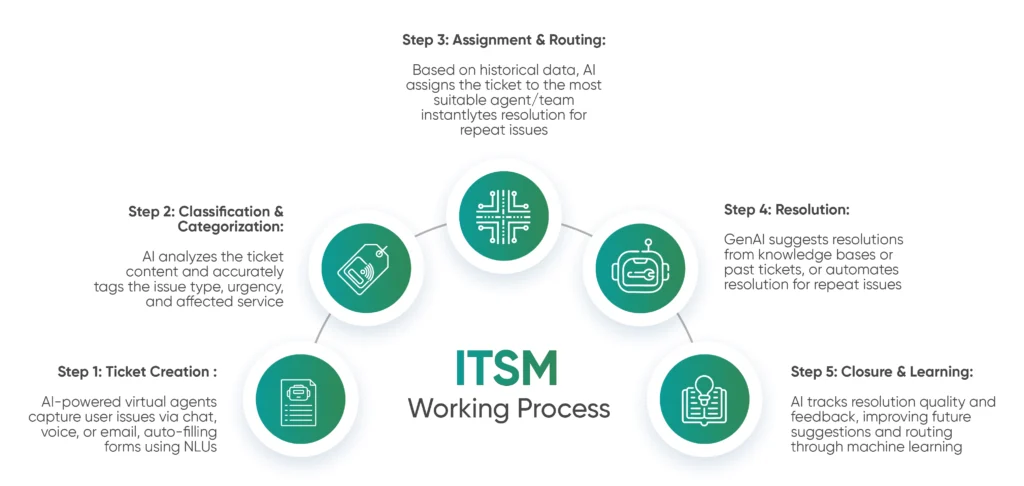
But it doesn’t stop there—AI integration takes this system to a new level. ServiceNow’s intelligent ticketing capabilities leverage virtual agents to instantly resolve common requests, use machine learning for smart categorization, and apply predictive analytics to prevent repeat incidents.
With a user-friendly interface, tickets are submitted via a portal, email, or even a chatbot. Behind the scenes, the platform captures essential details, prioritizes based on urgency, and automatically routes requests to the right support team—accelerating resolution time without manual overhead.
Throughout the lifecycle—from creation to closure—ServiceNow enables seamless collaboration providing real-time updates and access to resolution knowledge. This not only boosts IT efficiency but also enhances the end-user experience. End result? Faster fixes, happier employees, and an IT function that actively drives business value.
Difference Between Ticketing Software and ServiceNow ITSM
Traditional ticketing software handles routine IT issues, but the modern, tech-driven business environment demands more than just reactive support. That’s where ServiceNow ITSM comes in—an intelligent, end-to-end platform built to optimize, automate, and enhance every aspect of IT service delivery. Here’s how it rises above basic ticketing tools:
| Feature | Traditional Ticketing Software | ServiceNow ITSM |
| Core Functionality | Basic issue tracking and ticket resolution | End-to-end IT service management with intelligent workflows |
| Automation Capabilities | Limited rule-based automation | Advanced AI and ML-driven automation across the ticket lifecycle |
| Scalability | Suited for small teams or departments | Enterprise-grade, scalable across global organizations |
| Integration Ecosystem | Minimal or isolated integrations | Deep integrations across ITOM, ITAM, HR, CSM, DevOps, and more |
| User Experience | Often manual and reactive | Predictive, proactive, and personalized through AI and GenAI |
| Reporting & Analytics | Basic ticket reports | Real-time dashboards, KPIs, and performance insights |
| Customization | Limited configuration options | Highly customizable workflows, forms, and portals |
| Value to Business | Solves isolated issues | Aligns IT with business goals and drives strategic value |
Business Value of ServiceNow ITSM
As businesses advance on their digital journey, syncing ITSM with strategic goals becomes a key priority. It’s no longer just about managing IT incidents—it’s about delivering measurable value, improving agility, and supporting enterprise-wide goals. It all comes down to adopting smarter practices, scaling automation, and empowering teams with the right tools and knowledge.
- Prioritize High-Value ITSM Practices: Start by refining practices that offer the most operational value, using ITIL as a guiding framework.
- Automate at Every Step: Embrace automation to simplify complex IT environments and boost efficiency.
- Expand Beyond IT: Scale ITSM into enterprise service management begin with departments like HR or facilities to maximize impact.
- Understand Total Cost of Ownership (TCO): Evaluate all cost factors—including infrastructure, licensing, and maintenance—against long-term efficiency gains.
- Track and Optimize Performance: Set clear metrics, monitor outcomes, and make continuous improvements to service delivery.
- Invest in Knowledge Management: Build a centralized system to capture and share knowledge that supports AI and self-service tools.
- Upskill Your Teams: Provide training on new technologies, especially AI, to ensure staff adapt and thrive in a digital-first culture.
Best Practices to Follow While Implementing ServiceNow ITSM
Implementing ServiceNow ITSM goes beyond deploying a tool—it’s a tactical transition in how your organization manages and delivers IT services. Consider these proven best practices:
- Start with Clear Objectives: Define what success looks like. Whether it’s faster ticket resolution or better user experience, align ITSM goals with your business vision.
- Adopt a Phased Approach: Don’t try to do everything at once. Begin with high-impact modules like incident, change, or problem management and expand as your maturity grows.
- Customize with Caution: Tailor the platform to your needs, but avoid over-customization. Stick to configurations that are scalable and easy to maintain.
- Focus on user experience: A clean, intuitive interface drives adoption. Design portals and workflows that are simple for both end-users and agents.
- Promote automation and self-service: Use AI and knowledge bases to empower users and reduce ticket volumes.
- Train and communicate: Equip your teams with proper training and keep stakeholders informed throughout the implementation journey.
- Measure, learn, improve: Track KPIs like resolution time, user satisfaction, and service availability to identify gaps and continuously refine your ITSM strategy.
Essential IT Service Management Metrics to Track
Tracking the right ITSM metrics helps you move from reactive to proactive service delivery. These metrics not only provide insights on IT team performance but also highlight user satisfaction and areas of improvement. Looking to enhance efficiency, cut downtime, or elevate employee experience? Let these KPIs steer your efforts.
Here are the most essential ITSM metrics every organization should monitor:
- Number of Incidents: Helps assess the volume and trend of unplanned disruptions. A sudden spike could indicate deeper issues.
- Number of Service Requests: Tracks standard user needs like access, setups, or information—great for planning resources and improving self-service options.
- Employee/Customer Satisfaction Score (CSAT): Measures how satisfied users are with the support received—direct feedback that shapes service improvements.
- First Contact Resolution Rate: Shows the percentage of issues resolved on the first interaction—a strong indicator of support efficiency.
- Average Incident Resolution Time: The shorter, the better. This measures how quickly your team resolves issues, affecting user productivity.
- Net Promoter Score (NPS): Gauges user loyalty and willingness to recommend IT services—a high NPS reflects trust and quality.
- SLA Breach Rate: Tracks how often service level agreements are missed. High breach rates can damage credibility and user trust.
- Service Availability: Reflects system uptime—critical for ensuring business continuity and user confidence in IT.
Monitoring these metrics regularly empowers your IT team to make data-driven decisions, improve service delivery, and contribute measurable business value.
Fueling Smarter IT with Aelum and ServiceNow ITSM
The future of IT isn’t just digital – it is intelligent, agile, and user-first. ServiceNow ITSM is leading the way, transitioning from a traditional service desk into a smart, connected ecosystem, elevating both employee and customer experiences.
At Aelum, we do more than implementation—we optimize workflows, transform your experiences, and help you evolve. As a Premier ServiceNow partner, we bring deep expertise, agile execution, and a user-first mindset to every transformation journey. Be it replacing legacy systems or growing service delivery across your enterprise, Aelum’s ServiceNow implementation expertise makes your business adaptive, secure, and even a little fun. Together, we create IT experiences that inspire happier employees and deliver measurable business impact.
Let’s evolve, together.