Meeting customer expectations today takes more than operational speed, it requires a connected ecosystem where every interaction, from purchase to support, feels effortless. That’s where a CRM becomes essential, helping you unify data, channels, and operations to deliver seamless, context-rich experiences.
People often ask, ‘Is ServiceNow really a CRM?’ The answer is yes. While it started as a platform for ITSM and ITOM, ServiceNow expanded in early 2025 to offer comprehensive CRM capabilities, covering end-to-end service delivery, AI-driven automation, and unified processes to improve customer experience and business operations.
With its advanced ServiceNow CRM capabilities, the platform goes beyond traditional CRMs by connecting sales, service, and fulfillment on a single workflow-driven foundation. From intelligent case routing and predictive insights to proactive support, it helps businesses deliver seamless, efficient, and personalized customer experiences.
Let’s explore the key ServiceNow CRM features that help businesses like yours turn every customer interaction into a moment of delight.
ServiceNow CRM Explained
The ServiceNow CRM platform is more than a place to store customer data; it’s built to move work forward. It connects front-end channels with back-end operations, ensuring every customer interaction is supported by seamless workflows across the business. No matter if you’re leading sales, marketing, or customer success, it brings your teams together on one platform to act faster, smarter, and in sync. With AI-driven processes and real-time visibility, ServiceNow helps you deliver consistent, proactive, and personalized experiences, right when your customers need them most.
Kickstart Your ServiceNow CRM Implementation Today
Is ServiceNow a CRM or an ERP?
ServiceNow is neither a traditional CRM nor a traditional ERP. It is an AI-powered workflow platform that includes modern CRM capabilities while connecting seamlessly with ERP systems.
Unlike conventional CRMs that primarily manage customer data and sales pipelines, ServiceNow CRM orchestrates customer-facing processes across sales, service, fulfillment, and support. At the same time, it integrates with ERP platforms to connect front-office experiences with back-office operations.
In simple terms, CRM manages customer relationships, ERP manages business resources, and ServiceNow helps both work together through unified workflows and automation.
What Makes ServiceNow CRM Different?
- One connected customer ecosystem bringing sales, service, fulfillment, and operations together on a single platform.
- Workflows that move work forward by eliminating silos, reducing manual effort, and accelerating outcomes.
- Built for industry complexity with capabilities tailored to unique products, services, and customer journeys.
- Frictionless digital experiences through self-service, commerce capabilities, and integrated customer engagement channels.
- AI woven into every interaction with intelligent insights that enhance productivity and personalize customer experiences.
ServiceNow CRM moves beyond traditional systems of record, turning customer interactions into connected, intelligent workflows that drive meaningful outcomes.
What’s New in ServiceNow CRM: Recent Innovations and Updates
ServiceNow’s biggest CRM leap yet, unveiled at Knowledge 2026 in Las Vegas:
1. Autonomous CRM
A full vision spanning sales, service, quoting, order fulfillment, invoice disputes, renewals, and customer lifecycle management, shifting CRM from logging work after the fact to completing work in real time.
2. CRM AI Specialists
Role-based AI agents that qualify sales leads, generate quotes, resolve invoice disputes, handle renewals, and triage customer contacts, storing intent, sentiment, and resolution context throughout.
3. ServiceNow Otto
A multimodal interface that converts user intent into completed enterprise work, spanning talk, chat, and browse, orchestrating tasks across the business.
4. Action Fabric
Opens the ServiceNow AI platform to run headless, enabling any AI agent connected via Model Context Protocol (MCP) to execute governed workflows on the platform.
5. AI Included in All Licenses
AI capabilities are now bundled across ServiceNow’s entire product portfolio, meaning every existing customer already has access; the question is whether your operations are connected enough to activate them.
From Static to Smart: ServiceNow vs. Traditional CRM
Traditional CRMs have often failed to create better customer experiences. They track data but don’t drive work forward. ServiceNow changes that. While conventional CRMs mainly support sales, ServiceNow unites sales, service, and product fulfillment on a single platform. It transforms disconnected tasks into seamless approaches, shifting the focus from managing tools to delivering meaningful customer outcomes.
Why Traditional CRMs Fall Short – and How ServiceNow CRM Raises the Bar
| Challenge | Traditional CRM | ServiceNow CRM |
| Service Delivery Gaps | Most CRMs stop at sales and lead management, offering limited tools for post-sale service and customer support. | ServiceNow goes further, enabling seamless service delivery, from order tracking to issue resolution, within a unified system. |
| Fragmented Customer Data | Disconnected systems lead to siloed information, making it difficult to get a complete customer view. | ServiceNow unifies data across departments by integrating with core enterprise platforms like ERP and ITSM, offering a single source of truth. |
| Limited Intelligence and Automation | Traditional CRMs often require manual input, and their AI capabilities are basic at best. | ServiceNow leverages AI for smart case routing, predictive insights, and self-service options. With Autonomous CRM, AI specialists can autonomously resolve cases, generate quotes, and handle renewals end-to-end with minimal human intervention. |
| Poor Handling of Complex Customer Needs | Resolving multi-layered service issues or managing interactions across channels can overwhelm legacy systems. | ServiceNow streamlines these operations with built-in orchestration, virtual agents, AI specialists, and tools designed to handle complexity at scale. |
| Scalability and Omnichannel Limitations | As customer expectations rise, scaling consistent service across channels becomes tough. | ServiceNow adapts effortlessly, supporting high volumes and omnichannel engagement, with AI specialists that operate autonomously across every customer-facing function. |
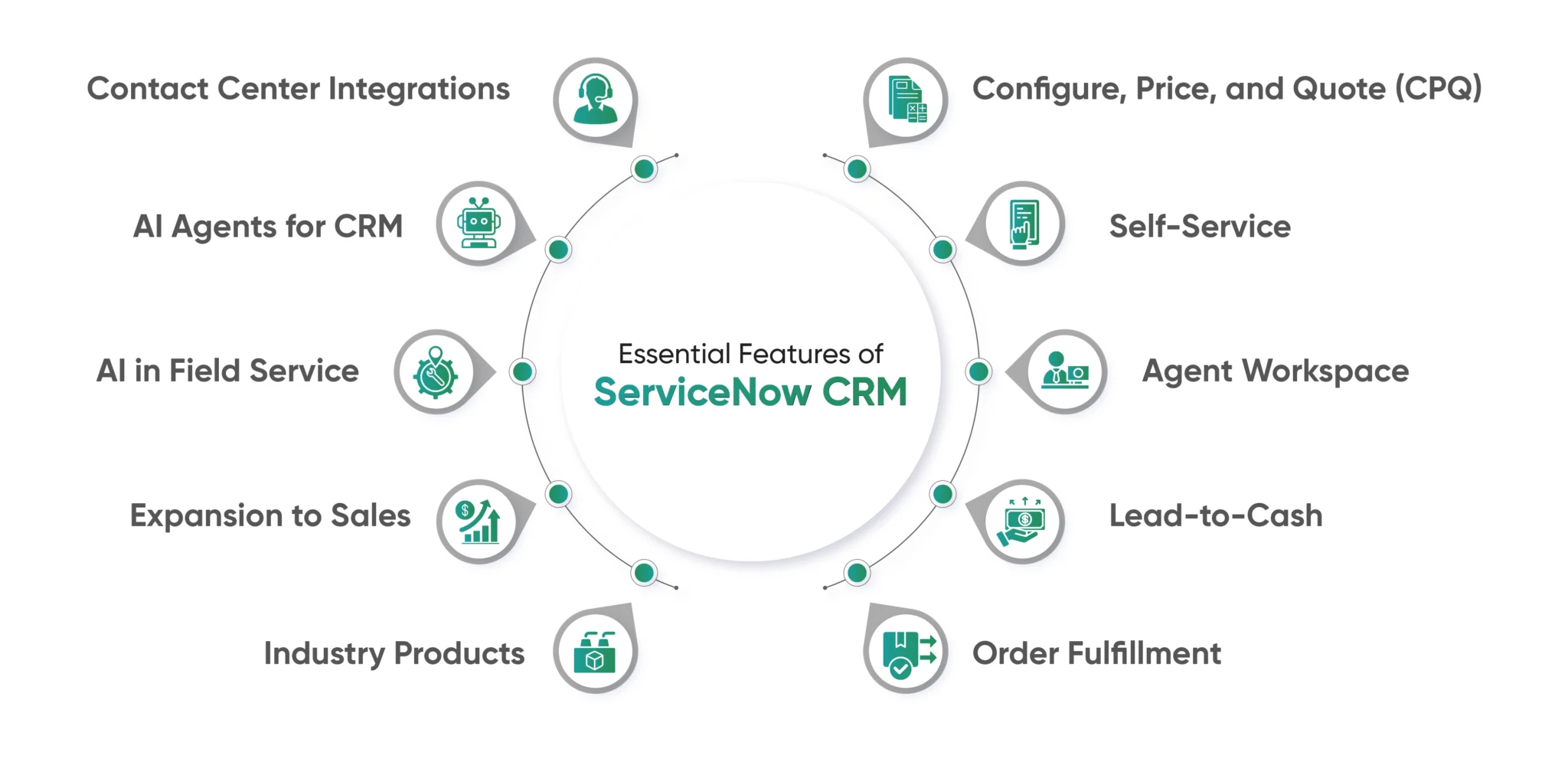
10 Essential Features You Need to Know About ServiceNow AI-Powered CRM
The role of CRM has expanded past basic contact management. It now focuses on how workstream across the entire business drive better outcomes. ServiceNow redefines CRM by focusing on results, not only interactions. The platform orchestrates intelligent task lifecycle, powering automation, and driving seamless experiences across departments.
Discover ten impactful ServiceNow CRM features that are transforming customer engagement and service delivery:
 1. Contact Center Integrations
Integrate voice, messaging, chat, and email into a unified workspace that gives agents complete visibility. No more jumping across systems ServiceNow brings everything into one streamlined view, helping agents resolve issues faster and more accurately.
2. AI Agents for CRM
Let intelligent AI agents handle routine tasks autonomously from answering common queries to updating records. These AI agents scale support operations, reduce response time, and free human agents for higher-value work.
3. AI in Field Service
With predictive intelligence and real-time insights, ServiceNow improves field technician dispatching, inventory tracking, and issue resolution. AI ensures the right person, with the right part, shows up at the right time, every time.
4. Expansion to Sales
Extend the power of ServiceNow beyond service into sales by streamlining opportunity management, automating approvals, and connecting teams across the sales cycle. Say goodbye to siloed pipelines and hello to connected selling.
5. Configure, Price, and Quote (CPQ)
Accelerate the quoting process with guided selling tools, automated pricing logic, and seamless integration into downstream fulfillment. ServiceNow CPQ helps reduce errors and shortens the lead-to-cash cycle.
6. Industry Products
ServiceNow offers pre-built procedures tailored to industries like telecom, manufacturing, financial services, and healthcare. These built-in features help organizations get started quickly, delivering value faster with less setup work.
7. Self-Service
Empower customers to help themselves through AI-powered knowledge bases, virtual agents, and guided help journeys. ServiceNow makes true self-service possible, deflecting tickets while improving customer satisfaction.
8. Agent Workspace
Agents get a unified workspace with context-driven views, smart recommendations, and real-time insights. This helps them prioritize tasks, collaborate better, and resolve cases faster, without relying on tribal knowledge or sticky notes.
9. Lead-to-Cash
Unify the customer journey from lead capture to revenue recognition. ServiceNow aligns marketing, sales, fulfillment, and finance teams on a single workflow platform, removing silos and accelerating the revenue cycle.
10. Order Fulfillment
Ensure seamless handoffs between sales, service, and operations. ServiceNow automates complex fulfillment processes, tracks order statuses in real-time, and reduces friction between departments.
Begin Your ServiceNow CRM Journey with Aelum – A Proven Implementation Partner
Customer expectations are evolving, and so are the platforms that power them. ServiceNow CRM represents a shift from managing customer data to driving customer outcomes, connecting people, processes, and AI on a single platform.
The opportunity is no longer just to improve customer experiences, but to transform how work gets done across the enterprise.
Whether you’re exploring ServiceNow CRM, modernizing legacy CRM investments, or building an AI-first customer engagement strategy, Aelum can help you move forward with confidence.
Ready to see what’s possible with ServiceNow CRM? Connect with our experts today.
Transform customer experiences with a seamless ServiceNow CRM Implementation