A few years ago, a two-day loan approval was considered fast. Today, customers expect approvals within minutes and often abandon applications that take longer. This shift highlights how rapidly expectations in financial services have evolved.
Competition in financial services has also shifted. Institutions are now judged against seamless digital experiences, raising expectations for speed, personalization, and convenience.
At the same time, many traditional institutions continue to operate with legacy core systems, fragmented data environments, and processes that were not built for today’s pace of innovation. The result is a widening gap between customer expectations and the capabilities of many financial systems.
For financial institutions, the conversation has moved beyond modernization. It is now about how quickly they can adapt, how well they can execute, and how effectively their technology investments deliver business outcomes.
This blog explores how technology solutions for financial services are shaping this transformation. It covers the key challenges institutions are navigating, and the areas where technology investments are creating the most impact in building faster, smarter, and future-ready operations.
Key Challenges in Adopting Technology Solutions for Financial Services
To understand where financial services are headed, it is important to look at the key pressures shaping the industry today. These challenges are not isolated and are increasingly interconnected across banks and fintechs. Together, they are defining how institutions approach modernization and technology investment.
1. Legacy Core Systems vs. Scalable Digital Architecture
Traditional banks continue to rely on legacy core banking systems that are stable but rigid, making real-time integration, API adoption, and rapid innovation difficult.
Fintechs, on the other hand, are often built on modern architectures but face challenges when scaling these systems across markets, products, and enterprise-level workloads.
Result: Banks struggle with agility, while fintechs struggle with scalability and long-term system resilience.
2. Security Risks Amplified by AI-Driven Threats
Banks deal with highly targeted attacks on critical infrastructure, where outdated systems make threat detection slower and more complex.
Fintechs operate in highly digital ecosystems, making them more exposed to API vulnerabilities, fraud automation, and AI-powered phishing and identity attacks.
Result: Both face rising cybersecurity costs, but attack surfaces differ; core systems vs. distributed digital layers.
3. Regulatory Complexity and Continuous Compliance Pressure
Banks operate under strict, long-established regulatory frameworks (KYC, AML, data localization), making system updates slow and heavily controlled.
Fintechs, especially in cross-border or embedded finance, struggle with evolving and inconsistent regulations across regions, often needing to adapt compliance frameworks on the fly.
Result: Banks face rigidity; fintechs face fragmentation and unpredictability.
4. Data Silos vs. Data Overload Without Structure
Banks typically suffer from deeply entrenched data silos across departments and legacy systems, limiting real-time insights and personalization.
Fintechs, while more data-rich, often struggle with unstructured, high-velocity data that lacks governance and standardization for enterprise decision-making.
Result: Banks lack accessibility; fintechs struggle with data maturity and control.
5. Talent Shortage in Cloud, AI, and Modern Engineering Skills
Banks face difficulty attracting and retaining digital-native talent due to legacy environments and slower innovation cycles.
Fintechs compete aggressively for the same talent pool but face high attrition rates and rising costs as demand for AI, cloud, and cybersecurity skills increases.
Result: Both struggle, not with availability of tech, but with sustained expertise.
6. Scaling Innovation While Maintaining Stability
Banks often struggle to balance modernization with operational stability, where downtime risks are extremely high and experimentation is limited.
Fintechs prioritize speed and innovation but often face challenges in maintaining reliability, uptime, and enterprise-grade stability as they scale.
Result: Banks are stable but slow; fintechs are fast but operationally fragile.
How Financial Institutions Are Investing in IT Solutions in 2026
Financial institutions are moving beyond traditional modernization and making targeted investments to build more agile, data-driven, and connected ecosystems. As priorities shift from incremental upgrades to long-term transformation, these investment areas are emerging as critical to staying competitive in a rapidly evolving financial landscape.
1. Core System Modernization
Financial institutions are modernizing their core systems to enable faster innovation, seamless integration, and greater operational agility. As digital ecosystems become more complex, traditional core infrastructures are becoming a key barrier to growth.
Banks: Banks are focused on modernizing or gradually replacing core banking platforms that limit real-time processing and slow down the launch of new products.
Fintechs: Fintechs are building modular, cloud-native architectures that support rapid scaling, product experimentation, and seamless connectivity with external ecosystems.
2. Data Platforms and Real-Time Intelligence
Unified data platforms are essential for eliminating silos, enabling real-time insights, and supporting personalized customer experiences. Data maturity is now a key differentiator in financial services.
Banks: Banks are focused on consolidating fragmented data across multiple systems to improve visibility, reporting accuracy, and decision-making.
Fintechs: Fintechs manage high-velocity, high-volume data and are investing in structuring and governing it effectively to improve analytics, personalization, and risk management.
3. AI, Automation, and Intelligent Operations
AI and automation are reshaping financial operations by improving efficiency, reducing manual effort, and enabling faster, data-driven decision-making across workflows.
Banks: Banks are using AI and automation to streamline process-heavy operations such as approvals, compliance checks, and customer service.
Fintechs: Fintechs are embedding AI directly into product design, fraud detection, customer engagement, and risk models to drive innovation and differentiation.
4. Cybersecurity and Digital Trust
With increasing digital exposure and evolving threat landscapes, cybersecurity and resilience have become top priorities for financial institutions. Ensuring continuous operations is now critical.
Banks: Banks are strengthening security across core infrastructure and enterprise environments to protect sensitive financial data and maintain regulatory compliance.
Fintechs: Fintechs focus on securing distributed architectures, digital interfaces, and external integrations that power their customer-facing platforms.
5. Regulatory Technology and Compliance Automation
Rising regulatory complexity across regions is pushing institutions to adopt automation for compliance, reporting, and risk management. Agility in compliance is now a competitive advantage.
Banks: Banks leverage RegTech solutions to manage large-scale compliance requirements such as AML, KYC, and audit reporting across multiple jurisdictions.
Fintechs: Fintechs use compliance automation to adapt quickly to evolving regulations across markets, especially in cross-border and embedded finance models.
6. Platform-Based Ecosystems and API-Driven Integration
Modern financial institutions are investing in platform-based architectures and API ecosystems to enable seamless connectivity across systems, partners, and digital services. Integration is no longer just a technical requirement but a foundation for scalability and innovation.
Banks: Banks are adopting API-led architectures to connect internal systems with modern applications, enabling faster collaboration across functions and partners.
Fintechs: Fintechs are expanding their API ecosystems to build partner-driven models, while strengthening governance and reliability to reduce external dependency risks.
The Business Impact of Modern IT Solutions in Financial Services
In financial services, the value of IT investments is now defined by the business outcomes they drive rather than implementation alone. As institutions move from isolated upgrades to integrated digital ecosystems, the impact is becoming visible across operations, customer experience, and growth.
1. Faster Time-to-Market
Modern architectures and automation enable institutions to launch new products and services faster, helping both banks and fintechs respond quickly to changing customer needs and market opportunities.
2. Operational Efficiency at Scale
Automation and streamlined workflows reduce manual effort, improve process consistency, and lower operational costs, allowing institutions to scale without proportional increases in overhead.
3. Experience-Led Growth
With access to real-time data and connected systems, financial institutions can deliver more personalized, seamless, and omnichannel experiences that drive customer satisfaction and retention.
4. Stronger Risk and Compliance Posture
Advanced analytics, automation, and compliance technologies improve visibility and control, helping institutions proactively manage risks and meet evolving regulatory requirements more efficiently.
5. New Revenue Streams and Business Models
Platform-based ecosystems and API-driven innovation are enabling institutions to explore new revenue opportunities through partnerships, embedded finance, and digital-first offerings.
Redefine Financial Services with Connected, Intelligent Workflows
ServiceNow for Financial Services as a Modern IT Solution
ServiceNow has emerged as a leading, AI-powered platform for financial institutions looking to unify operations and accelerate digital transformation. By bringing together workflows, data, and systems on a single platform, it enables banks and fintechs to move from fragmented processes to more streamlined, intelligent, and scalable operations.
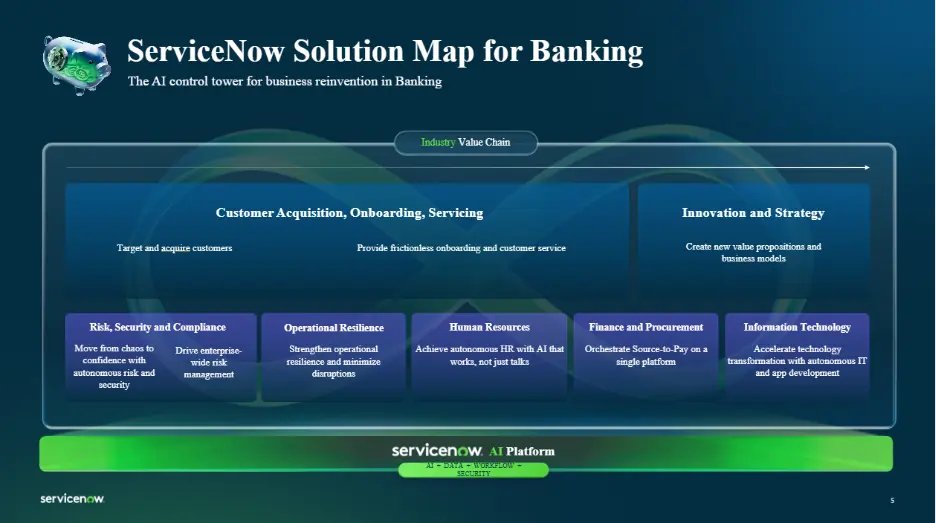
Core Capabilities Powering Modern Financial Services
1. Financial Services Operations (FSO)
ServiceNow Financial Services Operations (FSO) enables financial institutions to transform and scale core operations such as onboarding, loan servicing, and customer request management. By digitizing and standardizing high-volume processes, it drives greater visibility, reduces manual dependencies, and significantly improves turnaround times, helping banks streamline complex, large-scale operations while enabling fintechs to scale customer processes rapidly with consistency and control.
2. IT Service Management and IT Operations Management
ServiceNow IT Service Management (ITSM) and IT Operations Management (ITOM) provide the foundation for resilient, high-performing IT environments. They empower institutions to modernize IT operations, proactively manage incidents, and minimize downtime, ensuring consistent service delivery across large, interconnected banking systems as well as fast-moving, cloud-native fintech environments. AI capabilities such as predictive intelligence, anomaly detection, and automated remediation help teams identify issues faster, reduce disruptions, and maintain business-critical service continuity.
3. CSM and Employee Center
ServiceNow Customer Service Management (CSM) and Employee Center enable institutions to deliver seamless, omnichannel experiences across both customer and employee journeys. By connecting front-office and back-office workflows, they accelerate resolution times, improve service quality, and enhance overall engagement, allowing banks to unify customer interactions across channels and fintechs to deliver faster, more responsive digital-first experiences. Embedded AI capabilities such as intelligent routing, virtual agents, and predictive insights help financial institutions resolve issues faster, personalize service, and improve operational efficiency at scale.
4. Governance, Risk & Compliance (GRC)
ServiceNow GRC/IRM enables financial institutions to strengthen governance, proactively manage enterprise risk, and streamline compliance and audit processes at scale. It provides end-to-end visibility across risk environments, supports faster regulatory response, and helps banks navigate complex compliance mandates while enabling fintechs to adapt quickly to evolving regulatory frameworks across markets.
5. Change Management
ServiceNow Change Management ensures that technology and process changes are executed in a controlled, structured, and risk-aware manner. It allows institutions to accelerate innovation while maintaining stability, reducing the likelihood of disruptions and ensuring compliance with regulatory standards, enabling banks to modernize critical systems safely and fintechs to scale innovation without compromising reliability.
The New Blueprint for Financial Excellence
Financial services is entering a phase where the institutions that lead will be the ones building connected, intelligent operations today, creating the agility, resilience, and clarity needed to stay ahead tomorrow.
Delivering on this vision requires more than intent; it takes the right execution approach, aligned workflows, and a platform that brings everything together seamlessly.
Aelum brings deep expertise in financial services and the ServiceNow ecosystem to help you get there. From strategy to execution, we help you bring transformation to life, aligning systems, accelerating outcomes, and building operations that are ready for what’s next.
The pace of change in financial services is only accelerating; your operations need to be ready for what’s ahead. Work with our financial services experts to shape your next phase of smarter, more resilient operations.