Your attack surface is growing by the day. But how much of it can you actually see?
Every laptop, service, medical device, industrial system, IoT device, cloud workload, and piece of code adds to an enterprise’s cyber exposure. The challenge is no longer simply finding vulnerabilities. It is understanding what is connected, what is exposed, what is at risk, and where to focus first.
This is where cybersecurity asset management becomes critical. It gives security teams the visibility and context they need to understand their attack surface, connect assets to potential exposure, and make more informed decisions about risk.
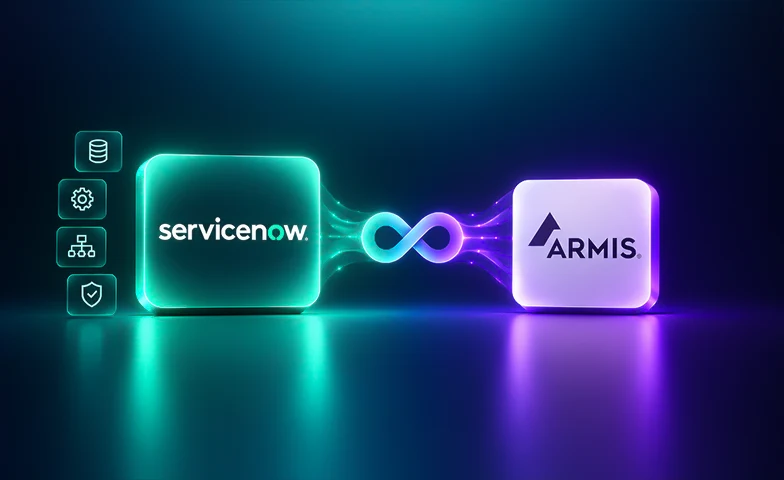
And now, there’s another development that makes this shift even more relevant. ServiceNow completed its acquisition of Armis in April 2026, bringing Armis’ real-time cyber asset discovery and cyber exposure management capabilities into the ServiceNow ecosystem. Together, the technologies connect asset intelligence with business context and automated workflows, helping enterprises move from knowing what is exposed to taking action on it.
So, what does modern cybersecurity asset management look like, and how can ServiceNow and Armis help enterprises gain greater visibility, prioritize risk, and act on it? This guide breaks it down.
What is Cybersecurity Asset Management?
Cybersecurity asset management (CSAM) is the continuous practice of discovering, identifying, classifying, and monitoring assets across an organization’s attack surface. It connects asset data with vulnerabilities, exposure, ownership, and business criticality to give security teams a current, contextual view of their environment and help them prioritize risk based on what matters most.
The distinction becomes clear when you look at how the two approaches handle asset visibility and risk:
| Traditional Asset Management | Modern Cybersecurity Asset Management |
| Focuses on what assets exist | Focused on what exists, what it means, and what is exposed |
| Primarily inventory-driven | Continuously monitors the attack surface |
| Often relies on static or periodic records | Uses continuously updated asset intelligence |
| Tracks asset attributes | Correlates assets with vulnerabilities, exposure, ownership, and criticality |
| Often operates in functional silos | Connects asset intelligence across IT, OT, cloud, IoT, and other environments |
This broader view becomes increasingly important as enterprise environments extend beyond conventional IT into OT, IoT, cloud, medical devices, remote infrastructure, and other connected systems. The goal is simple: know what you have, understand its context, and prioritize what matters most.
The challenge is keeping that view complete, current, and connected as the attack surface continues to expand. This is where traditional asset visibility begins to fall short.
6 Challenges Traditional Asset Visibility Cannot Solve
Traditional asset visibility can create a false sense of completeness. The real gaps often surface when security teams need to verify, contextualize, and act on what they see.
1. Unknown & Unmanaged Assets: Traditional discovery methods tend to focus on known managed assets, leaving unmanaged endpoints, shadow IT, cloud resources, IoT devices, and other connected assets outside the security picture. An incomplete inventory means security teams may be assessing risk across only part of the attack surface.
2. Stale & Siloed Asset Data: Asset records can quickly become outdated when they depend on periodic scans, manual updates, or separate inventories maintained by different teams. Without continuous updates and reconciliation, security teams may be working with incomplete or conflicting views of the same environment.
3. Limited Asset Context: Knowing that an asset exists is only the starting point. Without context around ownership, configuration, connectivity, vulnerabilities, and business or operational criticality, security teams have limited ability to determine what an asset actually means from a risk perspective.
4. Gaps in OT Visibility: OT environments introduce assets, protocols, legacy systems, and operational constraints that conventional IT discovery and scanning approaches may not fully address. Maintaining comprehensive OT visibility is particularly challenging, as active scanning can create operational risks in sensitive environments, while passive approaches may miss devices that are not actively communicating.
5. Severity Without Risk Context: A vulnerability’s severity score alone does not tell a security team how urgently it should be addressed. Effective prioritization also requires factors such as asset criticality, business impact, exposure, and evidence of exploitation. CISA, for example, recommends using its Known Exploited Vulnerabilities catalog as an input to vulnerability-management prioritization rather than relying on severity alone.
6. Disconnected Security Data: When asset, vulnerability, exposure, and ownership data sit across different tools, teams often have to manually correlate findings before they can determine what needs attention and who should act. This slows the path from identifying a risk to understanding it and responding effectively.

The Benefits of Modern Cybersecurity Asset Management
Modern cybersecurity asset management brings intelligence into the security process, helping teams turn asset data into clearer decisions and more targeted action. Its value lies in how effectively it connects discovery, analysis, prioritization, and response.
1. Continuous Asset Discovery: Modern platforms continuously identify assets as they appear, change, or leave the environment, reducing the blind spots created by periodic discovery and manual inventory updates. This helps security teams maintain visibility as the attack surface evolves.
2. Unified Asset Inventory: Instead of relying on disconnected inventories across different tools and teams, modern asset management brings asset data into a more consolidated and current view. The result is a more reliable foundation for vulnerability management, configuration management, and other security activities.
3. Context-Rich Asset Intelligence: Asset visibility becomes more useful when identity is combined with ownership, configuration, vulnerabilities, connectivity, and business or operational importance. This context helps teams understand what an asset means in the environment and make better informed security decisions.
4. Risk-Based Prioritization: Modern platforms help security teams move beyond volume-based vulnerability management by putting findings in the context of the affected asset and its importance. This enables teams to focus attention on the assets and exposures with greater potential impact rather than treating every finding equally.
5. IT, OT & IoT Visibility: Modern asset management extends beyond IT into OT and IoT, where legacy systems, diverse protocols, distributed assets, and operational constraints can make continuous visibility challenging. The National Institute of Standards and Technology (NIST) identifies comprehensive asset discovery and inventory as foundational to managing cybersecurity risk in OT environments.
6. Faster Risk-to-Action: The real value of asset intelligence comes when it can support action. By connecting asset, vulnerability, ownership, and risk information with existing security and IT workflows, teams can reduce the effort required to validate findings, identify responsibility, and move toward remediation.
Together, these capabilities turn asset management from a static record of what exists into a continuously useful source of security intelligence. That convergence of asset intelligence, security, and enterprise workflows takes on new significance with ServiceNow’s acquisition of Armis.
ServiceNow and Armis: Connecting Asset Intelligence to Action
On April 20, 2026, ServiceNow completed its acquisition of Armis, bringing Armis’ real-time cyber asset discovery and cyber exposure management capabilities into the ServiceNow AI Platform. Armis provides visibility and security intelligence across the full enterprise attack surface, while ServiceNow brings the enterprise context, security processes, AI, and workflows needed to act on that intelligence.
The significance lies in connecting what security teams know with what they can do about it. Armis can continuously identify assets, surface exposures, and prioritize risk. ServiceNow can connect those findings to asset records, ownership, business context, security operations, and remediation workflows. Together, this creates a more connected path from asset discovery to risk prioritization to action.
What this means in practice
A more complete asset picture
Armis extends visibility across conventional and non-traditional asset classes, while ServiceNow adds enterprise context such as ownership, business services, and operational relationships. A device or exposure can therefore be understood as part of the wider environment, rather than as an isolated security finding.
A shorter path from finding to action
Security findings can feed into ServiceNow workflows for investigation, assignment, remediation, and tracking. This reduces the manual effort involved in correlating findings, identifying owners, and determining the next step, while keeping remediation within governed enterprise processes.
One connected approach across IT and OT
The combination becomes particularly relevant as risk increasingly spans complex, distributed, and interconnected environments. Armis provides the asset intelligence across these environments; ServiceNow connects that intelligence to the workflows and controls used to manage security at enterprise scale.
Ultimately, the value is not simply seeing more assets. It is being able to identify the asset, understand its exposure and business context, prioritize the risk, and move the right action through the right workflow.
Put Cyber Asset Intelligence to Work with ServiceNow & Armis
Cybersecurity asset management is moving beyond inventory to become a strategic layer for security decision-making. With Armis bringing real-time asset intelligence and ServiceNow connecting it to enterprise workflows, organizations can build a more coordinated path from risk visibility to action.
Aelum brings 10+ years of ServiceNow experience, with expertise across security, risk, workflow transformation, and enterprise implementations. Our team helps organizations translate ServiceNow capabilities into practical, scalable outcomes across complex environments.
Talk to our experts to see how ServiceNow and Armis can strengthen your security operations.