Somewhere right now, an insurer is quoting a policy in under 60 seconds. Another is settling a claim without a single human touchpoint. The transformation is already happening; the only question is, how well are you keeping up?
From automated underwriting and real-time risk scoring to self-service policyholder portals and AI-driven claims adjudication, insurers today have the tools to move faster, price smarter, and serve better. Digital transformation gives you measurable efficiency gains, reduced loss ratios, faster time-to-market for new products, and a customer experience that matches modern expectations.
But legacy core systems, data silos, regulatory complexity, and rising cyber threats create friction for businesses aiming to modernize. So, how to achieve digital transformation in insurance without disrupting the business you’re trying to grow?
What is Digital Transformation in Insurance
Digital transformation in insurance involves embedding modern technology, AI, and automation across every layer of your operations: from distribution and underwriting to claims and customer service. And AI-powered underwriting systems can process applications 70% faster while maintaining or improving accuracy. This means moving away from rigid, decades-old policy administration systems toward flexible, cloud-based platforms that connect data, teams, and processes in real time.
Examples of digital transformation in insurance:
Automated underwriting, straight-through claims processes, policyholder self-service portals, predictive analytics, API-led core system integration.
Digitization vs Digital Transformation in Insurance
While digitization in insurance means converting paper records and manual processes into digital formats, digital transformation goes further by embedding AI, automation, and connected platforms across every business function to innovate insurance operations.
Benefits of Digital Transformation in Insurance
For insurance leaders evaluating where to invest, the benefits of digital insurance span every function from the claims floor to the boardroom. Let’s have a look.
- Service Excellence: Policyholders get self-service access, faster resolutions, and personalized interactions, driving up to 75% rise in self-service adoption and long-term loyalty.
- Product Agility: CIOs use real-time data pipelines to accelerate product launches, helping carriers outpace InsurTech competitors and respond faster to market shifts.
- Workforce Productivity: Automation eliminates manual bottlenecks, enabling claims and ops teams to manage 400+ cases monthly while staff focus on high-value work.
- Improved Visibility: CEOs and VPs gain live visibility into claims trends and customer behavior, cutting unfavorable customer experiences within just a few months. You thereby make smarter and enhanced decision-making.
- Regulatory Compliance: Automated audit trails and structured data governance help compliance officers reduce regulatory exposure and improve data compliance scores by 60%.
Where Automation Makes the Biggest Difference in Insurance
Digital transformation sounds strategic at the leadership level. But on the ground, it comes down to fixing very specific, costly operational problems that carriers have lived with for years. Let’s have a look at some challenges that automation addresses most effectively.
1. Duplicate Data Entry Across Platforms
Challenge: The same claim data gets manually entered across 3-4 systems: FNOL, claims admin, payment, and compliance, making every re-entry a fraud and error risk.
What Automation Does: Integration-led automation eliminates duplicate data entry by connecting all core systems, ensuring data entered once flows automatically across every platform.
2. No Visibility into Adjuster Workflows
Challenge: Adjusters informally hold onto claims beyond SLAs with no real-time visibility into individual workloads, making it nearly impossible for managers to intervene on time.
What Automation Does: Automated assignment rules, real-time workload dashboards, and SLA breach escalations give COOs full visibility and control over adjuster queues.
3. Untracked Underwriting Referrals
Challenge: When underwriters refer a risk for specialist review, it disappears into email chains with no tracking, no SLA, and no status visibility for the broker waiting on the other end.
What Automation Does: Automated referral workflows route, assign, and track every referral in real time with broker-facing status updates, eliminating the need for chasing emails entirely.
4. Late Identification of Subrogation Cases
Challenge: Carriers lose millions annually because subrogation opportunities, recovering costs from liable third parties, are identified too late or missed entirely during claims handling.
What Automation Does: Automated triggers flag subrogation potential at the moment a claim is filed, ensuring recovery opportunities are never missed and are acted on immediately.
5. Tracking Agent Licensing Across States
Challenge: Verifying that every agent is licensed in the correct state for the correct line of business, and that no license has lapsed, is a compliance disaster when done manually across thousands of producers.
What Automation Does: Automated onboarding workflows continuously monitor producer license statuses, trigger renewal reminders, and restrict access automatically when licenses expire.
6. Missed Regulatory Complaint Deadlines
Challenge: Most state regulators require insurers to acknowledge and respond to complaints within strict timeframes, with missed deadlines triggering direct regulatory penalties.
What Automation Does: Automated complaint logging, assignment, and escalation alerts ensure no complaint sits unacknowledged past its regulatory deadline across every channel and geography.
7. Adjuster Turnover Knowledge Loss
Challenge: When an experienced adjuster leaves, their claim-handling instincts, vendor relationships, and case-specific notes often walk out the door with them, leaving gaps that take months to recover.
What Automation Does: Structured automated case documentation and AI-assisted notes capture decisions and context throughout the claim lifecycle, keeping institutional knowledge in the system, not the individual.
How to Ensure You’re Using the Right Tech for Digital Transformation in Insurance
Investing in transformation is one decision. Investing in the right platform is another, and for insurance leaders, getting it wrong is expensive in both time and money.
Key questions every CIO, COO, and transformation lead should pressure-test before committing to a tech stack:
- Does it connect your core systems without replacing everything?
- Can it scale across claims, underwriting, compliance, and IT on one platform?
- Does it support regulatory compliance out of the box?
- How fast can you realistically go live?
- Does it have a clear AI and automation roadmap?
ServiceNow vs Salesforce vs Guidewire
ServiceNow, Salesforce, and Guidewire each solve part of the transformation puzzle. Here’s an honest look at where each platform leads, where it falls short, and why the answer depends on the scope of change you’re ready to take on.
| Dimension | ServiceNow | Salesforce | Guidewire |
| Primary focus | End-to-end operations workflow automation | CRM & distribution | Core P&C systems |
| Claims Management | Automates full claims lifecycle with AI triage | Routes claims data via Service Cloud, requires heavy integration | ClaimCenter, end-to-end claims management |
| Underwriting Support | Routes referrals, tracks tasks, automates underwriting workflows | Scores and distributes risk using AI, supports broker-facing submissions | Manages rating, quoting, and pricing natively through Underwriting Center |
| Policy Administration | Integrated with Guidewire, Duck Creek | Via Financial Services Cloud | Native PolicyCenter & InsuranceNow |
| AI & Automation | GenAI, Agentic AI, Virtual Agent across all workflows | Agentforce, Einstein AI | Predictive analytics, limited GenAI |
| Document Intelligence | Native extraction; AI reads, extracts & summarizes claim documents | Extracts document data through Einstein OCR via third-party integrations | Relies on Canvas analytics and partner tools; limited native extraction |
| Compliance & GRC | Native GRC mapped to NAIC, GDPR | Compliance features via integrations | Built-in audit trails but relies on partner tools for full GRC coverage |
| IT & Operational Resilience | ITSM, ITOM, proactive monitoring | Not a core capability, requires external tooling | Limited, relies on partner tools for monitoring |
| Field Service Management | FSM: CAT dispatch, optimizes routing, syncs field activity to claims | Through Salesforce Field Service with CRM integration | No native FSM capability, requires third-party tools |
| Legacy System Integration | Unifies data across legacy systems without replacing core infra | MuleSoft required for deep integration | API-first architecture supports integration but cloud migration is often required |
| CX | 24/7 virtual agent handles FNOL, billing, and policy queries without agent involvement | Serves policyholders through Experience Cloud portals and digital self-service | Relies on Jutro Digital Platform for CX but requires configuration and setup |
| Implementation Complexity | Modular, faster with a certified ServiceNow partner | Moderate, MuleSoft adds complexity | High complexity; core system replacement requires multi-year implementation programs |
The right choice depends on what problem you’re actually trying to solve. If you’re replacing a core system, Guidewire is purpose-built for that. If you’re modernising agent distribution and CX, Salesforce is strong. But if you’re trying to connect your entire operations: claims, compliance, IT, HR, and customer service, without a multi-year rip-and-replace, ServiceNow stands as the best-suited option.
Why 400+ Insurance Companies Choose ServiceNow for Digital Transformation
Insurance operations are complex by nature: disconnected systems, manual workflows, mounting regulatory pressure, and rising policyholder expectations all pulling in different directions.
ServiceNow brings these moving parts together on one connected platform, replacing fragmented point solutions with unified, automated workflows across claims, servicing, underwriting, and compliance.
Here’s how it delivers impact across your core functions:
Delivering a Connected, Transparent AI-Powered Claims Journey
- Role-based AI extracts summarize critical details from lengthy claim documents, boosting adjuster productivity
- Low-code tooling gives claims teams the speed and flexibility to adapt workflows without IT dependency
- Centralized claim data enables seamless handoffs between adjusters, minimizing errors and resolution delays
Simplifying & Personalizing Policyholder Servicing
- Self-service portals give policyholders 24/7 access to policies, claims, and billing, reducing operational costs
- AI matches policyholder tone and sentiment, enabling faster, more empathetic resolutions across every interaction
Strengthening Operational Resilience
- Integrated data across people, teams, and systems enables more accurate claims forecasting and premium-setting
- Automation and real-time monitoring keep critical insurance operations running through disruptions and peak periods
- A centralized control library aligned to regulatory frameworks simplifies compliance management across all geographies
Get a 90-day ServiceNow readiness roadmap built for your insurance operations
Core ServiceNow Modules for Insurance Operations
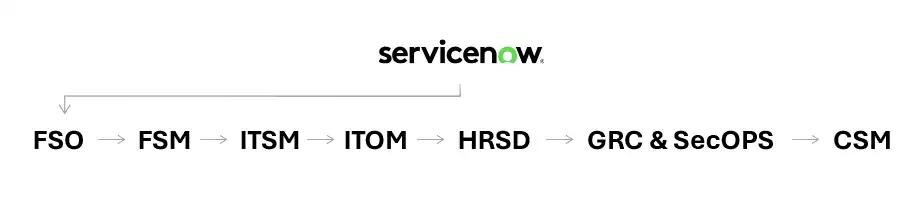
ServiceNow’s strength in insurance is the depth of its module ecosystem, each targeting a specific operational layer, from claims and field adjusting to IT resilience and regulatory compliance, working together on one connected platform.
ServiceNow Financial Service Operations (FSO)
ServiceNow FSO is the core insurance module, purpose-built to connect claims, underwriting, and policyholder servicing on a single platform. It gives carriers the workflows, integrations, and AI capabilities needed to reduce costs, accelerate resolutions, and improve retention without replacing existing core systems.
- Role-based AI automatically generates case summaries, extracting critical details from lengthy claim documents so adjusters focus on decisions.
- Purpose-built insurance workflows & out-of-the-box integrations with platforms like Guidewire, Duck Creek accelerate claims, servicing, underwriting processes from day 1.
- Custom workspaces for adjusters, underwriters, and service agents reduce errors and improve execution speed
Core Use Case: A carrier automates end-to-end claims intake and adjudication, reducing average claims cycle time and freeing adjusters from manual documentation.
ServiceNow Field Service Management (FSM)
For carriers managing loss adjusters, field inspectors, and third-party assessment crews, ServiceNow FSM brings scheduling, dispatch, and field visibility under one roof, replacing fragmented coordination with intelligent, automated workforce management.
- Automated scheduling and dispatching the right adjuster by location, availability, and expertise (critical during CAT events).
- Unified management of internal adjusters and third-party vendors gives operations teams one real-time view of all field resources.
- AI-driven process automation removes bottlenecks in field workflows, and ML-based recommendations continuously improve assignment accuracy & inspector productivity.
Core Use Case: Automated scheduling, dispatching, and tracking hundreds of field adjusters across regions following a major CAT event.
ServiceNow IT Service Management (ITSM)
Keeps the technology your claims, underwriting, and policy systems run on stable, supported, and available. ServiceNow ITSM manages incidents, change requests, and service requests across your IT environment, ensuring system downtime never becomes a claims handling crisis.
Core Use Case: Automates IT incident resolution workflows, ensuring core policy admin system outages are flagged, assigned, and resolved before business operations are impacted.
ServiceNow IT Operations Management (ITOM)
Gives IT and operations leaders real-time visibility into the health of critical insurance infrastructure. ServiceNow ITOM proactively monitors core systems: policy admin, billing, claims platforms, flagging issues before they impact adjusters, underwriters, or policyholders.
Core Use Case: IT team receives automated alerts when claims processing performance degrades, resolving infrastructure issues before SLA breaches occur.
ServiceNow HR Service Delivery (HRSD)
Streamlines HR operations for insurance workforces, from adjuster onboarding and licensing verification to benefits management and compliance training. ServiceNow HRSD reduces HR administration overhead while ensuring every employee has what they need to operate effectively.
Core Use Case: Automates new adjuster onboarding, reducing time-to-productivity by ensuring licensing, training, and system access are completed before day one.
ServiceNow Governance, Risk & Compliance (GRC) & Security Operations (SecOps)
Built for the regulatory complexity of insurance, ServiceNow GRC centralizes compliance controls, maps them to frameworks like NAIC and GDPR, and automates audit reporting across geographies. ServiceNow SecOps layers threat detection and vulnerability management on top, protecting sensitive policyholder data and keeping carriers ahead of cyber risk.
Core Use Case: Map new state compliance regulations against existing controls and generate audit-ready reports.
ServiceNow Customer Service Management (CSM)
Powers the policyholder-facing side of insurance operations. ServiceNow CSM connects customer inquiries, complaints, and service requests to back-office claims and policy workflows, giving service agents a complete view of every policyholder interaction and ensuring no complaint, renewal, or request falls through the cracks.
Core Use Case: Give service agents a complete view of claim history, coverage, and interactions to resolve policyholder disputes in one workspace.
Also Read:
ServiceNow AI Use Cases for Insurance
ServiceNow Agentic AI
- Automated triage and priority assignment of incoming claims
- Retrieves data from multiple sources to streamline underwriting
- Continuous monitoring for duplicate submissions and unusual billing patterns
- Seamless policy servicing with independent handling of routine tasks
- Intelligent real-time assistance for insurance agents and customer service teams
- Automated document intelligence, extraction, and processing
ServiceNow Now Assist
- Instantly summarizes lengthy claim documents for adjusters
- Generates first-draft responses to policyholder service requests
- Surfaces relevant policy and coverage details during live interactions
- Auto-populates case notes, reducing manual documentation time
- Recommends next best actions during claims and underwriting workflows
- Flags knowledge gaps and suggests resolution steps to agents
ServiceNow Virtual Agent
- 24/7 self-service for policy inquiries, billing, and renewals
- Guides policyholders through FNOL submission without agent involvement
- Handles endorsement requests and routes complex cases automatically
- Answers coverage questions instantly using policy documentation
- Escalates unresolved interactions to live agents with full context
- Reduces inbound call volume across servicing and claims teams
How Aelum Delivers Insurance Digital Transformation on ServiceNow
Digital transformation is an ongoing operational shift that touches every function, every team, and every system in your business. So, it becomes crucial to choose the right platform, define right workflows, and work with a partner that understands operational complexity of insurance from day one. And DT in your industry mostly falls short because of the gap between what a platform like ServiceNow can do and what your business actually implements, configures, and sustains.
At Aelum, we work exclusively within the ServiceNow ecosystem. We understand what an adjuster’s workload actually looks like. We know where bordereaux reconciliation breaks down between MGAs and carriers. We know what compliance officers face when a new state regulation lands and the audit clock starts.
That operational specificity is what separates a ServiceNow implementation that works on paper from one that holds up under real claims volume, regulatory scrutiny, and real policyholder expectations.
With 200+ successful ServiceNow implementations delivered and 180+ certified experts, we help you identify automation gaps, configure purpose-built insurance workflows, and accelerate deployments that generate measurable outcomes. If you’re still not sure where to start, talk to our ServiceNow insurance experts about any one operational challenge, and we’ll show you how ServiceNow solves it.