Pharma companies still hesitant to adopt digital technologies are losing competitive ground in speed, efficiency, and innovation. By 2030, digital-native approaches will capture 30-40% of market share, fundamentally transforming how drugs are developed. Companies that act now position themselves to lead with AI-driven discovery, real-time manufacturing optimization, and integrated clinical operations becoming the new industry standard.
The choice is clear: transform or fall behind. Leading pharma organizations are already digitizing processes. Now, they are redesigning operating models, decision-making structures, and how value is delivered across the enterprise.
What Digital Transformation Means for Pharma
For modern pharma enterprises, digital transformation is no longer an IT initiative. In 2026, it is a board-level business strategy that determines speed to market, regulatory confidence, and long-term competitiveness.
The surge of autonomous systems and reinvention pharma face in 2026 bring digital transformation into the picture. Digitalization in pharma is not about adopting every new technology. It’s about connecting existing systems into one that actually works, giving your patients lifelong branded experiences and employees promise of technology. A successful transformation connects R&D, manufacturing, quality, regulatory, and commercial teams into a single operational fabric, rather than optimizing each function in isolation.
From drug discovery and clinical trials to manufacturing, quality management, supply chain, and patient engagement, make your pharma future ready with the strategic adoption of cloud computing, artificial intelligence, automation, and data analytics.
Challenges driving digital adoption:
- Regulatory Complexity & Compliance: Pharma operates under strict regulations, FDA 21 CFR Part 11, GDPR, HIPAA, and more. Managing compliance manually across disconnected systems creates risk. A single documentation error can result in costly violations or delayed approvals.
- Data Security & Patient Privacy: Modern drug development generates massive volumes of sensitive data, including clinical trial results, patient information, and proprietary research. Fragmented systems make this data harder to govern, increasing exposure to security breaches, regulatory penalties, and reputational damage.
- Skills Gap & Workforce Challenges: As pharma companies adopt advanced technologies, they face talent shortages in AI, data science, and cloud computing.
- Operational Complexity: Global pharma organizations run thousands of interconnected processes across R&D, manufacturing, quality, and commercial operations. Legacy, siloed systems make coordination difficult, slow decision-making, and increase the risk of errors and delays.
Why Pharma Leaders Are Investing in Digital
Pharmaceutical leaders are investing in digital transformation for clear, measurable reasons: to increase operational efficiency, ensure regulatory compliance, transform data into actionable insights, and reduce risk across the drug development lifecycle. These four drivers represent the core business imperatives reshaping the industry:
1. Accelerating Productivity & Operational Uptime
Digital platforms increase productivity by enabling labs to process higher volumes of samples and datasets simultaneously. Automated systems operate continuously, eliminating downtime inherent in manual workflows and enhancing overall productivity.
Digitalization also streamlines laboratory operations by replacing time-consuming manual tasks with intelligent automation. Researchers gain instant access to critical data for decision-making, while robotic systems handle repetitive activities like sample handling, assay preparation, and analysis. This shift frees scientific talent to focus on high-value work like experimental design, data interpretation, and innovation.
2. Streamlining Quality & Compliance Processes
Modern quality management systems implement “audit by exception” approaches, automatically flagging only anomalies that require human review rather than requiring QA teams to manually verify every data point.
When quality issues arise, digital systems enable rapid, precise responses. Laboratory software can instantly pinpoint the exact location and source of defective samples across facilities, enabling quick isolation and removal. Automated audit trails document every action, environmental condition, and deviation, creating complete, tamper-proof records that satisfy regulatory inspections and reduce compliance risk.
3. Transforming Data into Strategic Insights
Pharma generates enormous volumes of complex data, from genomic sequences and clinical trial results to manufacturing parameters and supply chain metrics. Digital analytics platforms transform this raw data into actionable intelligence. Interactive dashboards and reporting tools provide real-time visibility into operations, replacing reports that historically required days or weeks of manual data collection and analysis. Advanced analytics automatically identify patterns, correlations, and anomalies.
Machine learning algorithms continuously analyze manufacturing data to predict equipment failures, optimize process parameters, and improve yield. In R&D, predictive analytics help identify promising drug candidates earlier, forecast clinical trial outcomes more accurately, and reduce costly late-stage failures. Visualization tools such as charts, graphs, heat maps, and interactive models make complex datasets accessible to non-technical stakeholders.
4. De-risking the Pharma Lifecycle
Digital transformation in pharmaceutical industry reduces risk across the pharma lifecycle through early detection, predictive capabilities, and data-driven validation. In early discovery, digitalization and machine learning algorithms predict the behavior and interactions of different drug candidates, identifying potential formulation challenges or safety concerns before expensive lab work begins.
Digital clinical trial platforms enable real-time safety monitoring, adaptive trial designs, and faster patient recruitment. When issues arise, connected systems enable immediate investigation and corrective action across global trial networks. In manufacturing, IoT sensors and digital twins provide continuous monitoring of critical process parameters. Predictive analytics detect subtle deviations before they impact product quality, preventing batch failures and costly production delays.
Core Technologies Transforming the Pharma Value Chain in 2026
The pharmaceutical industry is going digital, and it’s about time. Whether you’re running clinical trials, managing quality compliance, or optimizing manufacturing, modern technology can enhance your pharma operations. Let’s look at how digital innovation in pharmaceutical industry is changing enterprises for the better:
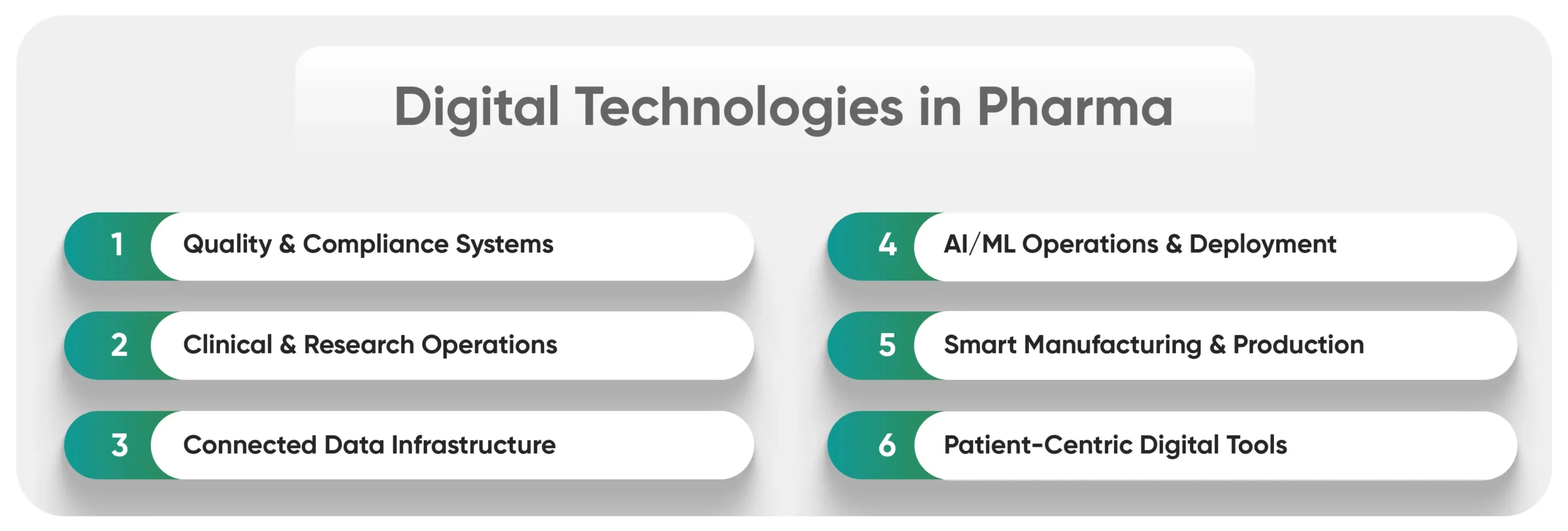
 1. Quality and Compliance Systems
 1. Quality and Compliance Systems
Digital quality management systems centralize regulatory data and automate compliance tracking across your pharmaceutical operations. You get real-time monitoring of quality issues before they impact production. Automated workflows handle deviation management, CAPA processes, and audit trails, reducing compliance lapses and speeds up regulatory approvals through digitized documentation.
2. Clinical and Research Operations
Running clinical trials means juggling data from multiple sites, tracking patient enrollment, and meeting tight regulatory deadlines. E-clinical platforms handle this complexity by automating data collection and giving you real-time trial visibility. Add AI into the mix, and you’re predicting which drug candidates show promise, identifying the right patient populations, and even flagging potential safety issues. AI-driven drug discovery tools can screen thousands of molecular compounds in the time it used to take for dozens.
3. Connected Data Infrastructure
Your manufacturing data lives in one system, clinical trial results in another, and supply chain information somewhere else entirely. Data Ops fixes this by creating a single source of truth. Once your data is connected, AI runs supply chain predictions, simulating trial scenarios, and spotting manufacturing barriers before they delay production. Cloud platforms make this data accessible to global teams instantly, whether they’re modeling protein structures or forecasting demand.
4. AI/ML Operations and Deployment
Building AI models is one thing, and deploying them across your organization is another. MLOps platforms help you standardize how AI gets developed, tested, and rolled out, whether it’s for predicting patient outcomes, optimizing formulations, or accelerating drug discovery. Instead of every department building AI solutions from scratch, teams can reuse proven models, monitor performance automatically, and scale what works. This keeps your AI initiatives compliant while moving faster than traditional development cycles allow.
5. Smart Manufacturing and Production
IoT sensors track everything from temperature fluctuations to equipment vibrations, feeding data into systems that predict when maintenance is needed. Digital twins let you test process changes virtually before touching actual production lines. So, you get less downtime, fewer quality incidents, and complete digital batch records that auditors appreciate. When your manufacturing systems connect to quality and supply chain data, you can respond to issues in real-time instead of discovering them weeks later.
6. Patient-Centric Digital Tools
Patients expect the same digital convenience from healthcare that they get everywhere else. Digital patient platforms make clinical trial participation easier with appointment reminders, secure messaging with study teams, and simple ways to report symptoms. For commercial products, these tools improve medication adherence by keeping patients engaged with their treatment plans. Better engagement means better outcomes, and the real-world data you collect becomes invaluable for future research.
Building the Digital Pharma Enterprise with ServiceNow
Pharmaceutical companies are collecting more data than ever, but most of it sits isolated across disconnected systems. Your manufacturing execution systems don’t talk to quality management. Clinical trial data lives separately from regulatory systems. IT and operational technology (OT) operate in parallel universes. This fragmentation creates blind spots that lead to compliance risks, unplanned downtime, and missed opportunities.
ServiceNow addresses this by connecting your entire operation on a single platform. With 400+ pharma and MedTech partners globally, ServiceNow has developed workflows specifically designed for life sciences complexity, from GxP compliance to production floor operations.
(Source: ServiceNow)
1. Healthcare and Life Sciences Service Management
Connects clinical operations with patient support services through integrated workflows. Patients can report issues, schedule appointments, or request support directly, even from within electronic medical records through EMR integration.
Key Capabilities
| 360-degree patient visibility | Clinical teams access complete patient information without switching applications |
| EMR integration | Report healthcare cases directly from electronic medical records |
| HL7 FHIR support | Exchange data with existing healthcare systems using industry standards |
| Patient support services | Streamline onboarding patients into support programs |
| Automated routing | Issues reach the right specialist with complete context |
Business Impact:
- Faster trial enrollment and improved protocol adherence
- Reduced resolution times for patient issues
- Better patient satisfaction and engagement
2. Operational Technology Management (OTM)
Bridges the IT/OT convergence gap by creating a unified view of every operational technology asset with full context about maintenance schedules, dependencies, and criticality to production. When vulnerabilities are detected in OT systems, ServiceNow automatically maps them to affected equipment and production processes, prioritizes based on actual risk, and schedules remediation during planned downtime
Business Impact:
- 1.75x higher operational equipment effectiveness vs. industry average
- 5% productivity improvement = $2.5M value per facility
- Complete digital audit trails for GxP compliance
(Source: ServiceNow)
3. ServiceNow GRC
Centralize compliance management across the enterprise with automated workflows for regulatory tracking, deviation management, CAPA processes, and audit preparation. The platform connects compliance activities across departments, linking manufacturing deviations to quality investigations, clinical adverse events to regulatory reporting, and risk assessments to mitigation actions.
Business Impact:
- Single source of truth for all regulatory obligations and compliance status
- Proactive risk identification prevents costly compliance failures and FDA warning letters
- Complete digital audit trails demonstrate compliance during inspections
A Practical Example
A leading Indian biopharma company operating across 50+ countries faced fragmented environmental monitoring and manual compliance tracking across critical facilities, risking product quality and regulatory penalties.
After implementing ServiceNow:
-
- 50% faster detection and response to environmental deviations
- 45% less manual compliance effort
- 30% fewer temperature-related product incidents
- Complete audit readiness with automated documentation.
Digital transformation protected product integrity, ensured regulatory compliance, and enabled scalable operations.
Got a roadmap question? Ask us directly
Leaders Dream Digital. Aelum Makes It Real.
Digital transformation in pharma has moved from experimentation to enterprise necessity, demanding platforms and partners that operate, comply, and compete.
As a certified ServiceNow partner, Aelum specializes in workflow automation that delivers real digital transformation for pharmaceutical enterprises. We understand the complexities of life sciences operations and help organizations deploy ServiceNow solutions that address your specific pain points, whether it’s achieving IT/OT convergence, streamlining compliance workflows, or optimizing clinical operations.
The goal isn’t transformation for its own sake. It’s building connected operations that let you focus on what matters: bringing treatments to patients faster. Talk to our ServiceNow experts and see how a digital pharma strategy does wonder for your business.