







Manufacturing is undergoing a major shift. Machines are becoming smarter, production lines generate vast amounts of data, and leadership teams face constant pressure to reduce downtime, control costs, and increase production speed. Traditional operations struggle to keep up with this pace. To compete, manufacturers must rethink how technology supports production.
One strategic shift is becoming central to this transformation. Organizations are bringing Information Technology (IT) and Operational Technology (OT) together under a single connected architecture.
This approach is known as IT/OT convergence. When implemented correctly, it forms the foundation of the modern smart factory. According to Gartner’s report, the industry is entering a ‘race to autonomous operations,’ where the convergence of IT and OT data is no longer a project, but the new genetic code of the digital factory.
This blog explains what IT/OT convergence really means for manufacturing organizations, why it matters now, and how it helps build the foundation for the smart factory.
What is IT and OT? Understanding the Core Difference
To understand convergence, it is important to understand how IT and OT have traditionally operated.
Information Technology (IT) includes the systems that manage business operations. These systems include ERP platforms, CRM tools, cloud infrastructure, enterprise databases, and cybersecurity solutions. IT teams focus on system availability, data security, scalability, and application performance.
Operational Technology (OT) refers to the technologies that control physical processes on the factory floor. These include PLCs, SCADA systems, sensors, robots, HMIs, and Manufacturing Execution Systems (MES). OT teams focus on machine uptime, production reliability, and operational safety.
For many years, these two environments operated separately.
IT systems were managed in centralized data centers and supported enterprise business processes. OT systems ran on the shop floor and controlled machinery and production workflows.
They used different technologies, different communication protocols, and often reported to different leadership teams. This separation once made sense. Today, it limits the ability of manufacturers to operate efficiently.
The Obstacles to IT/OT Convergence
Although convergence offers significant value, manufacturers often face real challenges when trying to connect to IT and OT environments.
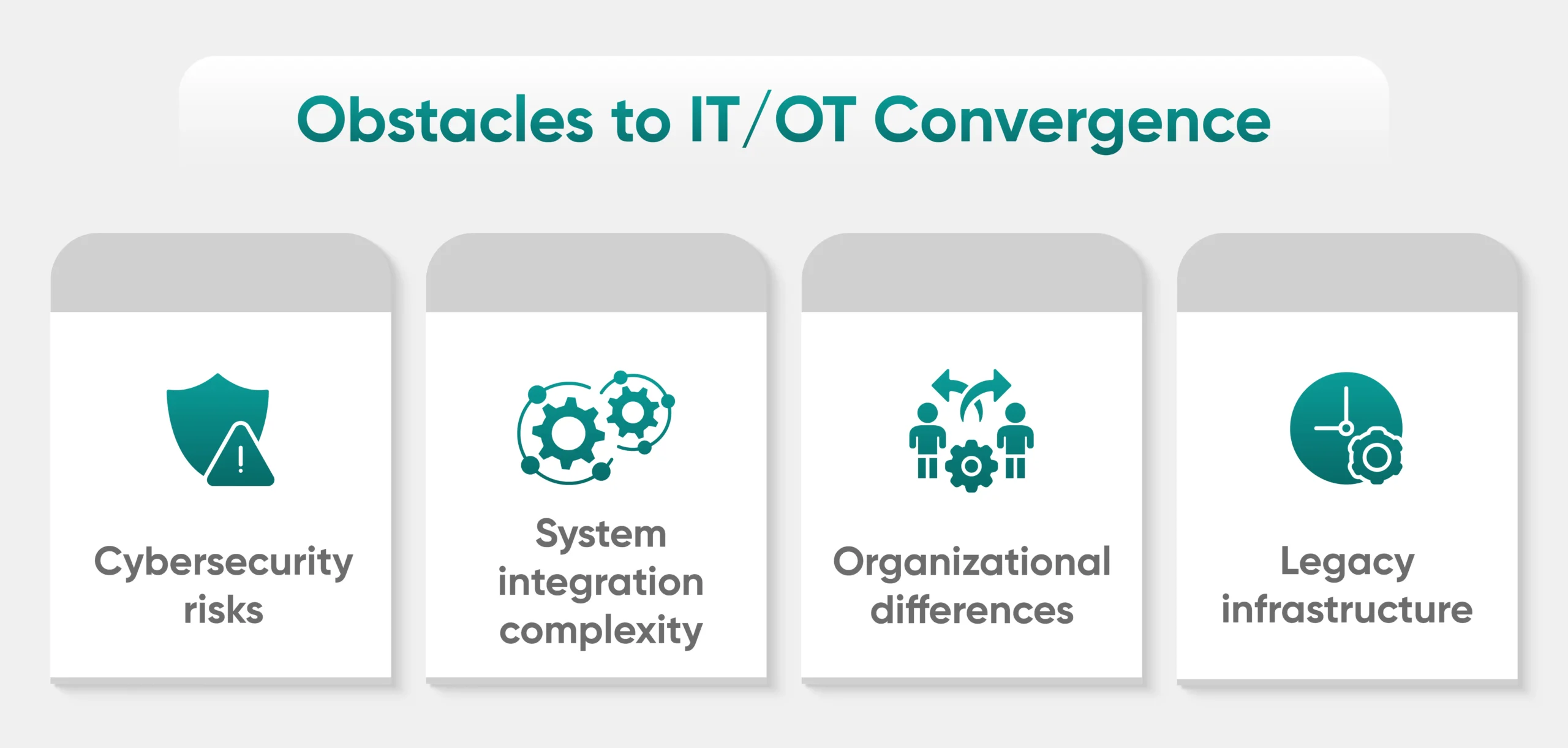
1. Cybersecurity risks
Most OT systems were originally designed as isolated environments. They were not built to operate on connected networks. When OT devices connect to enterprise networks, they introduce new attack surfaces. Cyber incidents in the IT environment can potentially impact physical production systems. This creates new risks for downtime, safety, and operational disruption.
2. System integration complexity
Manufacturing environments often contain equipment from different vendors and different technology generations. Many machines run proprietary communication protocols or outdated operating systems. Integrating these systems with modern IT platforms requires careful engineering and specialized expertise.
The Rise of IIoT in IT/OT Convergence
The Industrial Internet of Things (IIoT) plays a key role in enabling IT/OT convergence. It connects machines, sensors, controllers, and other factory assets to networks and cloud platforms, allowing operational data to be collected and analyzed in near real time.
In the past, most OT data remained on the shop floor. Machine alerts or faults were visible locally but rarely reached enterprise systems. With IIoT connectivity, this data can now flow into maintenance platforms, analytics systems, and enterprise applications. Teams can receive alerts faster, respond to issues earlier, and use data to predict equipment failures.
3. Organizational differences
IT and OT teams often work with different priorities. IT teams focus on software updates, patch management, and security controls. OT teams prioritize production uptime and are cautious about changes that might interrupt operations. These differences can create friction when teams attempt to work within a unified system.
4. Legacy infrastructure
Many factories still rely on equipment that is decades old. These machines often lack native connectivity, modern interfaces, or standardized data formats. Integrating them into a modern digital environment requires retrofitting, gateway technologies, or gradual equipment upgrades.
Key Technologies That Enable IT/OT Convergence
Successful IT-OT convergence depends on several core technologies working together.
1. Edge computing
Edge computing processes data is close to where it is generated. Instead of sending large volumes of sensor data to distant servers, edge devices analyze information locally. This reduces latency and allows faster responses to production events.
2. Industrial communication protocols
Protocols such as OPC-UA and MQTT provide standardized ways for machines, sensors, and enterprise systems to exchange data. These protocols help connect equipment from different vendors while maintaining reliable and secure communication.
3. Cloud and hybrid infrastructure
Cloud platforms allow manufacturers to store and analyze large volumes of operational data. They also enable centralized management of assets across multiple plants, supporting remote monitoring and collaboration.
4. Unified data models and CMDBs
Configuration Management Databases (CMDBs) provide a single inventory of all technology assets. When IT and OT assets exist in one unified model, organizations gain full visibility into system relationships, dependencies, and operational health.
5. AI and machine learning
When data from both IT and OT systems is combined, advanced analytics becomes possible. Manufacturers can use machine learning to detect anomalies, predict equipment failures, forecast production output, and optimize operational efficiency.
Want to upgrade on ServiceNow Australia with Aelum
Benefits of IT-OT Convergence
A connected IT–OT architecture is a key driver of digital transformation in manufacturing, providing real-time production insights and enabling faster, more informed decision-making across the enterprise.
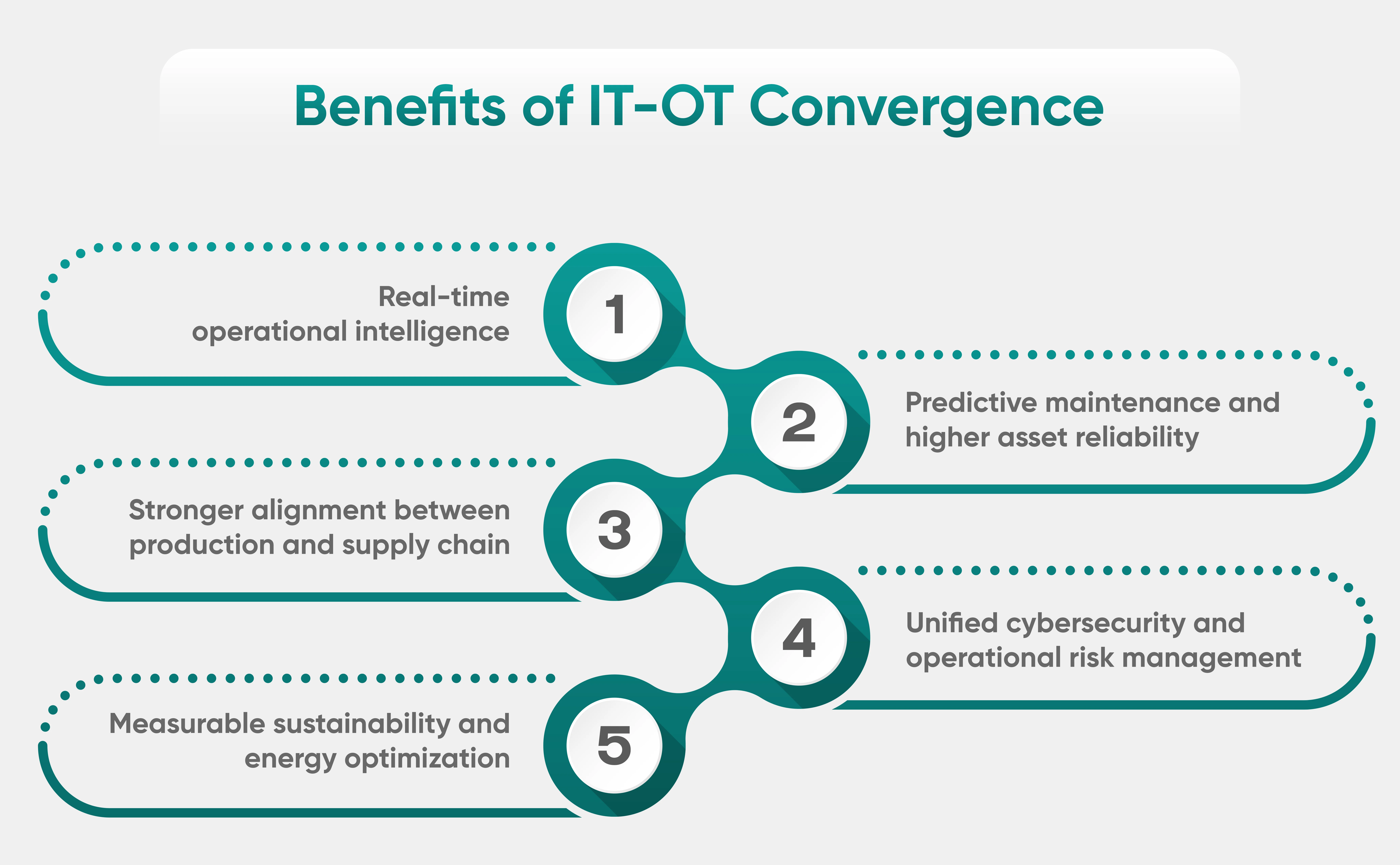 1. Real-time operational intelligence
A converged IT/OT architecture provides a continuous flow of data from machines, production lines, and industrial systems into enterprise platforms.
Plant managers and operations leaders can monitor machine performance, production throughput, and process conditions in real time. Instead of reacting to problems after they occur, teams can identify inefficiencies early and take corrective action before output or quality is affected.
This level of operational intelligence allows manufacturers to monitor Overall Equipment Effectiveness (OEE) more accurately and sustain higher levels of production performance.
2. Predictive maintenance and higher asset reliability
IT/OT convergence enables predictive maintenance by combining sensor data from OT systems with analytics platforms on the IT side. Machine learning models can detect patterns that indicate early equipment degradation.
Maintenance teams can then intervene based on actual asset condition rather than fixed maintenance schedules. This approach reduces unexpected breakdowns, improves asset utilization, and extends equipment lifespan.
3. Stronger alignment between production and supply chain
With IT/OT convergence, production data flows directly from the shop floor into enterprise planning systems, helping organizations overcome key supply chain challenges. Supply chain teams gain real-time insight into production capacity, throughput, and quality metrics.
This visibility allows organizations to respond faster to demand fluctuations, adjust production plans more accurately, and maintain stronger coordination between manufacturing and distribution operations.
4. Unified cybersecurity and operational risk management
A converged architecture allows organizations to manage security risks through a unified operational framework. Security teams can monitor vulnerabilities across enterprise systems and production assets, understand system dependencies, and coordinate responses across both domains. This integrated visibility helps organizations strengthen their security posture while protecting production continuity.
5. Measurable sustainability and energy optimization
When IT and OT data is connected, organizations gain detailed insight into energy consumption, resource usage, and production waste across facilities. This visibility enables more precise monitoring of sustainability metrics and helps manufacturers identify opportunities to optimize energy use and reduce emissions. As sustainability becomes a strategic priority, IT/OT convergence provides the operational data required to track and achieve measurable environmental improvements.
How ServiceNow Enables IT/OT Convergence in Manufacturing
Connecting IT and OT systems requires more than device connectivity. Manufacturers need a unified operational platform that can coordinate data, workflows, and response across both environments.
ServiceNow provides this foundation through its AI-powered platform for digital operations, bringing IT and OT processes together into a single system of action.
Instead of managing disconnected monitoring tools, ticketing systems, and asset inventories, manufacturers can orchestrate operations across the entire technology landscape from one platform.
1. A single platform for IT and OT operations
ServiceNow connects enterprise IT systems with operational technology environments through a unified architecture built on three foundations:
- One platform
- One data model
- One architecture
This approach allows manufacturers to consolidate operational data from machines, sensors, industrial controllers, and enterprise applications into a single operational layer. Teams gain a unified view of assets, incidents, vulnerabilities, and workflows across the factory.
The result is improved coordination between IT, operations, and maintenance teams while reducing fragmentation across systems.
2. Unified asset visibility across the factory
ServiceNow enables automated discovery of both IT and OT assets and maps them into a unified Configuration Management Database (CMDB).
Production equipment, industrial controllers, servers, networks, and applications are represented as connected configuration items within the same data model. This creates a complete inventory of operational assets and reveals dependencies between production systems and enterprise infrastructure.
The platform also supports asset modeling aligned with manufacturing frameworks such as the Purdue Model and ISA-95 architecture, allowing manufacturers to understand how systems interact across different layers of the factory environment.
3. Intelligent event monitoring and service orchestration
As production systems generate operational events and alerts, ServiceNow acts as the orchestration layer that connects monitoring systems with operational workflows.
Events from machines, sensors, and monitoring platforms are correlated and prioritized based on business impact. The platform can automatically create incidents, assign them to the right teams, and initiate predefined remediation workflows.
This structured response model helps manufacturers reduce mean time to repair (MTTR), minimize service disruption, and maintain higher equipment availability.
4. Enabling proactive maintenance and operational resilience
By combining OT sensor data with analytics and machine learning capabilities, ServiceNow helps organizations move from reactive issue management to proactive operations.
Predictive analytics can identify patterns that indicate potential equipment issues before failures occur. Maintenance teams receive early alerts and guided remediation steps through digital workflows.
This approach improves asset reliability, reduces downtime, and helps maintain consistent production output.
5. Supporting the smart digital factory
ServiceNow’s capabilities extend beyond incident management. The platform enables a broader set of operational improvements that support the development of the smart digital factory. Manufacturers can implement:
- Centralized monitoring and control across plants
- Automated asset discovery and lifecycle management
- Integrated security and vulnerability response for OT environments
- Predictive maintenance and industrial analytics
- Unified workflows for maintenance, operations, and IT teams
By bringing together analytics, security, service management, and automation on a single platform, ServiceNow helps manufacturers create a connected operational environment where production insights translate directly into action.
Use Cases of IT-OT Convergence in Manufacturing
1. Automotive Manufacturing
An automotive manufacturer operates multiple assembly plants with hundreds of robotic welding and painting systems. By converging IT and OT environments, sensor data from robots, PLCs, and production lines flows into enterprise monitoring and service management platforms. When a welding robot shows early signs of overheating, the system automatically triggers an alert, creates a maintenance ticket, and schedules repair during the next planned production pause. Plant managers gain real-time visibility into equipment health across facilities, allowing them to prevent unplanned downtime, maintain production schedules, and improve Overall Equipment Effectiveness (OEE).
Read case study: How a Global Automotive Manufacturer Simplified EX with ServiceNow HRSD, Workday Integration & AI Search
2. Life Sciences Manufacturing
A pharmaceutical manufacturer must maintain strict compliance, quality control, and environmental monitoring across its production facilities. Through IT/OT convergence, data from laboratory systems, manufacturing equipment, and environmental sensors integrates with enterprise platforms. When temperature levels in a drug production unit move outside validated thresholds, the system automatically records the event, alerts quality teams, and initiates a corrective workflow. This integrated visibility helps ensure regulatory compliance, reduces batch failure risks, and enables faster investigation of quality deviations while maintaining uninterrupted production of critical medicines.
Make IT/OT Convergence Work on the Factory Floor with Aelum
For manufacturing executives, the question is no longer whether to converge IT and OT. The question is how fast to do it, and with which partners and platforms. The organizations that treat convergence as a strategic priority today are the ones who will have the operational foundation to lead tomorrow.
Aelum helps manufacturers accelerate this shift by enabling practical IT/OT convergence across factory environments. We support organizations in bringing operational systems, enterprise applications, and production assets into a unified operational view. With 250+ experts our capabilities span OT asset visibility, service management for plant operations, security operations for connected environments, and digital workflows that connect maintenance, IT, and operational teams. By combining these capabilities, Aelum helps manufacturers reduce downtime, improve operational efficiency, and establish a strong digital foundation for the smart factory.
Start Your IT-OT Convergence Journey with Aelum
Frequently Asked Questions (FAQs)
What is IT/OT convergence in manufacturing?
IT/OT convergence in manufacturing means connecting information technology systems with operational technology on the factory floor. This allows machines, sensors, and production systems to share data with enterprise platforms. Manufacturers gain better visibility into operations, improve decision making, reduce downtime, and manage production processes more efficiently across the organization.
Why is IT/OT convergence important for smart factories?
IT/OT convergence is important because smart factories rely on connected systems and real-time data. When production equipment shares data with enterprise systems, manufacturers can monitor performance, predict maintenance needs, and optimize operations. This connection helps organizations improve efficiency, reduce downtime, and respond faster to production issues or demand changes.
Is IT/OT convergence secure for manufacturing environments?
IT/OT convergence can be secure when proper cybersecurity practices are implemented. Manufacturers use network segmentation, monitoring tools, and security frameworks to protect connected systems. With unified security visibility across IT and OT environments, organizations can detect vulnerabilities earlier, manage risks more effectively, and maintain safe and reliable production operations.
What is the difference between automation and smart factories?
Automation focuses on using machines and control systems to perform specific tasks automatically on the production line. A smart factory goes further by connecting machines, systems, and data across the entire operation. It uses real-time insights, analytics, and digital workflows to continuously improve production efficiency and decision making.
How do manufacturers get started with IT/OT convergence?
Manufacturers usually begin by identifying key production systems and assets that need better visibility. They connect OT devices with enterprise platforms, establish asset discovery and monitoring, and integrate operational data with maintenance and service workflows. Starting with small pilot projects helps organizations gradually expand IT/OT convergence across plants and operations.