










In an industry built on care and continuity, 70% of healthcare organizations saw patient services disrupted by cyberattacks last year. Risk management today is about ensuring resilience when it happens.
The ability to anticipate, absorb, and recover from disruption defines how well an organization can protect both its data and its people.
A stronger risk management framework could have made a life-saving difference. Maintenance backlogs could have been escalated sooner, controls verified continuously, and accountability enforced before patients were ever put at risk. When risk processes are connected and proactive, healthcare systems can detect vulnerabilities early, respond faster, and maintain care continuity even in the face of disruption.
As you read on, we’ll see different types of risks the healthcare sector faces today, and practical ways to stay ahead of them with a connected, proactive risk management framework.
What Risk Management Means in Healthcare?
Healthcare risk management is the process of identifying, analyzing, and addressing potential threats that could impact patients, staff, or operations within a healthcare system. It equips organizations with the knowledge and tools needed to act on risks before they escalate into harm.
In healthcare, there’s often a gap between the occurrence of an incident and its detection, and that’s when proactive risk management becomes important to both safety and sustainability. It ensures compliance with healthcare regulations and protects patient trust, data integrity, and organizational reputation.
A strong risk management framework helps remove the everyday inefficiencies that make hospital networks vulnerable, such as:
- Data silos between clinical, IT, and admin teams.
- Manual, error-prone patient and compliance workflows.
- Limited visibility across EHRs and medical systems.
- Poor transparency in cross-department risk response.
- Staff burn out excessive administrative loads.
- Difficulty scaling compliance across expanding care networks.
Strengthen Your Healthcare Risk Strategy
Types of Risks in Healthcare
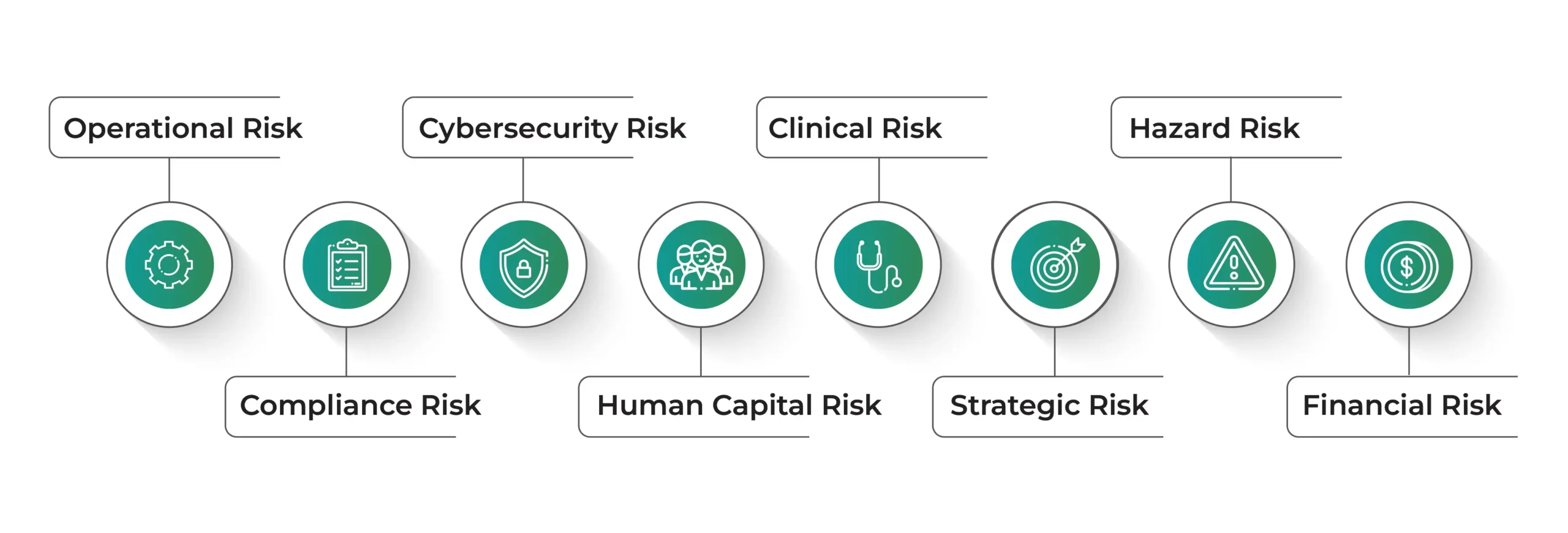
While patient safety is at the heart of healthcare, organizations also face a wider web of risks that can affect their clinical, financial, and operational resilience. Managing these interconnected risks is what keeps a healthcare enterprise strong, compliant, and trusted.
 1. Operational Risk
 1. Operational Risk
Operational risk arises when the core systems or processes that enable care delivery are disrupted. Even a minor breakdown: a data backup failure, a misconfigured software setting, or a gap in incident response can delay patient care and create operational issues. A massive amount of unorganized patient data also slows down clinical operations. These risks often stem from human error, weak internal controls, or process inefficiencies. Unexpected events, such as a contagious illness spreading among staff or patients, can also derail operations and impact service continuity.
2. Compliance Risk
Compliance risk occurs when healthcare organizations fail to meet standards set by laws and regulators such as HIPAA, OSHA, EEOC, or HITECH. Non-compliance can lead to hefty fines, loss of accreditation, reputational damage, and even criminal penalties. Companies spend billions in settlements for false claims or fraudulent reporting.
3. Cybersecurity Risk
Cybersecurity risks include ransomware attacks, phishing scams, insider threats, medical device vulnerabilities, vulnerable MCPs, and DDOS attacks. These attacks compromise patient data, disrupt operations, and endanger patient safety. The rise of telehealth and remote monitoring has also expanded the attack surface, making robust cyber hygiene non-negotiable. So, it becomes important to safeguard EHRs, patient data, medical devices, remote care tech, IoT devices, telemedicine platforms, research databases, and clinical trial information.
Did You Know?
53% of healthcare enterprises have felt the sting of one or more data breaches in the last 2 years.
4. Human Capital Risk
Healthcare depends on skilled, motivated people, and when they’re stretched thin, risks multiply. Human capital risk includes staffing shortages, burnout, low morale, and skill gaps. These issues affect patient safety and increase turnover and recruitment costs. A workforce that is not adequately supported or trained becomes both a symptom and a source of organizational risk.
5. Clinical Risk
Clinical risk directly impacts patient outcomes. It includes medication errors, surgical mistakes, misdiagnosis or delayed diagnosis, and hospital-acquired infections. Patient misidentification, falls, and inadequate infection control can all lead to significant legal and reputational consequences. Managing clinical risk is central to maintaining quality of care and patient trust.
6. Strategic Risk
Strategic risk arises when healthcare enterprises fail to adapt to changing regulations, technologies, or patient expectations. Ignoring innovation, delaying transformation, or making poor strategic choices can erode competitiveness. External factors like policy reforms, market disruptions, or emerging competitors can also derail long-term goals.
7. Hazard Risk
Hazard risk covers events that threaten the physical environment of care, natural disasters, equipment failures, or public health emergencies. Floods, power outages, or disease outbreaks can cripple operations, disrupt supply chains, and put patients at risk. Effective hazard planning ensures business continuity even under extreme conditions.
8. Financial Risk
Financial risk is the strain on a healthcare’s ability to stay solvent and resilient. It includes sudden costs, regulatory fines, malpractice settlements, or internal and external fraud. High labor expenses, tightening reimbursement rates, and rising equipment costs can quickly erode liquidity. Healthcare’s dependence on state funding and reimbursements also adds complexity, as these sources often have limited flexibility, making it difficult to achieve consistent ROI and long-term financial stability. Inefficient allocation of healthcare modernization budgets and low returns from high-tech medical investments further strain resources.
Nearly every type of risk: operational, compliance, or clinical, can cascade into financial risk, making it one of the most essential to manage across the healthcare ecosystem.
ServiceNow Risk Management for Healthcare
Visibility, speed, and agility are non-negotiable when it comes to building a resilient risk management structure for care providers.
ServiceNow provides enterprise-grade risk management solutions designed for every industry and for all company sizes. For healthcare specifically, ServiceNow strengthens compliance, improves patient and employee experiences, and stays responsive in evolving risks.
ServiceNow GRC (Governance, Risk, and Compliance)
ServiceNow GRC is like a hospital command center, monitoring every important function from one place. That’s what a unified risk management model does for an enterprise: one control center for every kind of risk.
ServiceNow GRC helps healthcare networks integrate risk management into their strategic planning through four key modules:
- Integrated Risk Management (IRM): Assess, monitor, and prioritize risks by embedding risk intelligence into decisions, enabling data-driven actions and operational resilience.
- Business Continuity Management (BCM): Plan for continuity, disaster recovery, and crisis response with built-in dependency mapping and impact visualization to maintain critical care operations.
- Privacy Management: Address evolving privacy regulations with automated privacy assessments and built-in compliance workflows that safeguard patient data.
- Third-Party Risk Management: Gain full visibility into vendor relationships with centralized oversight, automated due diligence, and proactive third-party risk monitoring.
ServiceNow GRC Benefits in under 30 Seconds for Healthcare:
- Low risk of non-compliance and penalties, HIPAA breaches, & patient safety incidents.
- Stronger change management for new care models, digital transformation, & regulatory shifts.
- Faster data capture from clinicians, staff, and vendors to assess and mitigate risks.
- Better communication and accountability across clinical and operational teams.
- Smarter decisions with real-time visibility into enterprise risks.
ServiceNow Security Operations (SecOps)
ServiceNow SecOps safeguards healthcare networks by aligning IT and security teams for faster, smarter responses to potential threats. It strengthens security posture by providing healthcare cybersecurity solutions, supports compliance, and protects sensitive patient data. And with a 26% rise in cyberattack severity, patient safety and data integrity are on the line.
Key capabilities include:
- Early detection and prioritization of potential threats.
- Increased transparency between development, security, and operations.
- GenAI and AI Agents for faster incident analysis and closure.
- Enhanced security across programming and operational workflows.
- Continuous training of SecOps teams to build a security-first culture.
SecOps Center
| What It Does | How It Works | Value for Healthcare |
| Continuous Network Monitoring | Tracks the IT environment for unusual activity in real time. | Prevents downtime, breaches, and patient data loss. |
| Incident Response | Automate detection and resolution of security incidents. | Limits breach impact and speeds system recovery. |
| Forensic & Root Cause Analysis | Identifies attack sources and system vulnerabilities. | Strengthens defenses, ensures HIPAA compliance & other standards. |
| Threat Intelligence | Analyze emerging threats and response plans. | Protects systems from ransomware and cyberattacks. |
Build a Risk-Ready Healthcare Enterprise
The future of healthcare depends on how effectively you manage and anticipate risks. Building a connected risk management framework is the way to build that, leading to patient trust and brand reputation.
With ServiceNow’s AI-powered risk management solutions, you get key risk indicators to monitor potential threats, an authority to document library with essential regulations and guidelines, and alignment with industry’s best practices.
At Aelum, we specialize in aligning ServiceNow’s capabilities with healthcare priorities, ensuring that risk, compliance, and care delivery move in sync with your operations. Master risk management in your enterprise. Talk to our ServiceNow experts.
See How ServiceNow Manages Risk in Healthcare
Frequently Asked Questions (FAQs)
1. Which hospital departments benefit the most from risk management software?
The hospital departments that benefit the most from risk management software are clinical, operations, IT, compliance, and finance. With real-time visibility into incidents, data, and regulations, healthcare networks get faster decision-making, fewer disruptions, and improved patient care.
2. How does risk management software improve patient safety metrics?
A risk management software improves patient safety metrics by spotting risks early and automating incident response, allowing hospitals to prevent errors before they affect patients. It ensures compliance, improves coordination across teams, and builds accountability, leading to safer care and stronger trust.
3. What features should you look for in healthcare risk management tools?
Look for tools that have features such as real-time monitoring, automated reporting, regulatory compliance tracking, incident management, data security, integration with your existing systems, and easy-to-use dashboards.
4. What are the best practices for implementing risk management software in a hospital?
Start by aligning your risk management goals with stakeholders and cross-departmental teams from IT, compliance, and clinical operations. Select a software with a user-friendly interface and integration features, and train your workforce well to make the best use of the software.
5. What major challenges does a risk management solution solve?
A risk management solution eliminates data silos, manual tracking, the inability to scale, and compliance gaps while improving coordination between departments.