










In every insurance lifecycle, there’s a moment when paperwork stops, and the policyholder needs real help. At that time, they’re met with confusing jargon, unclear claim statuses, and approval processes that take weeks. Policyholders want insurance that understands their needs, offers transparency into where their claim stands, and provides timely, clear answers.
Behind the scenes, underwriting, policy issuance, claims processing, billing, and mid-term servicing still rely on manual steps and disconnected systems. Customer expectations have outpaced legacy insurance processes, and that shift is already visible, with insurance AI spend projected to increase by more than 25% in 2026.
Insurers are turning to AI Agents to close this gap, streamlining workflows, delivering real-time transparency, and making insurance fast, clear, and personal. Let’s break down how this transformation is happening by understanding:
- Why Insurance Needs AI Agents
- Traditional RPA vs Generative AI vs AI Agents
- Benefits of Agentic AI in Insurance
- Agentic AI Use Cases for Insurance
- The Best Platform to Build AI Agents for Insurance
Why Insurance Needs AI Agents?
AI agents are automated digital assistants that work across insurance workflows to reduce response times, improve adjuster productivity, and bring consistency to customer interactions.
In the context of insurance, AI Agents instantly pull policy details, assess coverage eligibility, identify required documentation, and flag potential fraud indicators, allowing adjusters to focus on decision-making rather.
During customer interactions, AI Agents analyze tone and sentiment to provide personalized responses that match the policyholder’s emotional state, handling routine inquiries instantly. When cases are handed over to human agents, they arrive with full context already assembled, reducing repetition and frustration for policyholders.
To understand where AI agents fit, here’s how they compare to traditional automation:
| Traditional RPA | Generative AI | AI Agents |
| Automates repetitive tasks | Generates content and answers questions | Orchestrates end-to-end processes and makes decisions |
| Requires manual handoffs between steps | Works in isolation, needs human to act | Coordinates across systems without human intervention |
| Example: Copies data from claim form to system | Example: Summarizes a 50-page claim document | Example: Reviews claim, checks coverage, requests docs, assigns adjuster, updates policyholder |
Benefits of AI Agents in Insurance
Agentic AI acts as AI-driven support agents for insurance companies that fundamentally transform how insurers operate, and customers experience insurance. When implemented correctly, they deliver improvements across every insurance process. Here’s how they create tangible value for both insurers and policyholders:
1. Faster Claims Resolution
AI Agents extract and summarize crucial information from lengthy claim documents, medical records, and policy files. This allows adjusters to work more effectively, enables faster decision-making and reduces claim cycle times.
2. Simplified Insurance Lifecycle
From initial underwriting to policy issuance and ongoing servicing, AI agents create a unified workflow that connects previously siloed processes. They prioritize submissions based on risk and urgency, ensure smooth handoffs between teams, and reduce claim leakage by maintaining continuity throughout the entire policy lifecycle.
Improve Adjuster Efficiency Today
3. Enhanced Policyholder Retention
AI agents provide customer service teams with instant access to complete policy history and relevant coverage details through intelligent, role-based workspaces. This enables faster, accurate responses to servicing requests, creating experiences that keep policyholders loyal.
4. Personalized Recommendations
By analyzing customer data, claims history, life events, and interaction patterns, AI agents deliver personalized policy recommendations and communications that resonate with each policyholder’s unique situation. This customization drives higher conversion rates and deeper customer relationships.
5. 24/7 Self-Service Capabilities
AI agents empower policyholders to get answers, file claims, and make policy changes anytime, anywhere, without waiting for business hours. This round-the-clock availability meets modern customer expectations while reducing the burden on your contact center teams.
6. Compliance and Audit Readiness
Every action taken by AI agents is automatically logged and traceable, creating comprehensive audit trails that simplify regulatory compliance. They ensure that all processes follow current regulations and company policies, reducing compliance risk across your operations.
7. Scalability During Peak Demand
When natural disasters strike or claim volumes surge, AI Agents scale instantly to handle the increased workload. So, your team maintains service quality even during most challenging periods.
Did You Know?
AI adoption in insurance jumped from 8% to 34% in 2025, a 400% increase. In practical terms, for every one insurer fully using AI in 2024, nearly four were doing so by 2025.
Agentic AI Use Cases for Insurance
From claims processing to fraud detection, AI agents are transforming how insurance companies operate. Here are the key areas where they deliver value
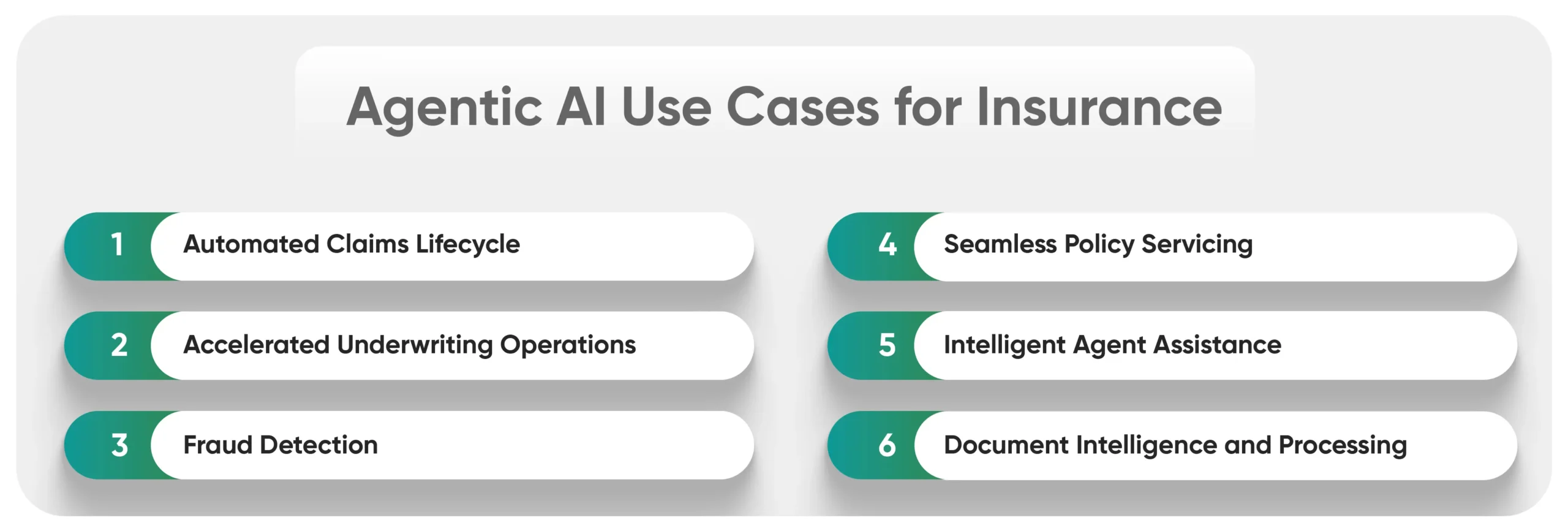 1. Automated Claims Lifecycle
AI agents handle the complete claims lifecycle, from initial intake through resolution. They automatically triage incoming claims by analyzing sentiment and urgency, verify customer and policy details, validate coverage, assess claim severity, and route cases to the appropriate adjuster based on expertise and workload. Throughout the process, they gather required documentation, send automated status updates to policyholders, and flag cases requiring human intervention.
2. Accelerated Underwriting Operations
For complex policies, AI agents streamline underwriting by automatically retrieving data from multiple sources: credit bureaus, claims databases, property records, and regulatory systems. They cross-reference information to identify anomalies, flag potential risks, and compile comprehensive risk profiles for underwriters. What once took days of manual research now happens in hours, enabling faster policy issuance without compromising accuracy.
3. Fraud Detection
AI Agents continuously monitor claims for suspicious patterns, duplicate submissions, inconsistent information, and unusual billing patterns, flagging potential fraud before payouts are made. This proactive approach minimizes financial losses and protects the integrity of your claims process. They also analyze patterns in denied loan requests and call data to detect fraud and help live agents identify suspicious activity.
4. Seamless Policy Servicing
Customers can independently handle routine tasks like checking coverage, updating contact information, or making payments through conversational interfaces. Behind the scenes, AI agents process these requests, verify eligibility, calculate premium impacts, update systems, and ensure compliance. When changes require approval or expertise, they route requests to the right team with full context, creating a smooth handoff.
5. Intelligent Agent Assistance
AI agents serve as real-time assistants for insurance agents and customer service teams. They provide instant access to policy details, claims history, coverage information, and procedural guidance during customer interactions. They surface relevant knowledge articles, suggest next-best actions based on the conversation context, and help agents navigate complex scenarios with confidence, reducing training time, improving first-call resolution, and elevating service quality.
6. Document Intelligence and Processing
AI agents extract, analyze, and summarize information from complex documents: claims forms, medical records, police reports, inspection reports, and legal documents. They identify key data points, highlight critical details, detect inconsistencies, and generate concise summaries that accelerate review processes. This ensures adjusters and underwriters can quickly grasp essential information without wading through hundreds of pages of documentation.
Also Read: How CIOs are Rethinking Business Transformation with Agentic AI
Why ServiceNow is the Best Platform to Build AI Agents for Insurance
Building AI Agents shouldn’t require an army of developers or months of implementation. ServiceNow makes it straightforward for insurance companies to deploy intelligent automation that works within their existing operations.
What sets ServiceNow AI Agents apart is how it addresses the unique needs of regulated industries like insurance. With AI Control Tower, you get centralized visibility and governance over every AI agent, ensuring regulatory compliance, audit readiness, and the ability to adjust quickly when business rules change. Your data stays secure within your enterprise environment, and no sensitive policyholder information leaves your systems, protecting both privacy and trust while meeting requirements like GDPR and state insurance regulations.
Build AI Agents Without Coding: ServiceNow AI Agent Studio lets your team create and customize AI Agents using natural language. Describe what you need the agent to do, define the outcome you want to achieve, and specify any compliance requirements or business rules it should follow. Whether you need an agent to handle FNOL (First Notice of Loss) intake, assist with policy renewals, or manage beneficiary changes, you can build and deploy it in days.
Integration with Your Existing Systems: Insurance operations run on multiple platforms: policy administration systems, claims management tools, CRM systems, document repositories, and legacy applications. ServiceNow AI Agent Fabric unifies these disparate systems, allowing AI Agents to access data and trigger actions across your entire technology landscape. Your agents work with what you already have, eliminating the need for expensive system replacements.
See How AI Agents For Insurance Work in Your Business
Partner With Aelum to Transform Your Insurance Operations
At Aelum, we specialize in helping insurance companies transform their operations into processes that deliver the experiences today’s customer demands with ServiceNow AI Agents.
We understand both the technology and the unique complexities of the insurance industry, from regulatory requirements to legacy system integrations. From initial assessment and strategy to deployment, training, and ongoing optimization, we’re with you every step of the way. So, your teams are equipped to manage and scale AI agents confidently. Schedule a 1:1 with our ServiceNow experts to learn how AI Agents can improve your insurance operations.
Frequently Asked Questions (FAQs)
1. How can an insurance agent use AI Agents?
An insurance agent can use AI Agents to delegate tasks and automate routine work such as retrieving policy details, tracking claim status, and responding to common customer queries live.
2. Will insurance agents be replaced by AI Agents?
No, AI Agents are unlikely to completely replace insurance agents. Instead, it supports them by automating repetitive tasks and providing real-time insights that improve decision-making.
3. How do AI Agents help insurance agents improve client retention?
AI Agents help insurance agents improve client retention by enabling faster responses, better transparency, and personalized interactions across the customer lifecycle. They are equipped with full context and next-best actions, making client conversations meaningful.