







You invested in ServiceNow. You survived the implementation. You went live.
And then… reality hit.
Tickets piling up. An upgrade on the horizon that no one has time to plan for. Modules you’re paying for but barely using. An internal team stretched thin across a platform that keeps evolving faster than they can keep up.
Sound familiar? You’re not alone.
Most IT leaders don’t have a ServiceNow problem, they have a support gap problem. The platform is capable of far more than it’s delivering, but without the right expertise and structure behind it, that gap only widens over time.
That’s exactly where ServiceNow Managed Services comes in.
ServiceNow Managed Services: Overview
ServiceNow Managed Services is an ongoing support model where a dedicated partner team like Aelum takes ownership of running, optimizing, and evolving your ServiceNow environment, so your internal team can focus on strategic priorities instead of firefighting.
Think of it less like outsourcing and more like extending your team with people who live and breathe ServiceNow. They handle the day to day, the upgrades, the health checks, the training, and they proactively surface issues before users even notice them. So ServiceNow becomes a platform that delivers the ROI you promised.
Stabilize, optimize, and scale your platform with a dedicated team
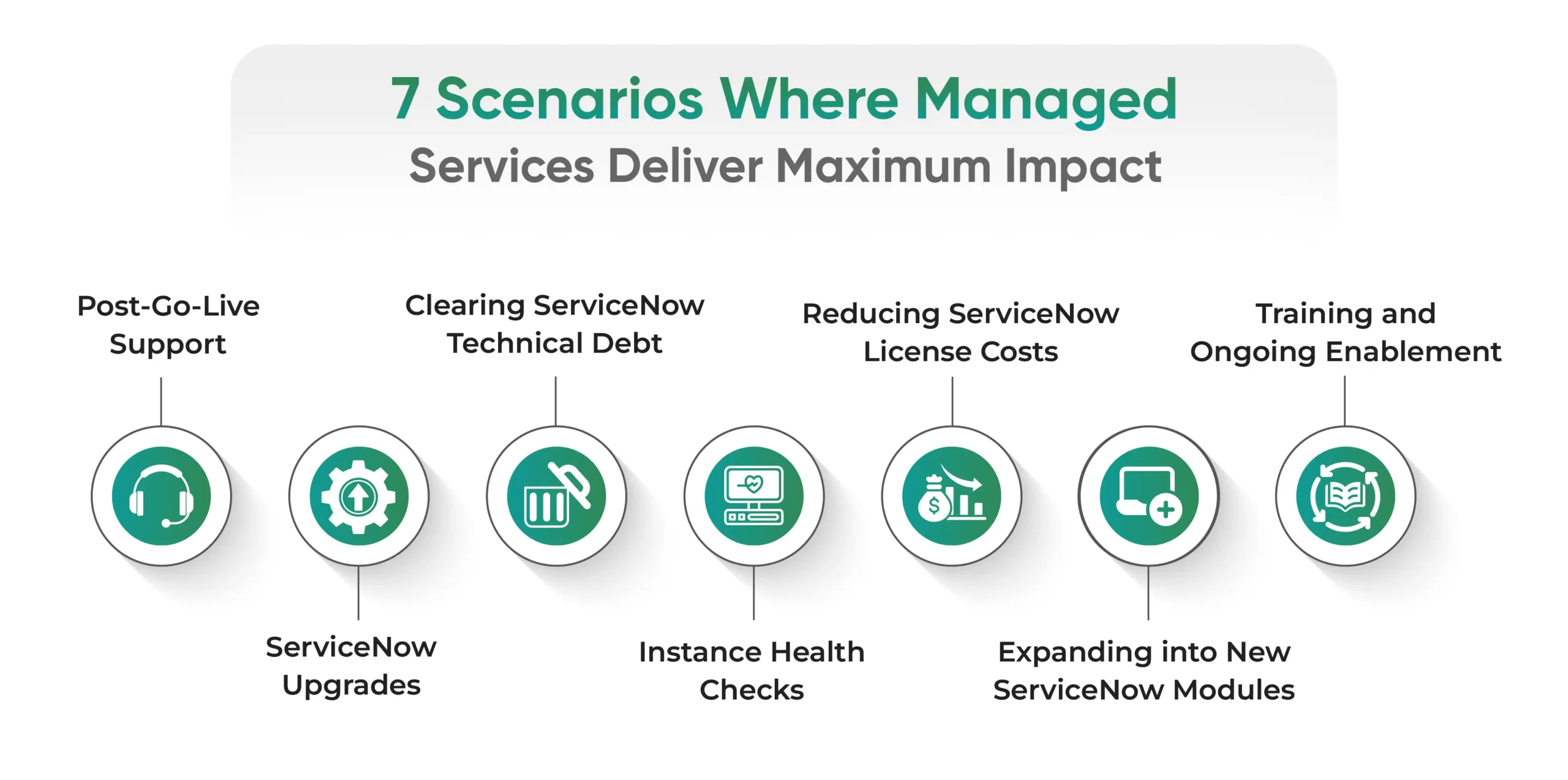
Seven scenarios where managed services consistently deliver the highest impact
Not every organization needs managed services for the same reason. But there are seven recurring scenarios where organizations consistently see the biggest value.
 1. Post-Go-Live Support
Go-live is a milestone, not a finish line. The weeks and months that follow are often where the real work begins. Workflows need tuning, users need hand-holding, and edge cases you never encountered in testing start showing up in production.
Without a structured post-go-live support model, most organizations end up in reactive mode. Small issues compound into bigger ones. Automation that was supposed to run at 80% efficiency stalls at 30%. User adoption lags because the experience is still rough around the edges.
A managed services partner provides the intensive “hypercare” phase that stabilizes the platform, then stays to systematically optimize it over time. They catch what your internal team misses simply because they’ve seen it all before.
2. ServiceNow Upgrades (Yokohama to Zurich to Australia)
ServiceNow releases two major platform upgrades every year. Each one brings new features, AI capabilities, and security patches, but also the very real risk of breaking your custom workflows if you’re not prepared.
Many organizations fall behind by one, two, sometimes three versions. The further you fall, the bigger the technical lift to catch up, and the more security and compliance exposure you accumulate along the way.
A managed services team owns the upgrade lifecycle end to end, including pre-upgrade impact analysis, testing in a sub-production environment, cutover planning, and post-upgrade validation. You get the benefits of staying current without your team having to clear their calendars every six months.
Also Read: What’s New in ServiceNow Australia Release?
3. Clearing ServiceNow Technical Debt
Every quick fix that was never properly documented. Every workaround that became permanent. Every script added in a rush that nobody fully understands anymore.
That’s technical debt, and it builds up silently until one day you realize your platform is slow, brittle, and terrifying to change.
Forrester has noted that more than half of technology decision-makers expect their technical debt to reach moderate or high severity, with that number climbing toward 75% in the near future. For ServiceNow specifically, accumulated debt also blocks AI readiness. You cannot build intelligent automation on a messy foundation.
Managed services teams systematically audit, document, and remediate technical debt. They do not just fix the symptoms. They address the root causes and put governance in place to prevent the same patterns from recurring.
4. Instance Health Checks
You would not skip an annual audit for your financials. Your ServiceNow instance deserves the same discipline.
An instance health check is a structured assessment of your platform’s performance, architecture, customizations, integrations, and upgrade readiness. It identifies bottlenecks, security misconfigurations, unused modules, and degrading scripts before they cause visible problems.
The best time to do a health check is before something breaks, ideally every 12 to 18 months, or ahead of a major upgrade or organizational change. Managed services partners typically include periodic health checks as a core part of their engagement, giving you a clear, recurring view into platform risk and opportunity.
5. Reducing ServiceNow License Costs
License costs are one of the first things IT leaders scrutinize when budgets tighten, and with ServiceNow, there is almost always room to optimize.
The problem is that internal teams rarely have the bandwidth to audit license utilization, right-size user access, retire unused capabilities, or renegotiate entitlements. It takes time and expertise that is hard to spare.
A managed services partner can map actual usage against what you are paying for, identify redundant or underutilized licenses, and help you go into renewal conversations with data. For many organizations, this alone covers a significant portion of the managed services investment.
6. Expanding into New ServiceNow Modules
ServiceNow has grown well beyond IT service management. HR Service Delivery, Customer Service Management, Security Operations, App Engine, the platform can connect workflows across your entire enterprise.
But adding new modules on top of an unstable or poorly governed instance is a recipe for disappointment. Expansions get delayed. Integrations fail. Adoption is low because the experience is inconsistent with what users already know.
Managed services ensures you are building on a solid foundation and that expansions are deployed thoughtfully, with proper testing, change management, and user training built in from the start.
7. Training and Ongoing Enablement
Even the best platform falls flat if users do not know how to use it. In a world where staff turnover is constant, knowledge does not naturally transfer on its own.
Managed services supports continuous enablement, from onboarding new admins and developers to delivering refresher training for end users. The goal is not just to fix problems, it is to build internal capability so your organization becomes less dependent on external help over time.
What Happens When All These Scenarios Occur Together?
Here is the honest truth. Most organizations are not dealing with just one of these scenarios. They are dealing with several simultaneously.
Technical debt is slowing performance. Upgrades are overdue. License costs are climbing. The team is too busy firefighting to think about expansion. Meanwhile, platform health is quietly deteriorating.
When these challenges compound, the risk is not just operational, it is strategic. Your platform becomes a bottleneck instead of an enabler. AI initiatives stall because the data foundation is not clean. Business stakeholders lose confidence in IT’s ability to deliver.
This is what we call compounding platform risk, and it is far more common than most CIOs realize until they do a proper audit.
Managed Services vs. Managing In-House: An Honest Comparison
There is no shame in asking whether you can handle this internally. Here is a straightforward look at how the two models compare:
| Criteria | In-House | Managed Services |
| Annual cost | High (salary, benefits, training, turnover) | Predictable subscription model |
| Certified coverage | Limited to whoever you can hire and retain | Multi-certified team across all modules |
| Upgrade ownership | Often delayed or deprioritized | Proactive, scheduled, end to end |
| 24/7 monitoring | Rarely sustainable | Built-in SLA coverage |
| AI readiness support | Dependent on individual expertise | Structured, platform-current approach |
| Health check cadence | Ad hoc, when time allows | Regular and systematic |
| Module expertise depth | Deep on core, shallow on newer modules | Breadth across the full platform |
| Time-to-value for new features | Slow, depends on internal capacity | Faster with dedicated resources |
Across managed services engagements, the impact is measurable.
- 30 to 50% reduction in incident resolution time through proactive monitoring and structured SLAs
- 25 to 40% faster upgrades with minimal disruption to business operations
- 15 to 30% savings on licensing through usage optimization and entitlement alignment
- Up to 2x improvement in user adoption due to continuous enablement and UX improvements
- Significant drop in backlog as technical debt is systematically reduced
These are not one-time gains. They compound over time as the platform becomes more stable, optimized, and aligned with business goals.
How Aelum Consulting Delivers ServiceNow Managed Services Across All Seven Scenarios
Aelum Consulting is a certified ServiceNow partner with a managed services practice built specifically for organizations that want to get more from their platform without adding headcount. Our team brings years of hands-on ServiceNow experience across industries, including BFSI, manufacturing, healthcare, and retail, with certified specialists covering ITSM, ITOM, HRSD, CSM, SecOps, and beyond.
We do not just support ServiceNow. We know it deeply across its full breadth, and we have seen what works and what does not across dozens of implementations and managed engagements. Here is how that expertise maps to the scenarios that matter most to your business:
- Post-Go-Live Stabilization & Optimization: We do not disappear after implementation. Our team stays embedded through hypercare and beyond, tuning workflows, improving adoption, and continuously optimizing your instance as your business evolves.
- Upgrade Management (Yokohama to Zurich to Australia): Our certified consultants own the upgrade lifecycle end to end. We handle impact analysis, sub-production testing, cutover planning, and post-upgrade validation, keeping your instance current without disrupting operations.
- Technical Debt Remediation: We conduct structured audits, prioritize debt by business risk, and work through remediation systematically. Every change is documented, so your team always knows what was done and why.
- Instance Health Monitoring: Through regular health checks and continuous monitoring, we surface risks before they become incidents. You get clear, actionable reports, not a list of problems left for your team to figure out.
- License Optimization: Our team maps your actual usage against your entitlements, identifies waste, and equips you with the data needed to approach renewal conversations with confidence.
- Module Expansion: Whether you are rolling out HRSD, App Engine, or CSM, we ensure each expansion is built on a governed, stable foundation, with proper testing, change management, and adoption support from day one.
- Training & Knowledge Transfer: We invest in building your internal team’s capability at every stage of the engagement. Our goal is platform independence for your organization, not long-term dependency on us.
Our engagement model is flexible. Some clients need a light-touch advisory arrangement. Others need a fully embedded team handling everything from daily operations to strategic roadmap planning. Either way, we structure our support around your actual needs, not a fixed-scope contract that stops short of where you need help.
Your Platform Is Only as Strong as the Support Behind It
ServiceNow is one of the most powerful platforms in enterprise today. But capability on paper does not translate to value in practice without the right expertise and structure behind it.
The organizations getting the most from ServiceNow are not necessarily the ones with the biggest budgets. They are the ones that treat the platform as a living, evolving asset and invest in supporting it accordingly.
If any of the seven scenarios in this blog sound familiar, it is worth a conversation. Whether you are dealing with post-go-live turbulence, a looming upgrade, growing technical debt, or a platform that is underperforming against expectations, Aelum has seen it before and knows how to fix it.
Schedule a complimentary instance health review
Frequently Asked Questions (FAQs)
1. How does managed services model go beyond traditional post-go-live support?
Managed services shifts the focus from reactive ticket resolution to proactive, continuous improvement. It includes workflow optimization, upgrade management, and ongoing platform monitoring. Instead of maintaining the status quo, the model ensures the platform evolves with business needs and consistently delivers measurable outcomes over time.
2. How does a partner help reduce technical debt and make your platform future-ready?
A structured approach to technical debt starts with auditing customizations, identifying high-risk areas, and prioritizing fixes based on business impact. Standardizing configurations, improving documentation, and enforcing governance creates a more stable platform that is easier to upgrade, scale, and support future capabilities like AI.
3. How are instance health checks and ongoing monitoring typically handled?
Effective managed services combines periodic deep-dive health assessments with continuous monitoring. This includes evaluating architecture, integrations, security, and usage patterns. The goal is to provide ongoing visibility and actionable insights, allowing teams to proactively address risks and performance issues before they affect users.
4. What does managed services typically cost, and how is ROI measured?
Managed services usually follows a subscription-based model aligned to platform complexity and support scope. ROI is measured through faster incident resolution, reduced upgrade effort, optimized license usage, and improved user adoption. These gains compound over time, freeing internal teams to focus on strategic initiatives. Connect with Aelum experts for better guidance.
5. How is hypercare and post-implementation stabilization managed?
Hypercare focuses on the immediate post-go-live phase, ensuring rapid issue resolution, workflow tuning, and user support. A strong approach goes beyond stabilization by identifying early optimization opportunities and improving adoption, enabling a smoother transition into steady-state operations with minimal disruption.
6. How is AI readiness and adoption enabled on the platform?
AI readiness depends on clean data, standardized workflows, and strong governance. Reducing technical debt, aligning processes, and staying current with platform updates creates a solid foundation. This allows organizations to adopt AI capabilities more effectively and scale automation without being constrained by underlying system inefficiencies.