
The automotive industry is at an inflection point, and the window to act is narrowing fast. Supply chain disruptions, semiconductor shortages, and the rapid shift to Software-Defined Vehicles (SDVs) are reshaping how OEMs, suppliers, and dealer networks operate, even as expectations to stay lean and responsive continue to rise. These forces are exposing a deeper issue: fragmented operations. Disconnected systems across engineering, manufacturing, procurement, and service are slowing decisions, limiting visibility, and weakening real-time response.
At the same time, the stakes are rising. With McKinsey projecting a 30% increase in vehicle lifecycle revenues by 2035, the opportunity is expanding, but only for those who can execute faster and with greater coordination.
Stepping into this complexity, ServiceNow acts as the digital backbone of modern automotive enterprises, connecting workflows, data, and teams across the entire value chain. As an AI-powered platform, it orchestrates end-to-end operations, enabling real-time visibility, intelligent automation, and faster, coordinated decision-making at scale.
In this blog, we explore the key challenges facing the automotive industry and how ServiceNow enables automotive enterprises to move to a more coordinated, intelligent execution.
The Defining Challenges of the Modern Automotive Enterprise
As the industry evolves, persistent operational challenges are becoming harder to ignore and costlier to manage. Here’s where the pressure is building:
1. Supply Chain Instability & Multi-Tier Visibility Gaps
Automotive supply chains span multiple tiers, yet visibility often stops at Tier-1 suppliers. Disruptions deep in the network go unnoticed until impact hits production, leading to delays, reactive chaos, and limited ability to proactively mitigate risks.
2. Geopolitical & Trade-Driven Volatility Impacting Production
Tariffs, trade restrictions, and regional conflicts are forcing manufacturers to constantly rebalance sourcing and production strategies. This volatility introduces cost pressures, compliance complexity, and frequent disruptions to established manufacturing and distribution plans.
3. Semiconductor & Critical Component Constraints
Ongoing semiconductor shortages and dependency on limited suppliers for critical components continue to disrupt production schedules. Even minor component shortages can halt entire assembly lines, exposing the fragility of just-in-time manufacturing models.
4. Transition to Software-Defined Vehicles (SDVs)
The shift to software-defined vehicles is transforming cars into continuously evolving digital platforms. This requires seamless collaboration between hardware and software teams, faster release cycles, and robust lifecycle management across development, deployment, and updates.
5. Increasing Manufacturing Complexity & Downtime Risks
Modern automotive manufacturing involves highly automated, interconnected systems. Any equipment failure, maintenance delay, or process inefficiency can trigger costly downtime, impacting production targets, quality standards, and overall operational efficiency.
6. Data & AI Adoption Gap
While automotive enterprises generate vast amounts of data, much of it remains siloed and underutilized. Limited integration and lack of actionable insights hinder AI adoption, slowing decision-making and preventing organizations from enabling full operational intelligence.
These challenges are interconnected and systemic. Addressing them requires a unified, platform-driven approach that can connect operations, data, and decisions across the automotive value chain.
Build the Future of Automotive with ServiceNow
ServiceNow for Automotive Powering the Next Era of Mobility
ServiceNow is enabling automotive leaders to move beyond disconnected operations by embedding intelligence, automation, and real-time coordination into core business processes. Across the value chain, it delivers measurable impact, from improving supplier risk visibility and factory uptime to accelerating vehicle programs and enhancing dealer and customer experiences.
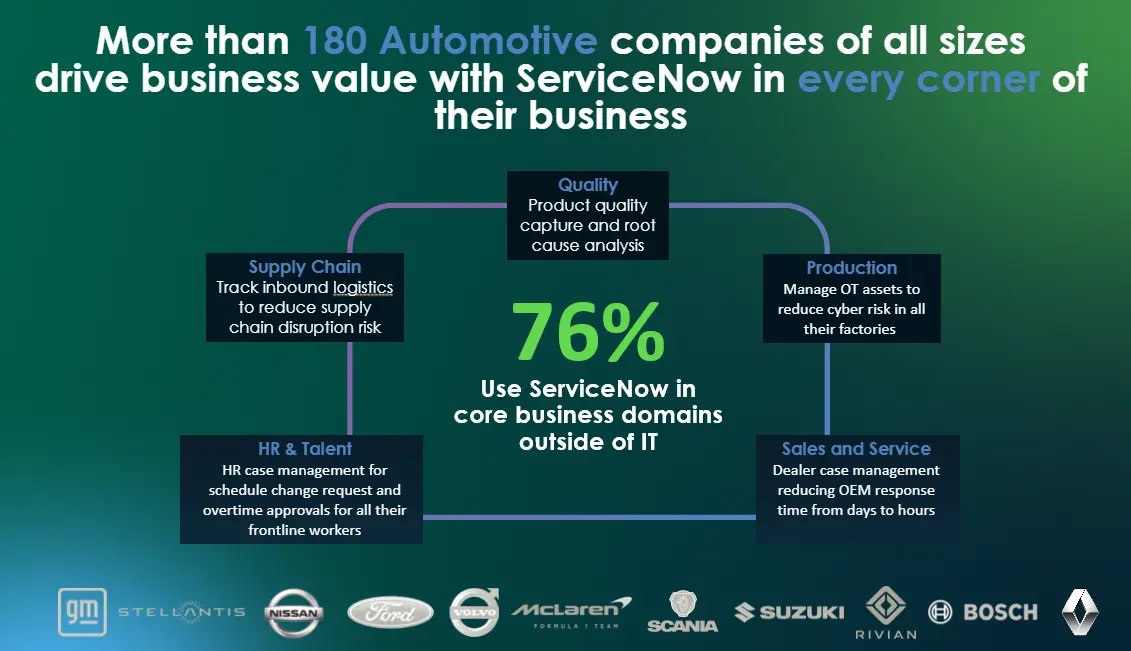
Core Capabilities for Automotive
1. Operational Technology Management
- Real-time visibility into OT assets and shop-floor systems
- Minimize downtime and production disruptions
- Secure industrial environments with OT risk monitoring
2. Manufacturing Commercial Operations
- Manage recalls, warranties, and service campaigns
- Improve dealer collaboration and service resolution
- Connect OEM, dealer, and service workflows
3. Strategic Portfolio Management
- Align vehicle programs and EV/SDV initiatives
- Optimize engineering capacity across platforms
- Accelerate NPI/NPD execution
4. Source-to-Pay
- Enable multi-tier supplier visibility and collaboration
- Manage supplier risk and disruptions
- Align procurement with production needs
5. App Engine (Low-Code Platform)
- Build workflows for ECR/ECO, quality, and plant ops
- Replace manual and legacy processes
- Support custom automotive use cases at scale
6. Manufacturing Employee Experience
- Streamline shop-floor employee services through a unified portal
- Digitize HR, IT, and operational requests to reduce delays
- Improve workforce productivity and issue resolution with automated workflows
ServiceNow Reimagining the Automotive Value Chain
The next phase of automotive transformation will be defined by how seamlessly the value chain operates as one. ServiceNow enables this by driving alignment, control, and continuity from concept through customer.
1. Across Core Automotive Operations
- Design & Engineering: Bring products to market faster with streamlined development workflows, faster validation cycles, and reduced engineering bottlenecks.
- Supply Chain: Strengthen multi-tier supplier collaboration while proactively identifying disruptions before they impact production.
- Production: Digitize plant operations, minimize downtime, and secure OT environments to ensure uninterrupted manufacturing.
- Sales & Service: Create connected dealer ecosystems and deliver seamless, personalized experiences across the customer journey.
2. Built-In Quality, Risk & Compliance
- Quality Management: Detect defects early, accelerate containment, and maintain consistent product quality across the lifecycle.
- Risk, Security & Compliance: Move from reactive firefighting to proactive risk management with enterprise-wide visibility and control.
3. Powering the Backbone of Operations
- IT Operations: Enable intelligent automation and self-healing systems to support always-on automotive operations.
- Employee Experience: Empower plant and frontline workers with faster support and frictionless service delivery.
- Finance & Procurement: Streamline shared services, reduce operational costs, and improve financial control across the enterprise.
How ServiceNow AI Is Rewiring Automotive Operations
AI in automotive is becoming central to how operations are executed in real time. ServiceNow embeds AI directly into workflows, enabling automotive enterprises to predict, prioritize, and act on issues before they impact production, supply chains, or customer experience.
1. Predictive Supply Chain Intelligence
Anticipate disruptions before they impact production by combining real-time data with AI-driven insights. Move from reactive firefighting to proactive supply chain resilience.
- Detect supplier risks and disruptions early using pattern recognition
- Prioritize critical parts and suppliers impacting production
- Trigger automated mitigation workflows before escalation
2. Intelligent Operations & Incident Resolution
Ensure plant operations run smoothly by predicting issues and resolving them before they escalate. Connect IT and OT environments for faster, coordinated response.
- Predict equipment failures and plant issues before breakdowns
- Auto-route and resolve incidents across OT and IT environments
- Enable self-healing workflows for faster recovery
3. AI-Driven Service & Customer Operations
Enhance service efficiency and consistency by embedding AI into customer and dealer workflows. Deliver faster resolutions while improving overall experience.
- Automate case routing, prioritization, and resolution
- Provide AI-assisted support to dealers and service teams
- Deliver faster, more consistent customer experiences
4. Accelerated Engineering & Change Management
Streamline engineering changes by gaining real-time visibility into dependencies and downstream impact. Reduce delays and improve execution across vehicle programs.
- Analyze impact of engineering changes (ECR/ECO) in real time
- Identify dependencies across systems, suppliers, and production
- Reduce delays in vehicle program execution
5. Enterprise-Wide Decision Intelligence
Break down data silos to enable faster, more informed decision-making across the enterprise. Shift from hindsight-driven actions to predictive, insight-led execution.
- Turn siloed data into actionable, real-time insights
- Enable faster, data-driven decisions across functions
- Shift from reactive response to predictive execution
Reimagine Automotive Operations with Aelum and ServiceNow
Drive Automotive Excellence Forward with ServiceNow and Aelum
The automotive enterprises that will lead the next decade are building operational clarity, connected workflows, and intelligent foundations today that will separate them from the competition tomorrow.
Aelum brings deep ServiceNow expertise and automotive domain knowledge to help you get there. Whether you are just beginning your transformation journey or looking to scale what is already in motion, we help you implement with precision, move with confidence, and deliver results that last.
The industry is shifting. Make sure your operations are built to move with it. Start the conversation with our manufacturing experts and explore your next step toward smarter, connected automotive operations.