Let’s say you have 2000 employees handling requests across your organization. IT help desk tickets, HR onboarding queries, procurement approvals, customer disputes, and security incidents. The usual chaos, every day. It’s a lot of people, a lot of hours, and honestly? A lot of work that doesn’t exactly need a human brain behind it.
That’s the core idea behind ServiceNow Autonomous Workforce, an intelligent system where AI agents take ownership of routine work, from start to finish, so your actual team can focus on the problems that genuinely need them.
And before you say, “sounds like something we’ll look at in a few years”, it’s not. ServiceNow itself is a living proof. They deployed Autonomous Workforce internally, and their AI specialists are autonomously resolving 90% of L1 IT tickets in-house. No human hand-holding, no escalation loops, just resolved.
Then at Knowledge 2026, ServiceNow took it further and brought Autonomous Workforce to every major business function in the enterprise. So, the question isn’t really whether this is the future of work. The question is whether your enterprise is going to be early to it or catching up.
Let’s dig into what ServiceNow Autonomous Workforce actually is, what makes it different from the AI Agents you’ve already heard about, and the very real value it brings to the table.
Meet Your New Digital Employee: ServiceNow Autonomous Workforce
Imagine an employee with 20+ years of operational intelligence, knows your incident history, resolution playbooks, and authorization policies. Well, put simply, that’s ServiceNow Autonomous Workforce.
It’s an enterprise AI framework that deploys AI specialists, each designed to perform a complete job role, not just a single task. Unlike chatbots that give you summaries or AI assistants that tell you what you should do next, these specialists actually own work end-to-end. They self-assign cases and tickets, diagnose issues, execute resolution workflows, escalate with full context when needed, and create a complete audit record, all without waiting for a human to step in.
They slot directly into your existing assignment groups using the same process you’d use to onboard a new human employee. No rebuilding workflows, no new infrastructure. They operate inside your governance model by default, respecting approval chains, inheriting role-based access controls, and following your security and compliance frameworks.
This is also why the AI Control Tower is central to the Autonomous Workforce story. It’s the command center where enterprises can connect strategy, governance, performance monitoring, and management of all their AI, including their AI specialists, from one place.
Did You Know?
ServiceNow is the only AI-powered platform where the AI front door is actually connected to autonomous workflows that finish the job.
AI specialists inherit your CMDB, service-graph, authorization models, incident patterns, resolution playbooks, and knowledge base. All the enterprise context you’ve spent years building is precisely what makes autonomous execution possible.
A Quick Look at ServiceNow Autonomous Workforce Benefits
Before the strategy, architecture, roadmap, there’s a simpler question any business leader should ask about a new technology: what does it actually give my team back? With ServiceNow Autonomous Workforce, the answer is concrete, measurable, and starts on Day 1.
- Instant capacity, zero map time: AI specialists onboard in three clicks; no months-long training, no onboarding backlog.
- 24/7 availability: Tickets and cases don’t pile up overnight or over weekends; resolution happens in real time.
- Human team freed for complexity: Routine, repetitive work handled autonomously, so your people focus on strategy and what genuinely needs human judgment.
- Built-in governance and compliance: Permissions, approval chains, and audit trails are the foundation.
- Continuous self-improvement: AI specialists learn from every resolved case, getting smarter over time.
- Intelligent escalation: When a case is out of scope, it’s handed to a human with full context.
The Four Core Values of ServiceNow Autonomous Workforce
ServiceNow built Autonomous Workforce as a new way of working. And what gives it staying power isn’t the automation itself, it’s the four principles baked into how every AI specialist thinks, acts, learns, and governs itself. These are the architectural choices that separate a system you can trust in production from one that stays stuck in a pilot.
1. Out-of-the-box AI Specialists
AI specialists arrive pre-trained on the context that matters most in enterprise IT, and they plug directly into ServiceNow’s existing workflow infrastructure. There’s no complex implementation project, no months of model training, no custom orchestration layer to build.
The first available specialist: the L1 Service Desk AI Specialist handles the exact things that eat the most time at any IT desk: password resets, account unlocks, VPN issues, software provisioning, and access requests. And at Knowledge 2026, ServiceNow massively expanded the lineup, bringing specialists to CRM, HR, security, and more.
Also Read:
Aelum at Knowledge 2026: AI Stops Assisting, Starts Executing
2. Intelligent Self-Assessment and Escalation
ServiceNow’s AI specialists use a confidence scoring system, reinforced by similar closed incidents and knowledge article usage signals, to assess whether they can resolve a given request autonomously. When confidence is high, they act. When it isn’t, they escalate, but not blindly. They pass the case back to the right human assignment group along with all their research, diagnostics, and attempted steps. A human agent picks up where AI left off, not from scratch.
3. Autonomous Workforce Management
Managing AI specialists works the same way you’d manage human team members in ServiceNow. You add them to existing assignment groups. You monitor their performance through existing Performance Analytics dashboards. If you already have breakdowns by assigned group and assigned to, the AI specialist’s metrics appear right alongside your human agents. No new dashboards to build.
You can also see additional metrics directly in the AI specialist’s profile, tracking resolution rates, escalation patterns, and response times. This gives business leaders full visibility into how their autonomous workforce is performing and where to improve.
4. Continuous Learning and Improvement
Unlike static automation that does the same thing the same way forever, AI specialists improve over time. Each resolved ticket, each knowledge article interaction, and each escalation pattern feeds back into how the specialist handles similar situations in the future. The system learns what works for your specific environment, users, and incident patterns, making every subsequent interaction smarter than the last.
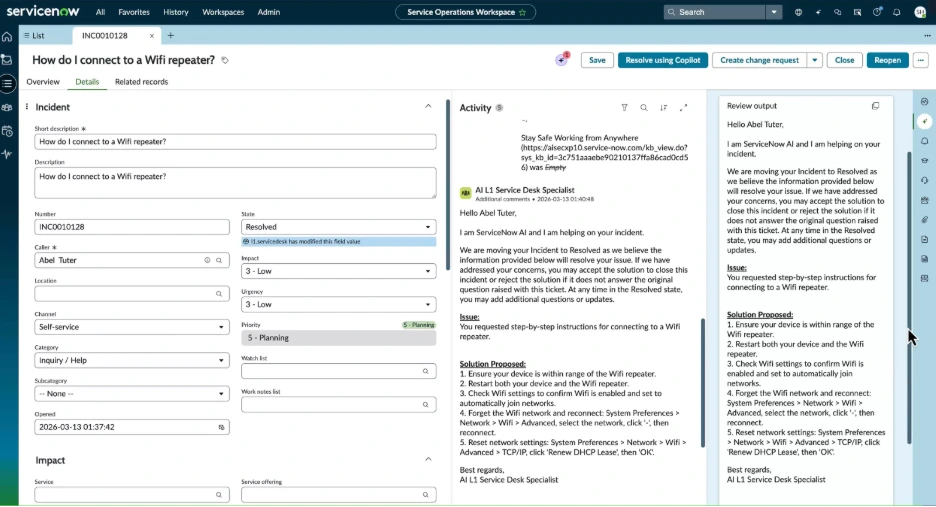
ServiceNow Autonomous Workforce dashboard showing L1 Service Desk Specialist resolving incident, generating response, updating status, and suggesting solutions automatically.
The Full Lineup: All Autonomous Workforce AI Specialists Explained
At K26, ServiceNow made a landmark move: it brought Autonomous Workforce into every major business function. Let’s see what every AI specialist is capable of doing:
Autonomous IT
The L1 IT Service Desk AI Specialist self-assigns tickets, resolves IT issues end to end, and escalates intelligently with full context when needed. Password resets, access provisioning, VPN issues, hardware requests, and ITSM incident triage are handled without keeping a human in the loop.
The broader IT AI specialist wave is coming in June 2026, spans infrastructure monitoring, site reliability engineering (SRE), asset lifecycle, and portfolio planning. An AIOps specialist cuts through alert noise, correlates events, and triggers remediation before issues escalate. An SRE specialist takes over when incidents happen, running triage and generating post-incident reviews end to end.
Autonomous CRM
Most CRM systems are good at tracking customer interactions, but they’re not built to finish them. ServiceNow’s CRM AI specialists close that gap across the full customer lifecycle: triaging and resolving cases, nurturing new leads with automated outreach, processing billing disputes and chargeback fraud, monitoring customer engagement health to flag renewal risks early, and supporting expansion conversations with live health data.
A case specialist also pulls together a 3600 view of customer and case context, so resolution happens faster and with full context.
Autonomous Employee Experience
HR, legal, finance, procurement, and workplace services teams deal with the same problem at scale: high case volumes, repetitive triage, and service desks that can’t keep up. AI specialists across these functions act as role-specific digital employees, handling everything from onboarding tasks and HR growth planning conversations to voice-based HR request resolution.
Across ServiceNow’s customer base, these specialists resolve 91% of cases without reassignment.
Autonomous Security and Risk
Security teams are perpetually behind. Vulnerabilities stack up faster than they can be triaged, phishing incidents demand cross-tool investigation, and manual processes turn minutes into hours. The new Autonomous Security and Risk specialists are built to close that gap: one for autonomously triaging and remediating vulnerabilities (including at the hardware level), one for investigating and containing SOC incidents with humans in the loop, and one for screening third-party vendor risk so teams only spend time on what genuinely needs scrutiny.
ServiceNow’s AI also extends into app development through Build Agent, helping teams build enterprise apps faster using natural language, but that’s a separate capability from Autonomous Workforce.
Availability of AI Specialists
- Available Now: L1 IT Service Desk AI Specialist, CRM AI specialists, Employee service AI specialists
- Expected in June 2026: IT AI specialists (AIOps, SRE, asset, portfolio)
- Expected preview in June 2026, GA in Sept 2026: Security and risk AI specialists
Before Selling It, They Proved It. ServiceNow’s Own IT Desk Story
With 33,000+ employees, 950+ business applications, and 34,000 end-user devices to support, ServiceNow’s own digital technology team knew the pressure firsthand.
And, with a ratio of approx. 1K employees to every IT agent, the pressure to deliver fast and effective solutions is immense. Agents are often overwhelmed by many tickets, forcing them to choose between speed and quality. This leads to:
- Switching tab chaos
- Manual triage bottlenecks
- High MTTR
With an Autonomous IT service desk, ServiceNow achieved:
- 90% of IT support requests handled autonomously
- 96% resolution efficiency, increased from 81%
- 85% of IT support agents redeployed to higher value work
ServiceNow EmployeeWorks’ Relationship with Autonomous Workforce
Think of ServiceNow EmployeeWorks as the front door and Autonomous Workforce as everything that happens once the door opens. In most enterprises today, there’s a frustrating gap between when an employee asks for something and when it actually gets done.
Example:
They type a request in Slack, it becomes a ticket, the ticket sits in a queue, someone eventually picks it up, maybe routes it to the wrong team, and the employee follows up three days later. That gap between intent and execution is exactly what EmployeeWorks and Autonomous Workforce are designed to close, together.
ServiceNow EmployeeWorks is the single AI front door for the enterprise. Powered by Moveworks’ conversational AI (trusted by over 5 million enterprise users before the acquisition), it meets employees wherever they are: Teams, Slack, a portal, and understands what they need in plain language. Benefits questions, PTO requests, IT issues, and purchase order lookups.
Autonomous Workforce is what takes that intent and finishes it. Once EmployeeWorks understands the request, the right AI specialist picks it up and executes it end-to-end, running the workflow, applying fixes, checking approvals, and closing the loop.
Together, they create a closed loop:
Employee asks → EmployeeWorks understands → AI Specialist executes → Work is done
AI Agents or Autonomous Workforce? Which One’s Best for You
By now you’ve probably heard the word “agent” thrown around enough that it’s started to lose meaning. Every AI vendor has agents; every product announcement involves agents. So, when ServiceNow talks about Autonomous Workforce, a fair question is: isn’t this just agents with a different name? Well, not really. Understanding exactly why not is the key to figuring out where each fits in your enterprise AI strategy. Here’s the clearest breakdown of how they’re different, and why you may need both.
| Dimension | ServiceNow AI Agents | ServiceNow Autonomous Workforce |
| What they do | Execute a single, specific task (reset a password, look up a status, answer one question) | Own an entire job role end-to-end, from self-assigning a ticket to resolving, escalating, and documenting it |
| How they’re set up | Require technical configuration, orchestration, and often custom development | Onboard in 3 clicks, added to existing assignment groups like a new team member |
| How they operate | Need external orchestration to chain multiple steps; each agent handles its own narrow scope | Autonomously coordinate multiple AI agents internally to deliver a complete outcome |
| Governance & permissions | Permissions typically configured per-agent | Inherit all roles, permissions, and authorization policies from their assignment group by default |
Autonomous Workforce autonomously executes workflows by orchestrating teams of AI agents behind the scenes, so the specialist can focus on the outcome while the agents handle the individual actions.
So, the right question isn’t “which should we choose?” It’s “which layer of the problem are we solving?“
- Agentic AI: If you need a specific task automated
- Autonomous Workforce: If you need an entire job function to run autonomously
- Both working together: If you want enterprise-grade AI that scales across IT operations
Work With a Certified ServiceNow Partner Who’s Done This Before
GenAI vs Autonomous Workforce
| Dimension | Generative AI | Autonomous Workforce |
| Output | Generates text, suggestions, summaries, drafts | Executes actions, resolves incidents, closes tickets |
| Role in the process | Assists humans in doing work faster | Replaces humans on defined, repeatable work entirely |
| Governance | Often operates outside enterprise workflows | Lives inside ServiceNow’s workflow and permissions layer; every action is auditable |
| Learning | Pre-trained on general data | Learns from your specific incident history, knowledge base, and resolution patterns |
Virtual Agent vs Autonomous Workforce
| Dimension | Virtual Agent | Autonomous Workforce |
| Built for | Conversational chat interfaces: E.g., Teams, Slack, portal chatbots | Working on incident and request records |
| Interaction Model | Dialogue-driven; it asks, the employee responds, and the agent guides | Action-driven; it picks up tickets before a human does and resolves them without requiring a conversation |
| Resolution Capability | Guides employees to self-serve or routes them to the right team | Autonomously diagnoses, fixes, and closes tickets |
| Replacement | No, Virtual Agent handles chat deflection | No, AI Specialists handle queue-based resolution. They’re complementary, not competing |
AI Does the Work. We Help You Set It Up Right on ServiceNow.
The move from AI assistants to AI workers, from task automation to role automation, from reactive service desks to zero-touch IT aren’t incremental upgrades. They require a partner who understands how to install a platform and align it to your business architecture, your governance model, and the actual outcomes your IT leadership is accountable for.
This is where the depth of your implementation partner matters more than it ever has. Getting Autonomous Workforce up and running in three clicks is one thing. Getting it to resolve 90% of your tickets, earn the trust of your IT leadership, and scale intelligently across your enterprise is another conversation entirely.
At Aelum, we’ve been in that second conversation for a while. As a certified ServiceNow partner with deep practice across ITSM, AI, and platform implementation, we bring technical execution capability and a strategic lens to help enterprises move from a first deployment to a fully realized autonomous IT operation.
If Autonomous Workforce is the future of your IT org, it’s worth making sure you have the right people helping you build it right, the first time. Let’s start with building your roadmap. Talk to our ServiceNow AI experts today.