The platform is live. The confetti has been swept up, the project team has moved on, and ServiceNow is finally ready to make everyone’s working life easier. So why is everyone still emailing the service desk?
Here is the odd part about ServiceNow adoption. Even though organizations invest in AI, self-service and automated workflows, using ServiceNow can still feel like a scavenger hunt. Employees hunt for the right catalogue item. Agents hunt through emails for details to copy into tickets. The knowledge base gets a handful of views a week, while the answer sits three clicks away.
That gap between “live” and “used” is a people problem more than a technical one. ServiceNow’s own adoption team makes the same point: adoption doesn’t happen at go-live. Go-live is the starting line, not the finish line.
So what does adoption actually mean? It is the extent to which the people who should use ServiceNow actually use it as intended. Employees raise requests and search knowledge in the portal. Agents work tickets, follow workflows and keep records in the platform. Logins and license counts don’t tell you any of that, because logging in once is just showing up.
In this post, we look at why ServiceNow adoption stalls, what you gain when it works, and how Aelum helps swap the scavenger hunt for a clear path.
Challenges in ServiceNow adoption
Adoption rarely fails for a single reason. Across implementations, the same six obstacles keep appearing.
- Old habits and open email channels: Email, phone calls and messaging a friendly agent often feel faster than a portal. While those channels stay open, employees have no reason to change.
- A portal that is hard to use: Long catalogues, confusing forms and IT jargon push people back to email. Many catalogues mirror how IT is organized rather than how employees describe their problems.
- Knowledge people can’t find or trust: Articles are often long, outdated or written for IT experts. Once employees find one wrong answer, they stop searching.
- Training that stops at go-live: One-time sessions fade quickly, and adoption needs continuous, role-based enablement. Every upgrade and new catalogue item changes what people need to know.
- Forgotten audiences: Plans focus on employees and agents, but approvers and managers matter just as much. Slow approvals undo good portal adoption, and Prosci’s research has long ranked people-manager engagement as a top contributor to change success.
- No measurement: Many teams track logins instead of how work actually flows. Without a view of channel shift, self-service resolution and knowledge use, the problem stays hidden until leadership asks where the value went.
If two or three of these sound familiar, the issue is not the platform. It is the experience around it, the habits of the people using it, and the lack of anyone owning adoption after go-live.
Benefits of user adoption
Adoption decides whether ServiceNow delivers faster service, lower costs and better data, or just a more expensive ticketing tool. When people use the platform as designed, the gains show up for everyone.
#1. Employees get one front door, faster answers and fewer follow-ups. They solve common issues through self-service instead of waiting in a queue.
#2. IT agents stop re-keying details from emails. Work follows consistent workflows, and fewer repeat tickets arrive as self-service absorbs common requests.
The business gets cleaner data and more reliable reporting, because work is recorded in the platform rather than in inboxes and side spreadsheets. Leaders can finally connect the platform investment to real outcomes.
AI initiatives also depend on adoption. Features such as Now Assist only create value when people use them, and ServiceNow now offers dashboards that show Now Assist adoption by department so you can see where to focus enablement.
To prove these benefits, track measures that reflect behavior rather than logins:
- Portal and app share of tickets compared with email and phone
- Self-service resolution rate
- Knowledge article views and helpfulness
- User satisfaction with the service experience
These are the signals that show real progress, and they give leadership a clear view of whether adoption is improving.
How Aelum can help: ServiceNow Adoption & Value Realization
Fixing adoption takes more than a training session. Aelum treats it as an ongoing business performance initiative, built on three pillars that work together.
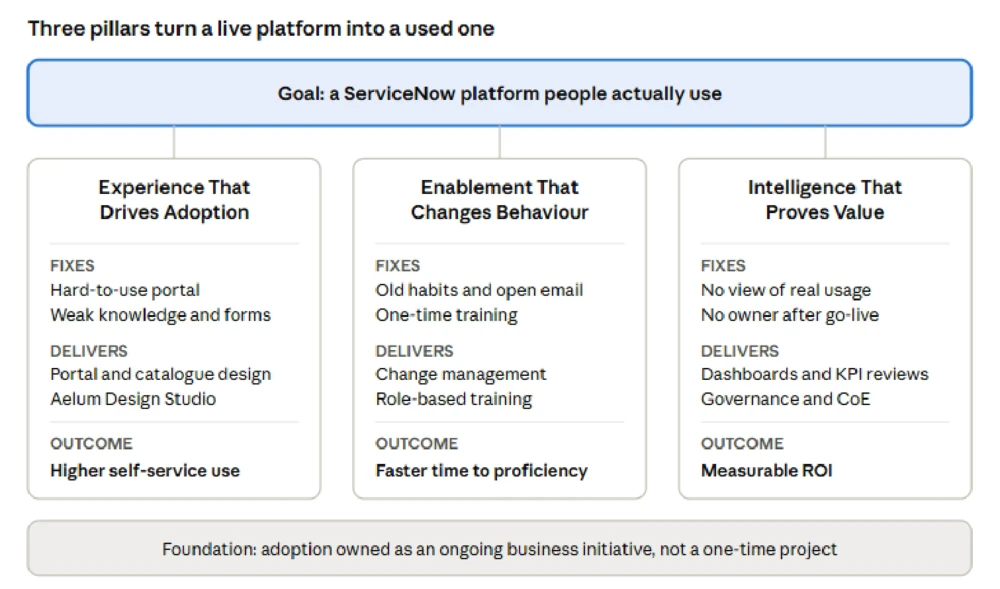
Each pillar answers a set of the challenges above: experience draws people in, enablement builds confidence, and intelligence keeps both improving.
Pillar 1: Experience That Drives Adoption
If the portal isn’t intuitive, people won’t switch. Aelum improves the employee experience through portal and Employee Center design, service catalogue simplification, and knowledge and self-service optimization. Persona-based, mobile-friendly experiences and simpler workflows and approvals make ServiceNow match how people actually work.
Aelum Design Studio is where this pillar comes to life.
The outcome: higher self-service use and less reliance on the service desk.
Pillar 2: Enablement That Changes Behavior
Habits change when people feel confident and supported. Aelum builds that through organizational change management, including readiness, stakeholder engagement and role-based communications, plus change champion programmes. Role-based training with quick guides and video tutorials keeps skills current, and enablement continues after each release and for every new joiner.
The outcome: faster time to proficiency and less resistance to change.
Pillar 3: Intelligence That Proves Value
What you don’t measure, you can’t improve. Aelum starts with an adoption health check to baseline usage, then sets up adoption dashboards, KPI reviews and user satisfaction surveys. Quarterly optimization recommendations and governance, including a Center of Excellence, give adoption a clear owner after go-live. For AI features, the same approach tracks Now Assist utilization.
The outcome: leadership can see progress and connect adoption to return on investment.
Want your ServiceNow users to actually use what you built?
Better ServiceNow adoption is not about adding another portal page or running one more training session. It is about earning enough trust, in the first few minutes and on every visit after, that people choose self-service over sending an email.
- Review your current adoption picture: Watch what employees and agents actually do in their first weeks on the platform, not what the workflow was designed to do on paper. Then compare portal share of tickets against email and phone.
- Explore Aelum Design Studio: See how Aelum combines design thinking, usability research and ServiceNow expertise to build experiences that employees choose to use.
- Talk to an Aelum consultant: If your self-service numbers are not matching your investment in AI and automation, the experience around the platform is usually the first place to look.
Frequently Asked Questions
ServiceNow adoption often struggles when workflows are complex, employees lack adequate training, or the platform does not align with everyday business needs. Limited change management, poor communication, and insufficient leadership involvement can also lead to low engagement and employees reverting to familiar processes.
Organizations can improve adoption by simplifying workflows, personalizing user experiences, and aligning platform capabilities with employee needs. Role-based training, leadership participation, regular feedback, and clear communication about business benefits help employees understand the platform’s value and use it consistently.
Key KPIs include active user rates, self-service adoption, portal visits, ticket deflection, workflow completion rates, feature utilisation, and employee satisfaction scores. Tracking these metrics alongside resolution times and platform usage trends helps organizations identify adoption gaps and measure business impact.
Employee Center provides a unified, personalized portal where employees can access services, find information, raise requests, and track progress. By simplifying service discovery and bringing multiple workflows into one experience, it encourages self-service, reduces dependency on support teams, and improves platform engagement.
Change management prepares employees for new ways of working through clear communication, stakeholder engagement, and structured transition plans. Continuous, role-based training builds confidence, reinforces platform usage, and helps employees adapt as new features and workflows are introduced. Together, they support sustained adoption and long-term value.