
When you order a customized car, you pick the model, engine, colour, add-ons, and instantly get a price. You don’t call three departments and wait a week. CPQ (Configure, Price, Quote) for manufacturing works the same way, but for your selling processes.
At its core, CPQ is a sales enablement tool that helps manufacturers handle complex product configurations, apply the right pricing rules, and generate accurate quotes without the back-and-forth. For manufacturers handling large product catalogs, custom orders, multiple sales channels, and tight margins, CPQ is the difference between a quote that takes days and one done in minutes.
Ahead in the blog, we’ll walk you through why manufacturers are prioritizing CPQ in 2026, how leading platforms compare, which segments benefit most, and how to choose the platform that won’t slow you down two years from now.
Why Manufacturers Need CPQ Softwares?
Manufacturing has always been complex. Thousands of product configurations, variable pricing across channels, coordination between sales, engineering, and production, all while keeping delivery timelines intact.
For years, this was managed with spreadsheets, tribal knowledge, and manual approval chains, resulting in quotes full of errors, slow sales cycles, and lost deals.
CPQ software fixes this. It enforces product rules so incompatible configurations never make it into a quote, automates pricing logic so discounting stays within bounds, and generates customer-ready proposals that operations can act on.
What Manufacturers Should Expect from a CPQ Software in 2026
CPQ software does a lot more than speed up quoting. For manufacturers dealing with complex products, multiple channels, and tight margins, it fundamentally changes how the sales process operates, from the first configuration to the final order. Here’s what to expect from a modern CPQ platform:
1. Handles extreme product complexity
Modern CPQ platforms should support highly configurable products, custom engineering requirements, and quotes with thousands of line items natively, without forcing teams to rely on spreadsheets, manual validations, or specialist intervention.
2. AI-guided selling & configuration assistance
AI is becoming a standard capability in CPQ. Manufacturers should expect guided selling, conversational quoting, intelligent product recommendations, and automated upsell suggestions that help teams configure the right solutions faster while reducing costly errors.
3. No-code administration for business teams
RevOps, Sales Ops, and commercial teams should be able to update pricing logic, approval workflows, discount structures, and product rules without depending heavily on IT.
4. Seamless quote-to-fulfillment
Once a deal is approved, BOM creation, ERP synchronization, inventory validation, production planning, and fulfillment workflows should trigger automatically without duplicate data entry across systems.
5. Unified omnichannel selling
Manufacturers should expect CPQ platforms to support direct sales, distributors, dealers, partners, and e-commerce channels from a single centralized system, ensuring consistent pricing, product logic, and customer experiences across every channel.
6. Real-time pricing & margin visibility
Modern CPQ platforms should help you protect margins with dynamic pricing, approval governance, and real-time visibility into discounts, profitability, and deal risks before quotes are finalized.
7. Enterprise-grade scalability and integration
In 2026, CPQ platforms are expected to integrate seamlessly with CRM, ERP, PLM, and supply chain systems while supporting global operations, multiple currencies, regional pricing models, and large enterprise sales environments.
ServiceNow CPQ Process for Manufacturing Sales
| Step 1: Target & Needs Analysis | Guided selling surfaces right product families based on customer application, industry, and volume requirements |
| Step 2: Product Selection & Configuration | Commerce Logic Engine validates every component selection in real time |
| Step 3: Pricing & Deal Structuring | Unified catalog applies volume tiers, regional rules, and discount guardrails automatically |
| Step 4: Quote & Commercial Package Generation | Accurate, branded quote generated instantly, including line items, BOMs, delivery terms, and any required compliance documentation |
| Step 5: Approval & Sign-Off | Automated routing based on deal parameters; approvers notified immediately |
| Step 6: Order Handoff | Quote converts to order; BOMs push to ERP; production scheduling, inventory checks, and fulfillment triggered automatically |
Manufacturing Segments CPQ Serves
ServiceNow CPQ adapts to segment-specific complexity rather than forcing manufacturers into a generic process. Let’s see how:
Automotive
Automotive manufacturers and suppliers deal with an enormous range of configurations: trim levels, component variants, regional compliance requirements, and dealer channel pricing. A single vehicle or component can have thousands of possible combinations, and errors at the quote stage can cascade into costly production changes. ServiceNow CPQ enforces configuration rules that reflect real engineering constraints, supports dealer and distributor channel pricing, and ensures what gets quoted is exactly what can be manufactured and delivered.
Also Read:
How Maruti Suzuki Transformed Dealer Liability Reconciliation with ServiceNow
Electronics
Electronics manufacturers face rapid product cycles, complex bill of materials, and customers who increasingly want to configure and buy without a sales rep involved. Pricing shifts frequently: component costs fluctuate, and discount structures vary by channel and volume. ServiceNow CPQ handles frequent catalog updates without IT involvement, supports self-serve and e-commerce configurations, and applies real-time pricing logic that keeps margins protected even when product lines change fast.
Read Case Study:
Electronics Manufacturer Centralized IT System Platform with ServiceNow ITSM
Industrial Equipment
For manufacturers of heavy or specialized industrial equipment, think custom conveyor systems, hydraulic machinery, or power generation units, every order is essentially a unique product. Standard CPQ tools fall apart here. ServiceNow CPQ’s dynamic configuration engine handles engineer-to-order and configure-to-order products, generates accurate BOMs from the configured quote, and routes non-standard deals through the right approval chains, all without pulling engineering into every sales conversation.
Aerospace & Defense
Aerospace and defense manufacturers operate under strict compliance requirements, long sales cycles, and highly complex, regulated product configurations. Quoting errors here cost money, delay contracts or create compliance risk. ServiceNow CPQ’s rules-based engine ensures configurations stay within approved parameters, approval workflows manage multi-stakeholder sign-off requirements, and the platform maintains a complete audit trail across the entire deal lifecycle.
Construction & Infrastructure
Manufacturers supplying the construction and infrastructure sector: precast concrete, structural components, modular systems often sell through project-based models where specs change mid-cycle and multiple delivery locations are involved.
ServiceNow CPQ supports multi-destination delivery, staged project requirements, and mid-deal configuration changes without losing deal history or creating rework downstream.
Process Manufacturing (Chemicals, Food & Beverage, Packaging)
Process manufacturers deal with formula-based products, regulatory labeling requirements, and pricing that shifts with raw material costs. Their quoting complexity is less about component selection and more about volumes, concentrations, compliance documentation, and contract terms. ServiceNow CPQ supports flexible pricing models, volume-based deal structures, and documentation generation, making it easier to quote accurately and consistently even when the variables change frequently.
Comparing The Big CPQ Players
Choosing the wrong CPQ costs you implementation, and every day after, in slow quotes, IT backlogs, and deals lost to faster competitors. Before you decide, here’s an honest look at how the four big CPQ platforms:
| Salesforce CPQ |
|
| ServiceNow CPQ |
|
| Oracle CPQ |
|
| SAP CPQ |
|
The Salesforce CPQ End-of-sale
Salesforce CPQ is now end of sale. Existing customers are being pushed toward Agentforce Revenue Management, a product still in its early stages, with limited large-scale deployments and higher-than-expected implementation costs.
For manufacturers who have been running on Salesforce CPQ for years, the choice is now:
- Stay on Salesforce CPQ until it reaches end of life.
- Migrate to Agentforce Revenue Management and take on that risk and cost.
- Evaluate alternatives built for manufacturing’s complexity.
Beyond Salesforce CPQ EOS, the broader case for acting now is clear. Manufacturing sales cycles are getting more complex. Buyers want faster quotes. Channels are multiplying; direct, partners, e-commerce, and product portfolios are expanding. A CPQ platform that was “good enough” three years ago is likely the bottleneck in your revenue process today.
Why ServiceNow Stands Among the Best CPQ for Manufacturing
ServiceNow CPQ (formerly Logik.ai) is built for the selling complexity that defines manufacturing. Thousands of product variants, engineer-to-order configurations, multi-tier channel pricing, and a shop floor that can’t afford to receive a wrong order. It eliminates the gap between what sales quotes and what production actually builds, from the first configuration to the final order handoff.
Did You Know?
The global market for CPQ Software is projected to reach US$7.3 billion by 2030, growing at a CAGR of 16.2% from 2024 to 2030.
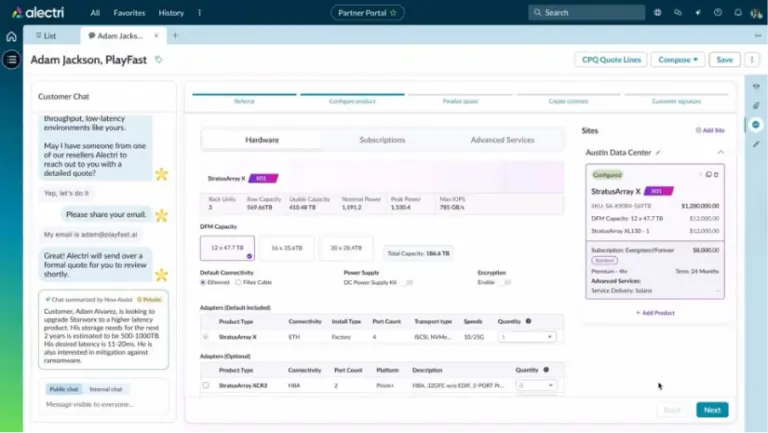
ServiceNow CPQ product configuration interface showing hardware selection, DFM capacity options, adapter settings, and a real-time quote summary for a customer order.
Manufacturing Challenges ServiceNow CPQ Solves
Oldcastle is one example. But the challenges ServiceNow CPQ solves go far beyond any single deployment. Here’s a direct mapping of each manufacturing challenge to the ServiceNow CPQ capability built to fix it.
1. Configuration Errors That Reach Shop Floor
Sales reps manually configuring complex products without guardrails inevitably produce errors: wrong dimensions, incompatible components, or missing specs, often caught only after production begins.
ServiceNow CPQ Capability: Rule-Based Configuration Engine
The Commerce Logic Engine enforces product rules at the point of configuration. Incompatible combinations are blocked before they ever make it into a quote. Every selection is validated in real time against a defined set of constraints: dimensions, dependencies, material compatibility, so what gets quoted is always something that can actually be built.
Example: A heavy equipment manufacturer prevents hydraulic system selections incompatible with specific chassis models. Factory floor errors dropped near to zero.
2. Manual, Slow & Error-Prone BOM Generation
Every time a quote gets approved in manufacturing, someone has to translate it into a Bill of Materials the shop floor can actually use. That translation (done manually) is where specs get misread, components get missed, and production gets the wrong inputs. The lag alone can cost days before a single part is ordered.
ServiceNow CPQ Capability: Automated BOM Generation
BOMs are generated directly from the configured quote; automatically, accurately, and without human translation. They’re then passed to ERP systems via API, triggering production scheduling, inventory checks, and procurement workflows the moment a deal closes. No re-entry, no interpretation, no delay.
Example: Oldcastle Infrastructure now generates BOMs in CPQ and pushes them automatically to SAP, turning a multi-day manual process into a same-day automated handoff.
3. Customized Products Break Standard Quoting
Manufacturers offering engineer-to-order or configure-to-order products face a fundamental problem: standard CPQ tools aren’t built for products that don’t exist yet. Every custom deal becomes a manual exercise involving engineering sign-off, back-and-forth emails, and delayed quotes.
ServiceNow CPQ Capability: Dynamic Product Configuration
Selections cascade and adapt based on prior choices, customer inputs, and engineering constraints. This means sales reps can build accurate quotes for custom or configure-to-order products in real time, without pulling engineering into every deal.
Example: A manufacturer of custom industrial enclosures used ServiceNow CPQ to model their engineer-to-order product range into the configuration engine. It reduced quote turnaround from 3-4 days to under 20 minutes.
4. Long Quotes Killing Deal Closure Rates
A quote that takes four days to produce often loses to a competitor who responded in four hours. Complex pricing approvals, manual configuration checks, and the need to loop in multiple departments all slow down the process.
ServiceNow CPQ Capability: AI-Guided Selling + Automated Approval Workflows
Millisecond configuration performance with AI-guided selling surfaces the right products, pricing, and options at the right moment, reducing the time reps spend navigating complexity. Approval workflows are automated based on deal parameters, so non-standard deals route to the right stakeholders instantly.
Example: A manufacturer reduced their quoting time from 5 days to 5 minutes after implementing ServiceNow CPQ.
5. Pricing Inconsistency Across Channels & Regions
A manufacturer selling through direct reps, distributors, and online channels often ends up with inconsistent pricing: different discounts, outdated price books, and no real-time guardrails on margins. This creates channel conflict, erodes trust with partners, and leaves money on the table.
ServiceNow CPQ Capability: Unified Pricing Catalog with Multi-Channel Pricing Logic
ServiceNow CPQ runs all channels: direct sales, partner portals, e-commerce, off a single unified product and pricing catalog. Pricing rules, discount thresholds, and margin guardrails are defined once and applied consistently everywhere. Volume-based pricing, regional variations, and promotional models are all supported within the same engine.
Example: A manufacturer selling through both a direct sales force and a distributor network enforced channel-specific pricing rules from one catalog. Pricing disputes with distributors dropped, and margin leakage from unchecked discounting was controlled.
6. SKU Sprawl Makes Catalog Unmanageable
Product line expansions, custom orders, regional variants, and years of one-off configurations leave most manufacturers managing thousands of SKUs, many of them redundant or barely differentiated. Sales reps can’t navigate them confidently, quotes become inconsistent depending on who’s doing the quoting, and maintaining the catalog requires constant IT involvement.
ServiceNow CPQ Capability: Intelligent Product Catalog Management
Configuration rules and variant logic dynamically represent product options, reducing catalog size while expanding what customers can actually configure. SKU proliferation is replaced by a structured, rules-driven model that’s easier to maintain, easier to sell from, and far less likely to produce inconsistent quotes.
Example: A manufacturer uses configuration logic to consolidate a sprawling product catalog, cutting admin overhead while maintaining their full product range for customers.
7. No Self-Service for Customers or Channel Partners
B2B manufacturing buyers increasingly expect to configure and price products without waiting for a sales rep to become available. Distributors want to build and submit quotes independently. Dealers want a portal that reflects their specific pricing and available product range. Legacy CPQ systems weren’t built for this.
ServiceNow CPQ Capability: Composable Omnichannel Commerce
The same configuration engine that powers your sales team can be surfaced through a distributor portal, a dealer interface, or a customer-facing e-commerce experience. Each channel gets the right experience, governed by the same rules and pricing logic, without duplicating systems or building separate tools per channel.
Example: Club Car deployed ServiceNow CPQ’s self-serve configuration capability through their e-commerce channel and achieved an industry-leading 3% lead conversion rate, turning what was previously a rep-dependent process into a scalable, always-on revenue channel.
How ServiceNow CPQ Transformed Sales & Operations for a Leading Manufacturer
Oldcastle Infrastructure, a North American infrastructure solutions provider with 70,000+ employees, ran on multiple disconnected product configuration systems. Each had its own security standards, making it difficult to maintain and monitor security protocols across the company. This led to slower delivery times, frustrated customers, and no self-service capability.
After Implementing ServiceNow CPQ:
- Complex configurations built instantly with 3D visualization
- BOMs auto-generated and pushed directly to SAP for manufacturing
- Sales, manufacturing, billing, and admin teams operate from one unified system
- API-first design removed manual data sharing across departments
- Security protocols are now managed from a single platform
Build your CPQ implementation plan with our ServiceNow experts
How ServiceNow CPQ and ERP Work as One
One of the most persistent challenges in manufacturing is the disconnect between front office and the back office.
A sales rep closes a deal, and then the real work begins someone manually takes the quote, interprets it, re-enters it into the ERP, and hopes nothing gets lost in translation. This is where errors compound, delays accumulate, and customer promises get broken.
ServiceNow CPQ addresses this through an API-first architecture that connects directly with ERP systems including SAP, Oracle, and others. When a quote becomes an order, the handoff is automated. BOMs generated inside CPQ flow directly into the ERP, triggering production scheduling, inventory checks, and fulfillment workflows without human intervention.
This means:
- Configuration data becomes production input; no translation, no re-entry
- Lead times shrink; production begins the moment a deal closes
- Billing aligns with what was configured: fewer disputes, less revenue leakage
- Every team: sales, manufacturing, billing, logistics works from the same data
The Right CPQ Changes Manufacturing. The Right Partner Makes It Happen.
If you’re currently on Salesforce CPQ, end-of-sale is a decision that needs to be made now, before competitors move first and implementation windows get tighter.
But the software is only half the equation. A CPQ implementation that’s poorly scoped, misconfigured, or disconnected from your ERP creates a new problem. Getting full value out of ServiceNow CPQ means configuring it around how your business actually sells: your product logic, your approval chains, your ERP integrations, your channels.
That’s exactly what we do at Aelum. As a certified ServiceNow partner, we work with manufacturers to implement, optimize, and migrate to ServiceNow CPQ, turning complex deployments into clean, high-performing systems that work from day one. Whether you’re starting fresh or moving off a legacy platform, we make sure you’re not just live on ServiceNow CPQ but getting everything it’s capable of.
Ready to see what that looks like for your manufacturing sales? Talk to our CPQ experts.