For years, Salesforce CPQ (originally SteelBrick) was the backbone of quoting for thousands of companies. It automated proposals, accelerated approvals, and gave sales teams a structured way to configure complex deals inside Salesforce. For many organizations, it delivered exactly what was needed at the time.
That time is over.
Salesforce CPQ has reached End of Sale on March 27, 2025. Most of the market is treating this as End of Life, and for existing customers, that is exactly what it feels like. No new sales. No product innovation. Shrinking support. Rising costs. And the only path forward Salesforce offers is a forced reimplementation on Revenue Cloud Advanced (RCA).
This blog covers everything a decision-maker needs to navigate that choice. We examine why Salesforce made this call, why the upgrade path to RCA is more complex than it is being sold as, what the real cost of delay looks like, and why ServiceNow CPQ has emerged as the most compelling migration destination for enterprise organizations. We also walk through a step-by-step migration strategy and a practical checklist, so if you decide to move, you know exactly where to start.
Salesforce CPQ EOS: The Beginning of the End
Here is what happened on March 27, 2025, and why it matters more than most companies have understood.
Salesforce did more than stop selling a product. They told every existing CPQ customer that the system they rely on has no future. No new features will be built. No innovation is planned. The talent that built and maintained CPQ implementations is already moving to other platforms. And your Salesforce Account Executive, however diplomatically they frame it, is now incentivized to move you to Revenue Cloud Advanced. Their commission is tied to that outcome.
There is a second dimension to this that gets less attention. Organizations staying on legacy Salesforce CPQ are now locked out of Agentforce integration, which is the centerpiece of Salesforce’s AI roadmap. As competitors use AI to automate guided selling, approval workflows, and deal intelligence, organizations on legacy CPQ will be running a static, frozen quoting system from 2021.
EOS is a strategic ceiling that compounds every quarter a company delays.
Why Has Salesforce Made the Decision to End Salesforce CPQ?
Salesforce frames EOS as a natural evolution. CPQ is being replaced by Revenue Cloud Advanced (RCA), formerly Revenue Lifecycle Management (RLM), now referred to in some communications as Agentforce Revenue Management (ARM). The repeated rebranding is itself a signal worth noting. Four forces combined to produce this outcome.
The Product Stopped Evolving Years Ago
Salesforce CPQ has received no meaningful updates in more than four years. Performance limits that frustrated enterprise teams in 2021 remain unresolved in 2025. Filed bugs remain open. The product entered quiet stagnation long before the official announcement. The announcement made it public.
The Architecture Hit Its Ceiling
CPQ was built as a managed package added onto Salesforce CRM. The architecture was well suited to its era, but it was designed for a simpler world. Large product catalogs slow down the quote line editor. Complex pricing scenarios require custom JavaScript scripts that only a specialist can maintain. Scalability was always a constraint.
The Market Moved Toward Full Revenue Lifecycle Management
Modern revenue operations require a platform that connects quoting to billing, billing to revenue recognition, and revenue recognition to contract management, all in real time. CPQ only addressed the quoting stage, leaving the rest of the chain to additional products and integrations.
Salesforce Needs a New Revenue Stream
RCA carries higher implementation and licensing costs than legacy CPQ. With the CPQ market growing fast and new competitors entering, Salesforce had a clear commercial reason to accelerate migration to a product that generates higher contract value. EOS is as much a pricing strategy as it is a product decision.
Why Revenue Cloud Advanced Is a Reimplementation, Not an Upgrade
Many Salesforce partners describe the move to Revenue Cloud Advanced as a natural next step. What they are slower to say is that this is a full reimplementation, presented as an upgrade.
RCA is architecturally distinct from legacy CPQ. Custom pricing rules, QCP scripts, product bundles, and approval workflows do not transfer. The data model changes. Users need retraining. Integration needs to be rebuilt. The only continuity is the Salesforce name on the contract.
The product naming history, from RLM to RCA to ARM, signals instability in the product itself. Organizations that began RCA implementations in 2024 have shared consistent feedback: longer timelines, higher costs, adoption challenges, and feature gaps relative to legacy CPQ in certain areas.
RCA may be the right path for organizations that are deeply committed to the Salesforce ecosystem and have the budget and timeline for a multi-year reimplementation. But that decision deserves clear thinking, not a sales pitch framed as a smooth upgrade.
Plan Your CPQ Exit Strategy
The Cost of Waiting and Why You Should Migrate From Salesforce CPQ
Every quarter a company delays its Salesforce CPQ migration, the cost of that migration rises. This is structural, not rhetorical.
The Talent Cost
The Salesforce CPQ specialist pool is contracting. Certified architects and experienced CPQ developers are retraining on RCA or moving to other platforms. As supply shrinks and migration demand spikes, the cost of the expertise needed to maintain a legacy system or move off it rises each month.
The Technical Debt Cost
Every customization added to legacy CPQ today becomes migration complexity later. Every workaround, every ad-hoc script, every spreadsheet a sales team uses because CPQ cannot handle a pricing edge case, all of it becomes friction in the migration project.
The Strategic Cost
By 2026, revenue operations are a standard organizational function. Boards expect unified forecasting, AI-driven insights, and tight alignment between sales, finance, and customer success. Legacy CPQ actively works against modern RevOps strategies. It cannot evolve alongside usage-based billing, AI-driven workflows, or multi-entity pricing complexity.
The Negotiating Cost
Waiting gives Salesforce and implementation partners increasing leverage. The closer a company gets to the renewal cliff, the fewer options remain and the less favorable the negotiating position. Companies that begin migration evaluation now choose on their own terms. Companies that wait until late 2026 will make reactive decisions under pressure.
The RevOps Reality Check
Count the spreadsheets, side tools, and shadow systems currently involved in your quoting process. Count how often your most complex deals require manual intervention outside of CPQ. If the answer is frequently, your CPQ has already stopped serving you. Migration is a present cost, already being paid.
The Next Best Alternatives for Salesforce CPQ
Before making the case for ServiceNow CPQ specifically, it is worth mapping the full landscape of options available to organisations leaving legacy CPQ.
Salesforce Revenue Cloud Advanced (RCA/ARM): The stay-in-ecosystem path. Full reimplementation with high cost and long timelines. Best suited for Salesforce-first organisations with mature implementation resources and a multi-year appetite.
Conga CPQ: A strong enterprise option with deep Salesforce integration and broad capabilities for complex revenue scenarios. Requires significant implementation expertise.
DealHub CPQ: A modern, mid-market focused platform with strong guided selling and proposal capabilities. Better suited to lower product complexity.
Oracle CPQ: Purpose-built for deep product configuration complexity, particularly in manufacturing. Significant implementation overhead.
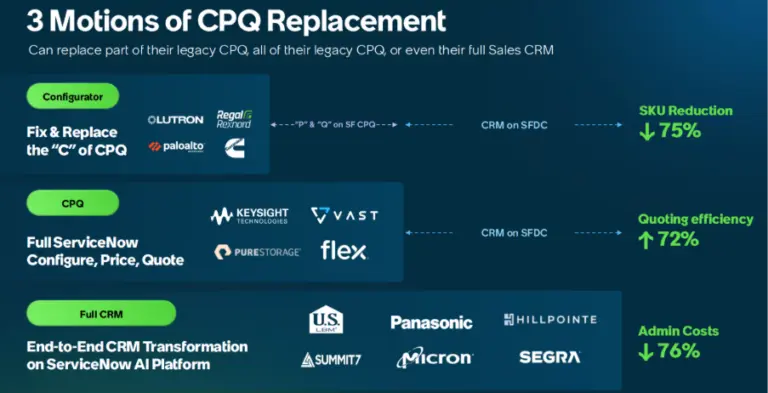
ServiceNow CPQ: The newest entrant, built on the April 2025 acquisition of Logik.ai, launched in October 2025. AI-native, workflow-first, and positioned specifically for enterprises already running ServiceNow.
For organisations that are already running ServiceNow for IT Service Management, HR, or Customer Service Management, or those open to introducing it, the case for ServiceNow CPQ is strong. The reasons are architectural and strategic, as explained in the sections below.
ServiceNow CPQ: The Challenger That Moved Fast
The timing of ServiceNow’s CPQ entry was deliberate. On April 3, 2025, one week after Salesforce’s EOS announcement, ServiceNow acquired Logik.ai, an AI-native CPQ platform purpose-built for enterprise product complexity. ServiceNow CPQ launched in October 2025, built on that acquisition.
That sequence reflects a strategic decision, executed with precision. ServiceNow identified the opening in the CPQ market and moved immediately.
What Is ServiceNow CPQ?
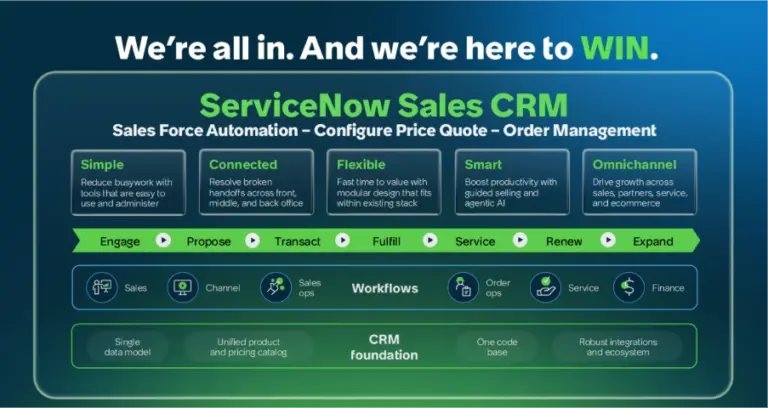
ServiceNow CPQ is a configure, price, and quote solution built natively on the Now Platform, the same platform enterprises already use for IT Service Management, HR Service Delivery, and Customer Service Management. The configuration engine comes from Logik.ai: a purpose-built, AI-native rules system designed for enterprise product complexity.
The core value is this: instead of a separate quoting tool connected to your CRM through middleware, CPQ lives where your service, customer, and operational data already reside. Sales, fulfillment, service, and renewal workflows run on one unified platform. A signed quote triggers downstream provisioning, billing setup, and service activation automatically.
Why ServiceNow CPQ offers a better path
-
- AI-guided selling: The Logik.ai engine recommends configurations and pricing dynamically, reducing errors and accelerating deal cycles.
-
- Real-time approvals: Discounts, approval workflows, and compliance checks happen within one system, with no middleware required.
-
- Composable architecture: Each layer, configuration, pricing, and quoting, scales independently.
-
- Low-code configuration: Pricing rules, product catalogs, and approval logic can be adapted without major development projects.
-
- Native integration: For organisations already running ServiceNow, CPQ runs on the same platform with no new integration to build.
- Native integration: For organisations already running ServiceNow, CPQ runs on the same platform with no new integration to build.
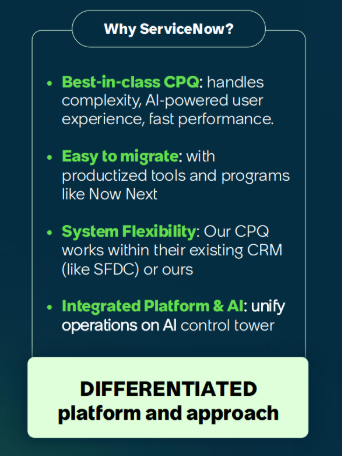
ServiceNow CPQ vs. Salesforce CPQ
Let’s compare the two platforms across the dimensions that matter most to enterprise decision-makers considering a CPQ migration.
| Dimension | Salesforce CPQ (Legacy) | ServiceNow CPQ |
| Product Status | End of Sale (March 2025) | Launched October 2025, actively evolving |
| Architecture | Managed package added onto Salesforce CRM | Native to the AI-powered Now Platform |
| Configuration Engine | Custom QCP scripts (JavaScript) | Logik.ai AI-native engine |
| AI Capabilities | Locked out of Agentforce for legacy users | Built-in AI guided selling and automation |
| Integration | Requires middleware layers for billing and fulfillment | Quote-to-cash and service unified natively |
| Scalability | Struggles with large catalogs and high volumes | Composable microservices, scales independently |
| Customization Cost | High, requires specialist Salesforce developers | Low-code and no-code configuration |
| Future Innovation | None, no roadmap, no new features | Actively funded, tied to ServiceNow platform roadmap |
| Talent Pool | Shrinking as specialists move to other platforms | Growing within the ServiceNow ecosystem |
| Best For | Simple quoting within a Salesforce-first org | Enterprises needing unified workflow and CPQ |
Move Beyond Legacy Salesforce CPQ
Step-by-Step Migration Strategy: From Salesforce CPQ to ServiceNow CPQ
A CPQ migration is one of the most complex technology transitions an organization can undertake. It touches sales process, pricing logic, data architecture, system integrations, and user behaviour simultaneously. Below is a structured migration framework built from direct implementation experience. Use it as a strategic guide and a working checklist.
Pre-Migration: The Questions That Define Everything
Before engaging a partner or beginning technical work, leadership needs clear answers to the following:
-
- Which quotes and contracts from legacy CPQ need to migrate, and which can be archived?
-
- What is the acceptable downtime window? Can the business run a parallel system, or is a hard cut-over required?
-
- What does success look like at 90 days post-migration? Define KPIs before work begins.
-
- Who owns this project? A CPQ migration without a named executive sponsor fails. Every time.
CPQ Migration Project Preparation Checklist
The checklist below covers all four phases of a structured migration. Use it to assess readiness, assign ownership, and track progress.
PHASE 1: Discovery and Audit
-
- Catalogue all active product bundles, pricing rules, and approval workflows
-
- Document custom QCP (Quote Calculator Plugin) scripts and dependent logic
-
- Identify all Salesforce CPQ integrations: ERP, billing, CRM objects
-
- Pull legacy quote and contract data, assess volume, quality, and gaps
-
- Map user roles and permission sets currently in CPQ
-
- Engage stakeholders: Sales, RevOps, Finance, IT, Legal
PHASE 2: Strategy and Planning
-
- Define migration scope: full cut-over or phased rollout
-
- Decide what legacy data migrates and what gets archived
-
- Select ServiceNow CPQ implementation partner
-
- Build business case and executive alignment document
-
- Set migration timeline and key milestones
-
- Establish rollback plan and risk register
PHASE 3: Build and Migrate
-
- Configure ServiceNow CPQ product catalog and pricing rules
-
- Rebuild approval workflows using Now Platform Flow Designer
-
- Execute legacy data migration: cleanse, transform, load
-
- Set up integrations: ERP, billing, CRM
-
- Conduct unit testing of all pricing scenarios and product configurations
-
- Validate migrated data against source records
PHASE 4: Launch and Optimise
-
- Run User Acceptance Testing (UAT) with key sales representatives
-
- Conduct a parallel-run period before the hard cut-over
-
- Deliver role-based training for sales, operations, and admin teams
-
- Go live and monitor quoting performance and error rates
-
- Decommission Salesforce CPQ instance after stability is confirmed
-
- Track post-migration KPIs: quote cycle time, error rate, win rate
Common CPQ Migration Challenges and How to Address Them
The following challenges appear in nearly every Salesforce CPQ migration. Preparing for them in advance is the difference between a controlled project and a crisis.
Complex product bundles: Bundle logic rarely migrates cleanly. Nested bundles, constraint rules, and option dependencies need to be rebuilt, not imported. Budget time to redesign, not just move data.
Custom QCP scripts: JavaScript pricing logic embedded in Quote Calculator Plugins is specific architecture. Every script needs to be reviewed, understood, and rebuilt in ServiceNow’s configuration engine. Some logic will need to be rethought from the ground up.
Legacy data quality: Years of quote data typically contain inconsistencies, orphaned records, pricing that no longer matches the current product catalog, and contracts without matching opportunities. Clean the data before migration. Migrating dirty data creates a more expensive problem downstream.
Approval workflow complexity: Multi-level approval chains with conditional logic are among the most time-consuming elements to rebuild. Map every approval scenario before starting the build phase.
User adoption: A well-built CPQ implementation delivers no value if sales representatives avoid using it. Plan for role-based training, executive sponsorship of adoption, and a structured feedback loop in the first 60 days post-launch.
Take Control of Your CPQ Future with ServiceNow and Aelum
Focus your energy on platforms you control. Salesforce CPQ is no longer evolving, its talent pool is shrinking, and the cost of waiting continues to rise. Moving to Revenue Cloud Advanced often means a full reimplementation with added cost and effort.
But the broader picture is clear. Salesforce CPQ has limited future potential and cannot support the level of innovation and AI-led transformation that modern revenue operations demand. For most organisations, the better path is to move to a platform where you control integrations, roadmap, and long-term costs.
Aelum helps you make that move with clarity and confidence. From honest assessments to full migration execution and post go-live support, Aelum ensures your transition is practical, structured, and aligned to business outcomes.
If you are evaluating your next step, now is the time to act.