
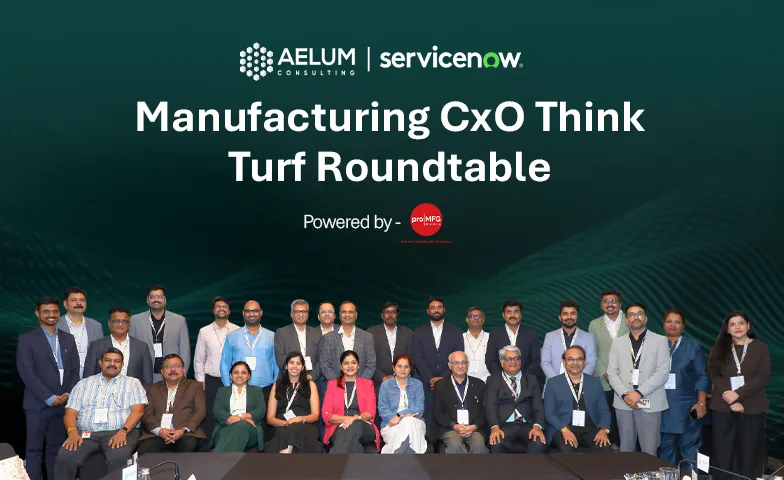
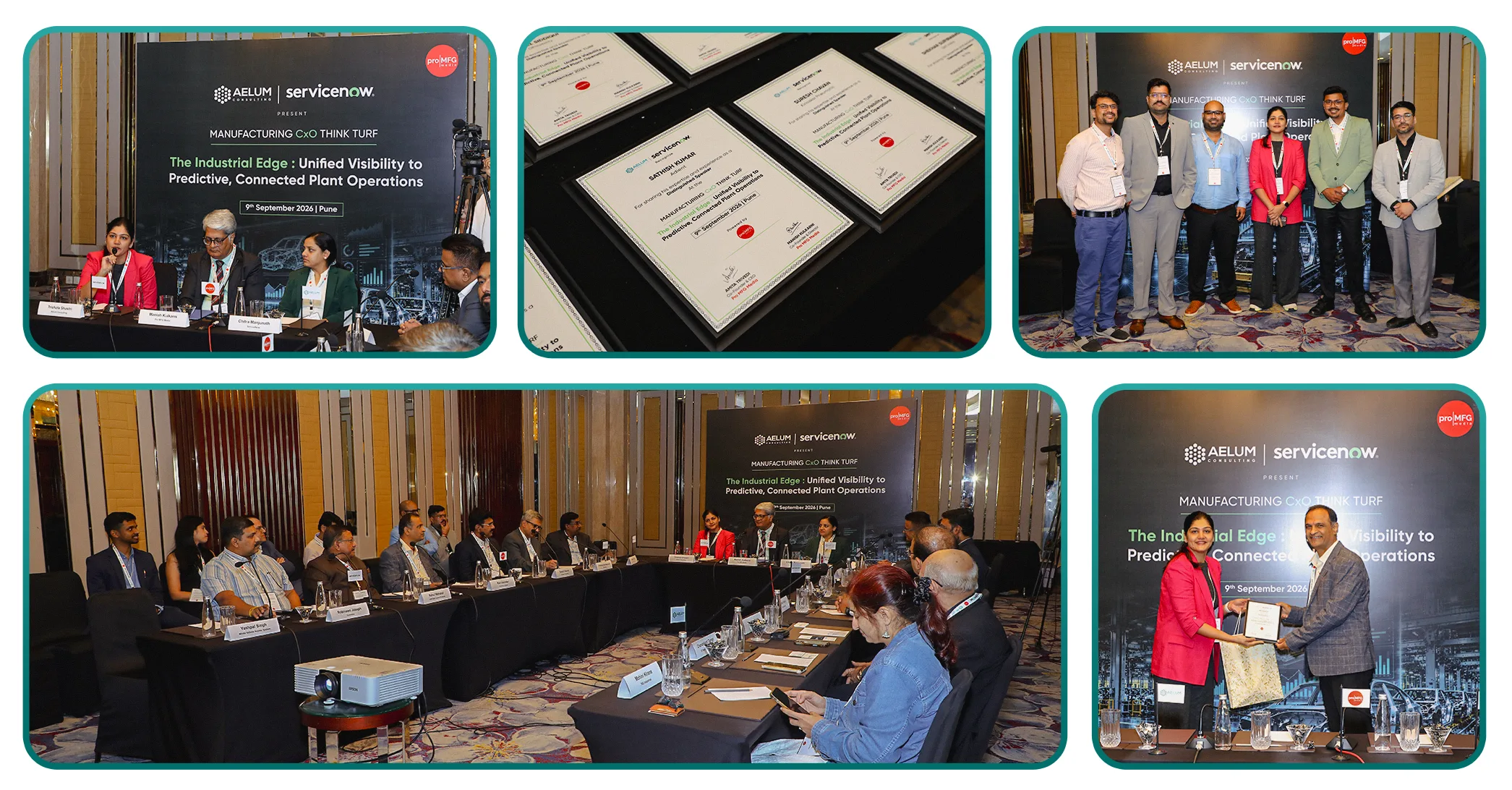
Pune, September 2026 — Aelum Consulting, in collaboration with ServiceNow and powered by Pro MFG Media Pvt. Ltd., brought together manufacturing leaders in Pune on September 9, 2026, for the Manufacturing CxO Think Turf Roundtable.
Held under the theme “The Industrial Edge: Unified Visibility to Predictive, Connected Plant Operations,” the closed-door roundtable brought together senior industry leaders to examine what it really takes to move from connected operations and fragmented visibility to more predictive, responsive, and intelligent plant environments.
The discussion moved beyond broad digital transformation narratives to focus on the realities of the shop floor: asset visibility, maintenance, production performance, OT security, real-time operational data, AI, and the role of people and governance in making connected operations work.
From Connected Operations to Predictive Decision-Making
Opening perspective from Jatin Arora, Regional Manager at ServiceNow, and Trishala Shastri, Co-Founder & COO, Aelum Consulting, setting the context for a broader conversation around the next phase of manufacturing transformation.
Leaders examined how manufacturers can bring asset, production, maintenance, and security data together to gain a clearer view of plant operations and act on issues before they escalate.
A key takeaway was the growing need for a unified operational view across plant and enterprise environments. For manufacturers, the challenge is increasingly less about generating data and more about connecting that data across functions, establishing the right context, and making it usable for faster decisions.
Putting IT/OT Convergence to the Test
The agenda also focused on the current state of IT/OT convergence across manufacturing environments.
The focus extended to the practical challenges of connecting plant systems with enterprise technologies, including persistent visibility gaps across operational environments. The conversation also explored how many devices on OT networks are genuinely visible and monitored, and how unknown or unmanaged assets can create operational and security blind spots.
From Reactive Maintenance to Predictive Operations
Maintenance emerged as another central theme, with leaders examining where organisations currently sit across the spectrum from reactive and scheduled maintenance to condition-based and predictive models.
The conversation focused on what continues to hold manufacturers back from predictive maintenance, despite increasing access to machine and asset data.
Participants also considered a more practical question: If one plant decision could move from reactive to predictive, which decision would create the greatest business impact?
The focus remained firmly on measurable outcomes, including asset reliability, downtime, operational continuity, and faster intervention.
When Operational Data is Not Live Enough
The roundtable also challenged how organisations use production performance data today.
With many OEE dashboards still operating on hourly or shift-based updates, they considered which decisions may be delayed simply because the underlying information is not available in real time.
This highlighted the importance of moving beyond retrospective reporting towards a more live operational view, where production, maintenance, asset health, and other critical signals can be understood in context and used to support timely decisions.
Strengthening the OT Security Lens
OT security formed another important part of the conversation, with perspectives from Sangita Panmand and Vishal Mohanani, followed by a live demonstration by Kamlesh Kumar.
Attention also turned to the limitations of periodic OT security audits and the visibility gaps that can emerge between assessments. Leaders examined what may remain unnoticed between audit cycles and how continuous visibility into assets and operational environments can strengthen the overall security posture.
The session also introduced ServiceNow and Armis, highlighting the role of broader cyber exposure visibility in helping organisations understand their operational technology environment and make more informed security decisions.
Where AI is Creating Real Value
AI emerged as another key focus, with the conversation examining the gap between its potential and practical application on the shop floor.
Manufacturing leaders shared perspectives on where AI is already delivering measurable value and where organisations still have sufficient data but continue to depend heavily on manual effort, individual experience, or traditional decision-making.
The exchange highlighted the close link between AI value and the quality, accessibility, and context of operational data. Intelligent technologies can support faster and more informed decisions, but meaningful outcomes depend on the underlying processes, governance, and operational foundation.
The Human and Governance Factor
One of the strongest themes from the roundtable was that connected operations cannot be reduced to a technology discussion.
Leaders considered whether the biggest barriers to progress lie in technology or in people, processes, skills, and governance. The conversation acknowledged that manufacturing organisations are at different stages of maturity, with different starting points, priorities, and investment realities.
That made the exchange particularly valuable: there was no single blueprint for the connected, predictive plant.
Instead, the perspectives shared pointed towards a more practical approach to transformation, one that connects technology with operational priorities and builds the foundations required for sustained adoption and measurable outcomes.
Building the Next Generation of Connected Plants
The Manufacturing CxO Think Turf Roundtable reinforced a clear direction for the industry: visibility is only the starting point.
The greater opportunity lies in turning connected data into operational context, using that context to support better decisions, and enabling teams to act before disruption becomes business impact.
Aelum Consulting remains focused on helping manufacturers bring plant operations, enterprise workflows, data, AI, and security into a more connected operational model. Through its manufacturing-focused capabilities and ServiceNow expertise, Aelum works with enterprises to translate transformation priorities into practical, scalable outcomes.
Aelum extends its appreciation to the manufacturing leaders who contributed their experiences, challenges, and perspectives to the discussion, as well as ServiceNow and Pro MFG Media Pvt. Ltd. for helping create a focused space for open and meaningful industry dialogue.
About Aelum Consulting
Aelum Consulting is a ServiceNow transformation partner helping enterprises modernize operations, strengthen workflows, and drive measurable business outcomes through ServiceNow, AI, and intelligent automation.
With expertise across manufacturing and other enterprise industries, Aelum works with organisations across strategy, implementation, integration, experience, and ongoing transformation to help them build connected, scalable, and future-ready operations.
To discuss your transformation priorities, get in touch with our experts.