
Would you leave your factory gate open when no one’s present? Or let an unknown technician access your equipment without verification? That same caution applied to factory floors is often missing from industrial networks and connected systems running behind it.
Operational technology (OT) was designed in a time when isolation was protection. Air gaps kept OT systems safe because they were never connected to anything that could carry a threat. That time is over. Smart manufacturing, remote monitoring, cloud connectivity, and Industry 4.0 have bridged the gap between office network and shop floor. But along with it, the attackers followed.
OT security protects the systems that run your physical operations, PLCs controlling your production lines, SCADA systems monitoring your energy infrastructure, sensors managing your supply chain. Unlike IT security, where a breach might mean leaked data, a breach in OT can mean a halted assembly line, a contaminated batch, or a damaged machine that takes weeks to replace.
What OT Security Means for Manufacturers
For manufacturers, OT security stands as a direct operational issue measured in production hours, batch quality, equipment health, and worker safety.
OT is the layer of systems that makes physical things happen. When a command goes out to tighten a bolt to a specific torque, control the temperature in a chemical reactor, or trigger a valve at a precise moment in a pipeline, that is OT doing its job. These systems are not passive. They are the digital nervous system of your physical operation. And like any nervous system, when something interferes with the signals, the results can be severe.
OT Security Failures & Their Real-World Impact
- Discrete manufacturing (automotive, aerospace, electronics assembly): OT systems coordinate robotic arms, multi-stage production flows, and quality checks. A cyberattack or undetected vulnerability can cause a robotic cell to act on corrupted instructions, producing defective parts at scale before anyone realizes something is wrong.
- Process manufacturing (chemicals, food and beverage, pharmaceuticals): The product itself can be compromised. A manipulation of temperature or mixture controls in a food plant could lead to contamination that is not caught until distribution. In pharma, a single deviation from controlled production parameters can render an entire batch unsellable and trigger regulatory investigation.
- Energy and utilities (power generation, water treatment, oil and gas): A compromised SCADA system managing a water treatment facility could silently alter chemical dosing. An attack on a power grid’s OT layer could cascade across regions.
- Heavy industry & mining: Unplanned equipment failure from a cyberattack costs production time, and equipment that takes months to replace. Industrial machinery pushed beyond its operational parameters, or cut off from its monitoring systems, can suffer physical damage that no software patch can undo.
OT Cybersecurity & ICS Cybersecurity
OT cybersecurity covers the tools, processes, and strategies that protect operational technology environments from threats. Within that, Industrial Control Systems (ICS) cybersecurity focuses specifically on the control systems that manage industrial processes: SCADA systems, distributed control systems, programmable logic controllers, and the networks they run on.
While the terms are sometimes used interchangeably, OT cybersecurity is the broader discipline, and ICS cybersecurity is the layer within it that governs how industrial processes are monitored and controlled.
IT Security vs OT Security
IT security and OT security share a common objective: keeping systems running and out of the wrong hands. But the environments they protect are fundamentally different, and those differences shape everything from how a threat is detected to how long it takes to get a patch approved.
| Dimension | IT Security | OT Security |
| Primary goal | Protect data and information systems | Protect operational continuity and physical processes |
| Systems covered | Servers, endpoints, cloud, applications | PLCs, SCADA, HMIs, sensors, industrial controllers |
| Patching tolerance | Frequent, largely routine | Rare, requires planned downtime, sometimes impossible |
| Downtime tolerance | Acceptable for maintenance windows | Extremely costly, sometimes a safety risk |
| Breach consequence | Data loss, financial and reputational damage | Production halt, physical damage, safety incidents |
| Team ownership | IT and cybersecurity teams | OT engineers and plant operations |
| Governing standards | ISO 27001, SOC 2, NIST CSF | IEC 62443, NERC CIP, NIS2 |
IT-OT Convergence & The New Attack Surface
For most of industrial history, OT security relied on a simple principle: separation. OT systems were air-gapped, isolated from corporate networks and the internet by design. That physical separation was the security model. Industry 4.0 dismantled it. Remote monitoring, cloud-connected equipment, IIoT sensors, predictive maintenance platforms, and enterprise-wide data integration have all required OT systems to open connections they were never built to handle. The efficiency gains are real, so is the exposure.
When IT and OT networks converge, every entry point into the IT environment becomes a potential path to the OT environment. A phishing email that compromises a corporate laptop can now be the first step in a chain that reaches a programmable logic controller on the production floor. A remote access connection opened for a third-party vendor can be exploited long after the vendor’s session ends. A misconfigured firewall at the IT-OT boundary can leave industrial systems entirely reachable from outside the organization.
The convergence has created a middle ground where IT security tools do not understand OT protocols, OT engineers do not have security training, and most organizations do not have a clear owner for what happens at the boundary. That gap is where the majority of industrial cyber incidents originate.
Did You Know?
OT Security market is expected to reach USD 50.29 billion by 2030 from USD 23.47 billion in 2025, at a CAGR of 16.5% from 2025 to 2030.
How AI & Automation Enhance OT Security
Automated OT security continuously discovers every connected device and tracks changes in real time, so you get a live, accurate inventory of your entire OT environment. Vulnerability detection flags firmware weaknesses, misconfigurations, and known exploit patterns as they appear, sometimes before they are exploited. When an incident occurs, automated workflows route it to the right team, generate remediation tasks, and track resolution from detection through to closure, without anyone manually driving the process.
AI surfaces anomalies in device behavior, unusual network traffic, and deviations from operational baselines that would be invisible in a log review. It prioritizes vulnerabilities based on where an affected device sits in the production process and what the actual impact of its failure would be. And it captures how incidents were resolved, building institutional knowledge that prevents the same diagnostic cycle from repeating every time a similar issue appears.
What OT Security Solves on the Factory Floor
Before evaluating any OT security solution, it’s important to be precise about the problems it is solving. Let’s have a look at the specific gaps OT security closes, mapped to the operational realities that industrial teams work within.
Challenge 1: Visibility Gaps That Security Tools Cannot Protect Against
Most businesses cannot produce an accurate, current list of every device on their OT network. Equipment gets added at the plant level without IT involvement. Legacy systems get integrated informally, vendors connect devices for maintenance and leave them behind. So, at the end, there’s a network where unmonitored devices sit alongside critical infrastructure, and no one holds a complete picture of the exposure. OT security closes this by continuously identifying every connected device, including ones never formally registered, and maintaining a current record of what exists, where it is, and what it is doing.
Challenge 2: Vulnerability Windows That Production Schedules Keep Open
A vulnerability is confirmed on a controller managing a high-speed production line. The patch exists, but applying it means taking the line offline, coordinating with operations, running post-patch testing, and getting approvals that span two departments. That process takes weeks, and in the interim, the vulnerability sits open. OT security resolves this by quantifying actual risk in production context, applying compensating controls to reduce exposure without touching the device, and scheduling remediation within planned downtime rather than forcing an unplanned shutdown.
Challenge 3: Security Alerts with No Operational Priority
Every connected OT device continuously generates status signals, error codes, traffic logs, and threshold readings, and in environments with hundreds or thousands of devices, that volume quickly becomes noise. Another major problem is that most alerts arrive without production context, so teams cannot tell whether a flagged anomaly affects a critical line or a secondary process that barely matters. OT security changes this by tying every alert to where the affected device sits in production and what the downstream impact of an incident would actually be. So, you get right alerts, ranked by what they would cost.
Challenge 4: Third-Party Access with No Audit Trail
Maintenance contractors, equipment vendors, and integrators regularly access OT environments, often through shared credentials, with no session monitoring and no record of what changed. This is one of the most common and least visible vectors for both deliberate attacks and accidental misconfigurations. OT security brings governance to this access, tracking who connected, when, what they touched, and what the state of the system was before and after.
Challenge 5: Configuration Changes with No Record and No Owner
In production environments, configuration changes to devices happen regularly. Without a recorded baseline, there is no way to distinguish a legitimate adjustment from an unauthorized one. By the time something behaves unexpectedly, the change that caused it is weeks old and undocumented. OT security maintains baselines for every managed device and flags deviations in real time, giving teams the ability to investigate changes as they happen rather than trace them backwards after an incident.
Challenge 6: Security Events That Fall Between IT and OT
When a security incident touches both IT and OT, it often falls into a gap between two teams who speak different operational languages and optimize for different outcomes. IT focuses on containing the threat, OT focuses on keeping the line running. Without a shared operational picture, each team’s instinct can work against the other. OT security creates a unified workflow where both sides have context, defined roles, and a coordinated path from incident to resolution.
Challenge 7: Compliance Posture That Is Always One Audit Behind
Manufacturers operating under NERC CIP, IEC 62443, or sector-specific frameworks have to demonstrate that their OT assets meet defined security requirements continuously. When that tracking is done manually, it is always trailing reality. A device that changed classification last month may not appear correctly in the compliance record until someone updates a spreadsheet. OT security automates status tracking across every asset, keeps records current without manual input, and generates the documentation regulators require as a byproduct of normal operations.
See what 1,901 manufacturers say about OT security
OT Security Use Cases
OT security applies across a range of operational scenarios, each with its own risk profile and response requirement. The use cases below reflect where OT security creates measurable value, scenarios that are common across manufacturers, regardless of sector.
Mapping OT Assets Across Production Sites: OT security enables continuous discovery and mapping of every connected device, organized by site, production zone, and criticality level using established frameworks. This gives operations and security teams a single, reliable picture across the entire enterprise rather than fragmented records across facilities.
Vulnerability Identification and Risk-Based Remediation: OT security assesses each vulnerability using CVE metrics, calculates a risk score based on where the device sits in the production process, and helps teams decide what to remediate, what to defer with compensating controls, and what to schedule within planned downtime. You get a prioritized remediation plan tied to actual operational impact rather than a generic severity ranking.
OT Incident and Change Management: OT security applies structured incident management workflows built for OT environments, ensuring that issues are escalated to the right team, stakeholders are kept informed, and resolutions are documented in a way that builds institutional knowledge over time. Configuration changes to OT devices are similarly managed against downtime schedules, reducing the risk of production disruption from uncoordinated updates.
Asset Lifecycle and Obsolescence Management: OT security tracks lifecycle status of every managed asset, flags devices nearing end of life or end of vendor support, and supports planning for replacement before obsolescence becomes a production or security risk. Maintenance schedules, spare parts inventory, and work orders are managed within the same platform, reducing the coordination overhead that typically falls to OT teams manually.
Automating Compliance Evidence Across OT Assets: OT security generates compliance documentation as a byproduct of normal operations, keeping records current without a separate process and reducing the preparation burden that typically precedes every audit cycle.
Post-Acquisition OT Environment Integration: OT security enables rapid discovery and classification of inherited assets, identification of vulnerabilities and configuration gaps, and establishment of a security baseline before the acquired environment is integrated with the parent organization’s network. This limits the window during which unknown exposure from the acquisition can propagate to the broader environment.
Why ServiceNow Leads in OT Security
Most OT security tools detect, alert, and produce dashboards that tell you something is wrong. What they do not do is tell you who needs to act, how, by when, and whether it actually got resolved. That gap between detection and action is where operational risk accumulates, and it is the gap that ServiceNow is specifically built to close.
ServiceNow’s security solution approaches OT security as an operational platform. It handles the coordination, prioritization, and follow-through required to resolve it without disrupting production on the same platform that most enterprise organizations are already using to run IT operations.
The platform connects OT asset discovery, vulnerability response, incident and change management, and asset lifecycle management in a single system. For businesses currently managing these across four or five separate tools, the consolidation alone reduces operational overhead significantly.
ServiceNow is an AI-native platform.
Generative AI accelerates diagnosis during incidents, surfaces root causes, auto-generates resolution notes, and helps OT teams build a knowledge base from every incident they resolve. ServiceNow AI agents handle data transformation when importing OT device records, correcting invalid data without manual cleanup. Vulnerability prioritization factors in production impact, not just technical severity.
ServiceNow’s Armis Acquisition
A significant development in 2026 is the completion of the Armis acquisition. Armis brings real-time cyber asset intelligence across OT, IoT, IT, medical devices, and cloud, tracking nearly 7 billion devices in real time through non-invasive discovery.
ServiceNow OTM: One Module for Entire OT Security Lifecycle
ServiceNow OTM (Operational Technology Management) brings OT asset discovery, vulnerability response, incident management, and asset lifecycle control onto a single platform. For OT security specifically, it closes the gap between identifying a risk and resolving it, connecting detection to action through automated workflows, AI-driven prioritization, and full production context, without requiring a separate tool for each function.
Core Features of ServiceNow OTM
- OT Visibility: Discovers and maintains a live inventory of every OT device across your production environment. Devices are automatically mapped to sites and production processes using the Purdue Model and ISA-95 standard. Data from third-party security tools like Claroty, Dragos, Nozomi, and Armis feeds directly into a single, reconciled record.
- OT Unified Security Exposure Management: Identifies firmware vulnerabilities, scores them using CVE metrics weighted by production impact, and automates remediation workflows. Low-risk issues can be deferred with compensating controls, while critical vulnerabilities are scheduled for resolution within planned downtime, keeping production running without leaving risk unaddressed.
- OT Service Management: Manages OT incidents, configuration changes, and service requests through structured workflows built for industrial environments. Changes to OT devices are coordinated against downtime schedules. AI accelerates diagnosis, surfaces root causes, and captures resolution notes as reusable knowledge, reducing repeat incidents over time.
- OT Asset Management: Tracks the full lifecycle of every OT device and piece of operational equipment, from maintenance plans and work orders to spare parts inventory and end-of-life status. Identifies assets nearing obsolescence before they become a reliability or security risk, and prioritizes work orders based on production criticality.
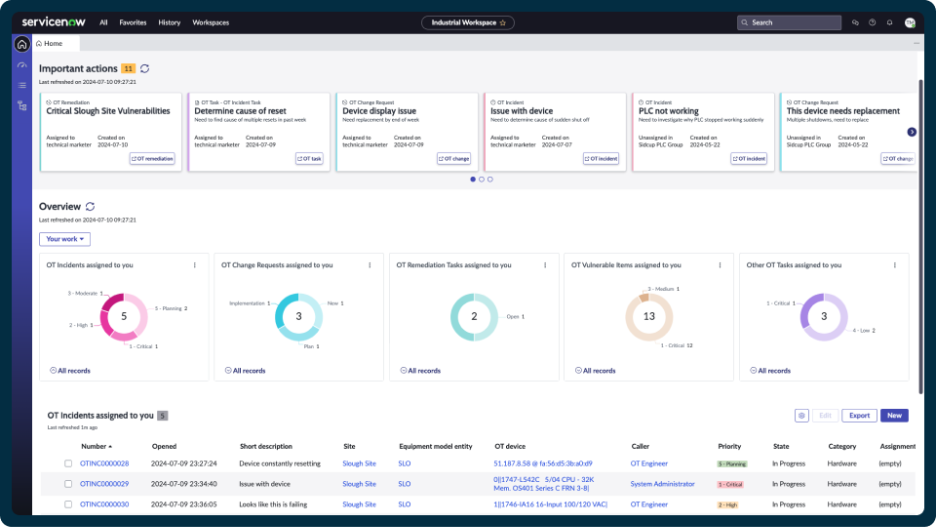
ServiceNow OTM dashboard displaying OT incidents, vulnerabilities, remediation tasks, device alerts, and operational workflows with real-time charts, priority tracking, and industrial asset management insights across multiple sites.
Also Read:
ServiceNow for Manufacturing: How Plant Owners Are Building Smarter Operations in 2026
The Next Step in Your OT Security Journey
The next step comes planning your implementation. Implementing OT security across a live production environment, with real assets, constraints, and compliance obligations, is where the complexity begins. Businesses that navigate this well treat OT security as a technology procurement decision. They approach it as an operational transformation that requires both platform expertise and domain understanding of how industrial environments actually work.
At Aelum, we’ve built that understanding by working directly with manufacturers on their ServiceNow journeys, including engagements with organizations like Maruti Suzuki. That experience translates into something that documentation and product demos cannot fully convey: knowing what works in production environments, not just in controlled environments.
As a ServiceNow implementation partner with deep expertise in OT security and industrial operations, we bring the combination of:
- Certified platform knowledge
- Industry-specific context
- Hands-on deployment experience that complex OT environments require
If you want to see what OT security looks like in your environment specifically, our team can walk you through a working demo built around your industry context. And if you are still mapping out where your current gaps are, book a 1:1 meeting with our OT experts before you decide what to do with them.