If your GCC has rolled out digital initiatives that technically work but still feel disconnected from how the business runs, you’ve probably been trying to fix it at the surface by adding another tool, refining a workflow, or pushing one more automation live.
That’s understandable. For a long time, digital transformation was treated as a series of upgrades. Implement the right platforms, introduce AI where possible, and outcomes would follow.
But the real challenge usually sits around those initiatives. It shows up in how systems connect, how data flows, and how decisions are made across teams. The problem is the operating environment around it.
What GCCs need is not more isolated transformation, but a more connected way of building it where workflows, platforms, and people are designed to work as one system from the start.
Common Challenges in GCC Digital Transformation
The barriers to digital transformation are rarely about intention. GCCs want to transform. The challenges are structural, systemic, and deeply interconnected. Here are the six that matter most.
Challenge 1: Legacy System Debt
Many GCCs operate on systems built for a different era of enterprise computing. These legacy platforms were designed for stability and scale, not for the API-first, AI-ready, cloud-native architecture that modern digital operations require.
Consequences:
The consequences are significant. Legacy infrastructure limits agility and integration capabilities. Transitioning away from these systems is resource-intensive, disruptive, and carries real operational risk. But continuing to run modern AI and analytics on outdated foundations is equally untenable.
The trap organizations fall into is treating modernization as a binary choice: full replacement or continued tolerance. Neither extreme works well. A legacy ERP system that took a decade to configure cannot be ripped out in a quarter. But leaving it in place and layering AI tools on top of incompatible data structures produces pilots that impress in demos and stall in production.
How to Overcome:
The organizations succeeding here are adopting an encapsulation-and-integration approach using API layers and middleware to connect legacy systems with modern platforms, creating interoperability without requiring full decommission.
Challenge 2: The Talent Gap
What’s Really Happening:
The GCC talent challenge has two distinct dimensions that often get conflated.
Consequences: Supply Shortage & Capability Depth Gap
The first is raw availability. There is currently only one qualified candidate for every two open GenAI roles in India a 53% gap between demand and available supply. In high-complexity domains like MLOps, VLSI design, and LLM engineering, the shortage is even more acute. This has triggered intense competition between GCCs for the same narrow pool of specialists, driving unsustainable wage inflation that undermines the cost model that originally made GCCs attractive.
The second dimension is capability depth. India produces millions of graduates annually. The shortage is not in people it is in “Day Zero ready” talent capable of owning enterprise-scale AI programs, not just consuming AI tools. There is a meaningful difference between a developer who can use a GenAI API and an engineer who can design, validate, and manage an ML model lifecycle in production.
How to Overcome:
GCCs that are winning the talent battle are not simply hiring faster. They are co-designing reskilling programs with hyperscalers and universities, building internal Skills Observatories to map current capability against future demand, and creating structured pathways from AI consumption to AI engineering. Weekly capability activation sprints that produce real automation or AI use cases are replacing monthly training calendars that produce certifications.
What Changes When You Get It Right:
The math is compelling, GCCs that invest in upskilling can reduce talent acquisition costs by 20-35% annually and accelerate time-to-market for digital products by 30–40%.
Challenge 3: Siloed Operations and Fragmented Governance
What’s Really Happening:
Enterprise digital transformation fails when it is treated as a collection of departmental projects rather than a coordinated organizational shift. In GCCs, this fragmentation is structurally encouraged by the way most centers were built different teams owning different platforms, data systems, and reporting structures, all loosely connected to a global HQ through SLAs and periodic reviews.
Consequences: Operational Inefficiency & AI Cannot Scale
The result is fragmented global operations requiring careful coordination across multiple time zones and cultures, process inefficiencies and redundancies impacting productivity, and inconsistent quality across business units.
This creates a compounding problem for AI adoption. Generative and agentic AI require real-time, contextually rich, governed data at the point of use. Most GCCs are running modern AI initiatives on data architectures built for compliance reporting, not intelligence.
What This Leads To:
Without a unified data foundation and governance layer, AI pilots stall because the models cannot access what they need to perform. The barrier to scale becomes organizational rather than technical and organizational problems are harder to solve than technology problems.
Challenge 4: Cybersecurity and Data Sovereignty
What’s Really Happening:
As GCCs have moved from supporting back-office functions to owning core intellectual property and global customer data, their risk profile has changed dramatically.
Consequences: Regulatory Complexity
The 2025 implementation of India’s Digital Personal Data Protection (DPDP) Rules introduced stringent compliance mandates that directly affect how GCCs collect, process, and transfer data across borders. Navigating these regulations requires not just legal awareness but architectural decisions about where data lives, how it flows, and who has access.
At the same time, the threat landscape has intensified. India’s CERT-In handled over 29 lakh cyber incidents in 2025 alone. GCCs that once managed relatively contained IT environments now sit at the center of global enterprise operations, making a single successful breach potentially catastrophic capable of paralyzing a Fortune 500 companies worldwide operations.
The cybersecurity investment gap is striking. Over a quarter of organizations rate their sector’s cyber risk as high, yet 27% dedicate less than a quarter of their security budget to threat detection and incident response. Cloud Security Specialists and DevSecOps practitioners are among the most demanded roles in the GCC ecosystem and among the hardest to hire.
How to Overcome:
Build security into the architecture from the start, align data governance with regulations, and invest in both tools and talent for proactive risk management.
Challenge 5: Change Management and Cultural Resistance
What’s Really Happening:
Digital transformation is a people problem as much as a technology problem. Resistance to change, uncertainty about new workflows, and a fundamental misalignment between what GCC leaders want to build and what employees are ready to embrace these forces slow transformation programs at every stage.
Consequences: Low Adoption and misalignment
In many GCCs, digital transformation has been positioned as an IT initiative rather than an organizational one. New platforms get deployed. Training sessions get scheduled. Adoption metrics get tracked. But the underlying culture the assumptions about how work gets done, how decisions get made, how performance gets measured remains unchanged.
How to Overcome:
Successful transformation requires communicating the benefits of new technologies clearly, involving employees in the journey from the beginning, and building leadership structures that connect GCC innovation mandates to individual roles and career growth.
Challenge 6: The AI ROI Gap
Perhaps the most visible challenge in 2025 is the widening gap between AI investment and AI returns.
Consequences: Low ROI Realization
In 2024, 72% of global companies had adopted AI for at least one business function. By 2025, the number of AI use cases in production had doubled. Yet only one in four initiatives is meeting its revenue impact expectations. At an average spend of $1.3 million per use case, this ROI gap is creating serious board-level scrutiny of AI programs.
The ISG analysis is pointed: AI investment is shifting toward revenue-generating functions, but the strongest actual returns are currently concentrated in compliance, risk management, and quality control not in the growth and cost outcomes most enterprises originally targeted.
Root Cause:
The pattern repeats itself across GCCs: a compelling proof of concept, a production deployment that underperforms, an inconclusive post-mortem, and a cooled appetite for the next initiative. The root cause is rarely the AI model itself. It is the data architecture beneath it, the integration gaps around it, and the workflow design connecting it to the humans who are supposed to act on its outputs.
How ServiceNow Helps GCCs Solve These Barriers
Every challenge described above has a technology dimension and an organizational dimension. ServiceNow operates at the intersection of both providing the platform infrastructure that makes transformation possible while forcing the workflow design discipline that makes it stick.
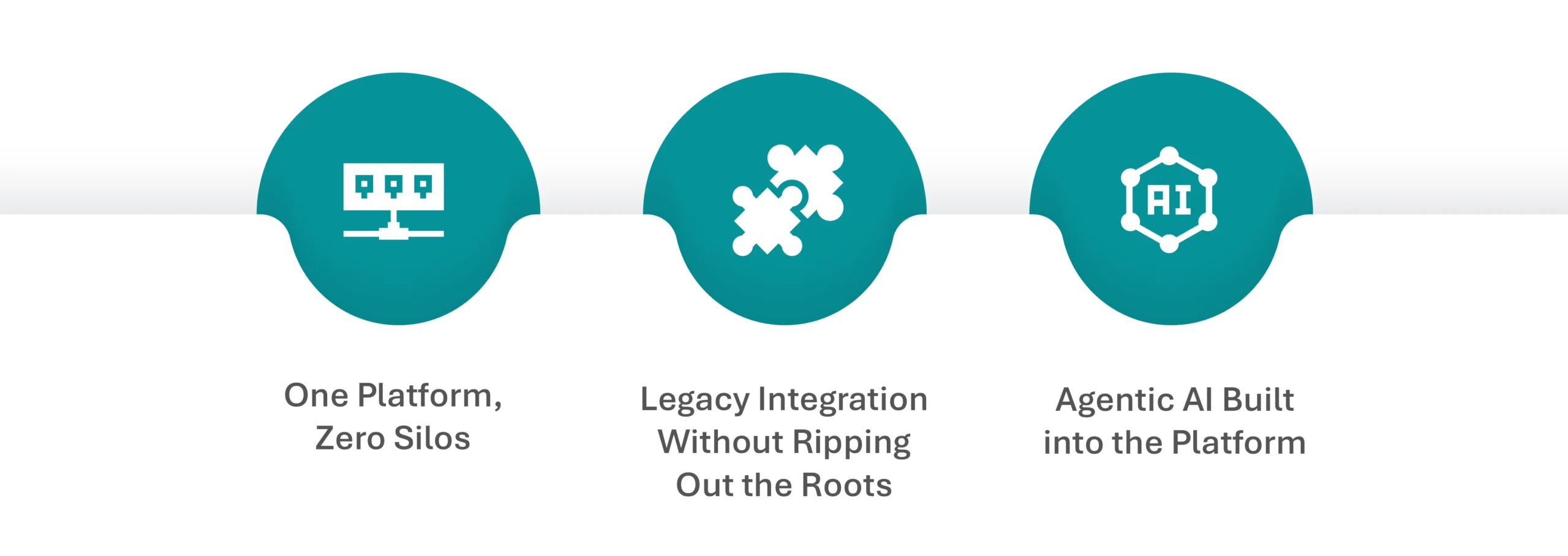
1. One Platform, Zero Silos
ServiceNow’s core value proposition for GCCs is unification. Rather than a collection of point solutions one tool for IT, another for HR, a third for compliance, a fourth for customer service and experience, the AI-powered Platform provides a single cloud-based system of record that spans the enterprise.
For GCCs managing fragmented global operations, this matters enormously. When IT, HR, finance, and operations share a unified data layer and workflow engine, cross-functional processes stop breaking at departmental handoffs. Visibility improves. Governance becomes data-driven rather than reactive. And AI has access to the integrated, real-time data it needs to produce reliable outputs.
2. Agentic AI Built into the Platform
ServiceNow has moved well beyond traditional automation. The Now Assist suite embeds GenAI directly into everyday workflows drafting incident summaries, generating knowledge articles, routing cases intelligently, and accelerating HR case resolution. The AI Agent Orchestrator allows organizations to deploy domain-specific AI agents across IT, HR, CRM, and finance agents that can communicate with each other and hand off tasks across systems. For GCCs, this translates into real efficiency gains across the operations they manage.
3. Legacy Integration Without Ripping Out the Roots
ServiceNow’s Integration Hub addresses one of the most practically challenging aspects of GCC transformation: connecting modern AI-powered workflows to the legacy systems that still run core operations. Organizations can automate routine tasks, centralize data, and build intelligent processes on top of existing infrastructure without requiring full replacement. This becomes a bridge that allows legacy systems to participate in modern workflows until full modernization is viable.
How Aelum Consulting Enables Digital Transformation for GCCs
Choosing the right platform is one decision. Deploying it in a way that creates genuine enterprise value rather than another layer of shelfware is a different challenge entirely. That is where implementation expertise becomes the differentiator.
The 1Hub Go-Live: A Proof Point for GCC Transformation
Aelum’s most visible GCC proof point is the co-delivery of the 1Hub go-live with ANSR and ServiceNow the industry’s first end-to-end Command and Control Centre for Global Capability Centers.
This implementation operationalized ANSR’s entire GCC service delivery on ServiceNow, integrating Now Assist’s GenAI capabilities to reduce time spent on operational activities, increase productivity, and improve employee satisfaction across 40,000 GCC employees. It set a blueprint for how GCCs can use the Now Platform to scale global workforce operations with agility and governance built in from the start.
GCCs You Don’t Have to Start from Scratch with Aelum
The next phase of GCC transformation will not be defined by which organizations adopt the most tools or the latest AI capabilities. The gap between technologies is already narrowing. The real advantage will come from how well GCCs build systems around those technologies, and how connected those systems are in practice.
This is where ServiceNow provides the foundation by bringing workflows, data, and AI into a single platform. And with Aelum’s experience in building and scaling these environments, GCCs can move from fragmented efforts to systems that hold together as they grow.