You and I, we both know the feeling. We need something simple.
A software license.
An updated address in HR.
A laptop for the new hire starting Monday.
So, we open a portal, navigate a category tree, fill out a form, submit a ticket, and wait. Meanwhile, your company has invested millions in “AI transformation”. ServiceNow EmployeeWorks asks a blunt question: what if the AI just… did all of it?
In December 2025, ServiceNow completed one of enterprise software’s most-watched acquisitions: Moveworks, an AI company trusted by over 5 million employees at companies like Toyota, JPMorgan, Siemens, and more.
2 months later, they launched EmployeeWorks. What they built in those 60 days, and why it now stands as an essential capability for every enterprise running on scattered AI tools, is the story we’ll tell you ahead in the blog.
ServiceNow EmployeeWorks Explained
ServiceNow EmployeeWorks is a conversational AI front door that understands employee intent in natural language and executes work end-to-end through governed ServiceNow workflows, rather than merely assisting or summarizing tasks. Unlike standalone AI assistants, EmployeeWorks doesn’t sit adjacent to your workflows; it executes inside them.
It combines Moveworks’ enterprise AI experience with the next generation of ServiceNow’s Employee Center portal experiences and workflow execution.
It’s like a single intelligent entry point for your enterprise. How? An employee doesn’t need to know which system to use, which team to contact, or which form to fill. They just type what they need, in plain language, and the system takes care of the rest.
Accessibility of 100+ Languages
ServiceNow EmployeeWorks is available in 100+ languages. For large enterprises operating across multiple countries, it’s a huge deployment plus point.
Benefits of ServiceNow EmployeeWorks
Most enterprises live with what’s called “portal sprawl”: separate tools for IT, another for HR, one for finance, another for facilities. Well, the existing generation of AI assistants, chatbots, and copilots made this slightly better by answering questions. You’d get a well-formatted answer telling you exactly what to do next. But the actual work? Still on you. EmployeeWorks closes that gap. It moves from AI that advises to AI that acts.
- AI handles the routine; you handle the rest: Submit one request and watch it turn into finished work across IT, HR, finance, procurement, and facilities without follow-ups, form-filling, or ticket chasing. End-to-end execution, not end-of-conversation handoff.
- Always know what needs your attention: AI surfaces your priorities from across the business in one unified view, so you spend less time managing tasks and more time driving outcomes.
- Adoption happens naturally: Adoption has always been the hardest part of software rollouts. When AI genuinely solves problems in an effortless experience, people use it, and not because they were told to, but because it actually helps.
- AI, data, and workflows in one place: The ServiceNow AI Platform brings together AI agents, data, and workflows in a single environment, built for scale, security, and efficiency.
Start with a 1:1 strategy call with our ServiceNow experts
The Capability Stack That Separates EmployeeWorks from Everything Else
So, how does ServiceNow EmployeeWorks actually work? Each feature in EmployeeWorks has a specific job, and together, they cover the entire journey from employee intent to completed work. Here’s the full picture:
1. Conversation-First Interaction
Employees interact via chat, voice, kiosk, messaging apps like Slack or Teams, or web portals. Everyday tasks and business transactions get done directly in chat; AI executes in line with how your business runs, following your processes, rules, and permissions while surfacing what needs attention along the way.
2. Search + Action in One
Employees can find precise, context-aware answers and take action across systems to complete tasks from one place. This collapses the old “find → go to system → do the thing” loop into a single interaction.
3. Automation at Every Level
Deploy hundreds of pre-built use cases that plug directly into your organization’s most pressing challenges, spanning IT, HR, finance, procurement, and beyond. From password resets to PTO requests to purchase order lookups, the automation library is built to cover the high-frequency, high-volume work that consumes your teams every day.
4. Omnichannel Employee Access
EmployeeWorks is available wherever your employees work, including any device, messaging apps, kiosks, voice, portals, or the web. The experience is consistent regardless of how or where an employee accesses it, whether that’s a factory floor terminal or a home office browser.
5. Moveworks Reasoning Engine
A proprietary reasoning architecture that interprets employee intent, builds an execution plan, selects the right integrations, and completes the action within your business rules and security boundaries. The engine runs on a continuous loop: plan, execute, observe, adapt, and continue. It also maintains multiple memory types: semantic, episodic, working, and procedural, so it reasons through complex, multi-step requests the way a human would.
6. AI Agent Marketplace
EmployeeWorks ships with 250+ enterprise-ready templates in the Moveworks AI Agent Marketplace covering everything from looking up purchase orders in Coupa, submitting expenses in SAP Concur, to completing interview feedback in Workday. Each can be deployed in minutes. For any system not covered, whether legacy, custom, or proprietary, Moveworks Agent Studio lets you build your own secure plugins without starting from scratch.
7. Built-In Governance
Every action EmployeeWorks takes respects role-based access controls (RBAC), follows your organization’s approval chains, and generates a complete audit trail. Nothing bypasses your governance model. Workflows, permissions, compliance requirements, and lifecycle controls stay intact even when AI is doing the executing.
8. Proactive Intelligence
EmployeeWorks doesn’t wait to be asked. It continuously monitors signals from across your business systems and surfaces what needs your attention before it becomes a problem. Pending approvals, overdue tasks, and flagged requests are presented in one clear view, so you can move from reactive task management to proactive decision-making.
Is ServiceNow EmployeeWorks Available Right Now?
Yes, ServiceNow EmployeeWorks has been generally available since 26th February 2026.
You can adopt it as a standalone Moveworks deployment or as a fully integrated component of your existing ServiceNow environment, giving you the flexibility to start where you are.
Book your ServiceNow EmployeeWorks
Readiness Assessment with Aelum
How EmployeeWorks Searches & Acts Across Business Systems
| IT | Ticket Lifecycle Knowledge Search IT Ops Incident Management Service Improvement & more |
| HR | Knowledge Search Talent Acquisition Onboarding HR Ops Internal Comms L&D Sentiment Analysis & more |
| Finance & Procurement | Accounts Payable Accounts Receivable Payroll Expense Management FP&A Budgeting Compliance |
| Sales & Marketing | Account Research Lead Management Seller Productivity Customer Outreach Loyalty & Advocacy Calendar Management |
| Operations | Facilities Management Manufacturing Ops Field Ops Legal Ops Engineering Ops Data Science Ops Internal Comms |
ServiceNow EmployeeWorks Industry-Wise Use Cases
ServiceNow EmployeeWorks is designed to fit how different industries actually operate. Here’s how it plays out across the sectors where the impact is most immediate.
1. Manufacturing
Shift workers, field technicians, and plant managers can request equipment, report incidents, or check safety workflows directly through voice or kiosk access; no desktop required. EmployeeWorks works on the floor, not just in the office.
Real-World Example: Johnson Controls, operating across 150+ countries, uses EmployeeWorks to manage service requests across its distributed, facilities-heavy workforce, where waiting on IT was never an option.
2. BFSI
Employees can access policy information, submit compliance-related forms, and raise risk requests, all within strict role-based access controls and full audit trail visibility.
Real-Word Example: JPMorgan Chase, one of the world’s largest financial institutions, is among enterprises running Moveworks-powered AI, where even minutes saved per request across hundreds of thousands of employees adds up fast.
3. Retail
High turnover in retail means onboarding never stops. EmployeeWorks automates credential provisioning, policy acknowledgements, and equipment requests for hundreds of new hires simultaneously, so your HR team isn’t buried every time the hiring cycle peaks.
Real-World Example: Consider a large retail chain onboarding 500 seasonal employees every quarter. With EmployeeWorks, IT access, policy sign-offs, and equipment requests are provisioned automatically, before the first shift starts.
4. Technology
Developer teams move fast and can’t afford any IT stoppages. ServiceNow EmployeeWorks handles software provisioning, access management, and license requests autonomously, freeing engineers to stay in flow instead of waiting for approvals.
Real-World Example: Broadcom, one of the world’s largest infrastructure software companies, relies on Moveworks-powered AI to keep its engineering workforce unblocked, autonomously handling the access requests and provisioning that would otherwise slow teams down.
5. Telecom
Large, distributed workforces with complex role structures make telecom a strong fit. EmployeeWorks streamlines internal service requests, network ops support queries, and workforce onboarding across field and office teams, all from one conversational interface.
Real-World Example: Consider a telco provider with 20,000 field agents across regions. With EmployeeWorks, each agent can raise a support request, check their schedule, or request tool access from their phone, in the field, in seconds.
6. Healthcare
Healthcare demands speed and compliance in equal measure. EmployeeWorks handles staff onboarding, IT support, and compliance workflows at scale without compromising patient data security.
Real-World Example: Siemens Healthineers built their internal AI assistant ‘Ada’ on Moveworks, saving their 74,000-strong workforce 5,000 hours every month at 91% satisfaction. CVS Health echoes the same priority with 300,000 colleagues across IT, HR, and procurement, automating the routine is what lets their people focus on the 185 million patients they serve.
ServiceNow EmployeeWorks Implementation
ServiceNow deployed EmployeeWorks internally in 20 days and achieved 45,000 conversations and 74% positive sentiment within the first few weeks. It gives employees around the world an easy-to-access surface to accelerate work. Here’s what a structured rollout looks like:
- Phase 1: Foundation check
Audit your CMDB, knowledge base quality, role-based access model, and existing ServiceNow workflows. Fix gaps before deploying AI on top. - Phase 2: Start with high-frequency use cases
IT password resets, VPN issues, benefits lookups, onboarding checklists: these are proven, low-risk, high-volume use cases with immediate ROI. - Phase 3: Extend via Marketplace
Use the 250+ templates to connect Workday, SAP Concur, Coupa, and other systems. Deploy them in the Moveworks AI Agent Marketplace. - Phase 4: Build custom plugins
For legacy or custom systems, use Moveworks Agent Studio to create secure, governed integrations. - Phase 5: Expand to Autonomous Workforce
Once EmployeeWorks is stable and adopted, layer in AI Specialists for fully autonomous L1 resolution.
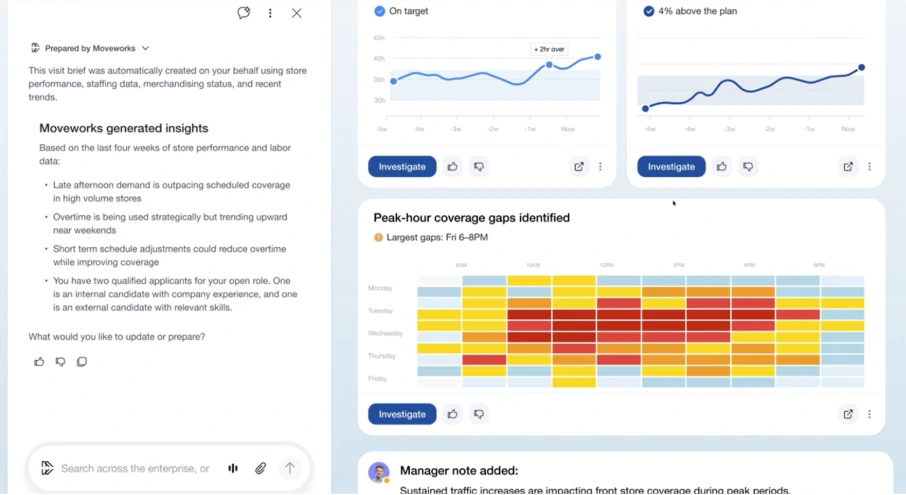
ServiceNow Employee Workflows dashboard showing AI-generated insights on store performance, staffing gaps, and overtime trends. Includes visual analytics like peak-hour coverage heatmaps and recommendations to optimize workforce scheduling and operations.
Did You Know?
A global automotive manufacturer achieved 75% increase in self-service with ServiceNow HR solutions.
You Bought the Vision. Now Build It Well with Aelum, On ServiceNow.
ServiceNow EmployeeWorks represents a fundamental change in how employees interact with every system in the organization. The technology is ready; the question is whether your environment is ready to make use of its full potential.
Getting EmployeeWorks’ complete value requires clean data, mature workflows, governed permissions, and an implementation partner who understands both the AI and ServiceNow layers well enough to connect them without shortcuts.
At Aelum, we’re an AI-and data-first ServiceNow consulting partner with 250+ certified experts.
- We audit your CMDB before we touch your configuration.
- We map your workflows before we build your use cases.
- We make sure the foundation is solid before the front door opens.
Why? Because that’s what separates an EmployeeWorks deployment that delivers ROI from one that stalls after the pilot. We work with the precision that a boutique practice brings and the depth that enterprise ServiceNow demands.
If ServiceNow EmployeeWorks is on your 2026 roadmap or anytime ahead, the best time to get the foundation right is before go-live. Let’s talk about what it takes to do it right. Book a 1:1 with our ServiceNow experts right away.