As vehicles grow more connected and software-defined, the attack surface grows with them, turning what was once a mechanical- engineering challenge into one of the most complex cybersecurity problems. This ever-expanding car data ecosystem requires enhanced data protection, making cybersecurity a built-in performance standard for automobiles.
UN R155 is a regulation that requires OEMs to hold a valid Cybersecurity Management System (CSMS) certificate before a vehicle can receive type approval, while ISO/SAE 21434 secure-by-design engineering standard demands cybersecurity to be embedded into every stage of vehicle development. Meeting these requirements is about operating cybersecurity as a continuous, enterprise-wide capability.
A robust CSMS enables OEMs to align risk, compliance, and security operations within a single, auditable framework. Platforms like ServiceNow support this by acting as a centralized orchestration layer, connecting disparate security tools, prioritizing risks, and coordinating response workflows across the organization.
Core Automotive Cybersecurity Threats
Connected vehicles face threats from every direction. Over the air, through the supply chain, inside the software stack, and deep in the cloud. Below are the core attack vectors that automotive OEMs and security teams must account for.
1. Network & Communication Attacks
Communication channels, including V2X, telematics, Bluetooth, and Wi-Fi, remain highly susceptible to man-in-the-middle (MITM) attacks, message spoofing, and replay attacks. As vehicles communicate with a growing number of external systems in real time, window for interception continues to widen.
Impact: Compromises integrity and authenticity of data exchanged between vehicle components or external systems, enabling remote manipulation of vehicle behavior.
2. Software and Firmware Exploits
Vehicle functionality is increasingly controlled by software embedded in ECUs, with the CAN bus acting as the primary internal communication backbone. Vulnerabilities in this software can be exploited to run malicious code, inject unauthorized firmware, or manipulate system behavior, often without physical access.
Impact: Loss of control over vehicle functions, disabling of safety systems, or persistent compromise that survives reboots and evades standard diagnostics.
3. Backend and Cloud Infrastructure Attacks
Today’s modern vehicles are deeply integrated with backend systems supporting telematics, fleet management and OTA delivery. Weaknesses in APIs, cloud misconfigurations, or compromised credentials allow attackers to gain unauthorized access to vehicle data or control systems.
Impact: A single backend breach can expose an entire fleet, compromising sensitive data, enabling unauthorized remote commands and creating considerable regulatory and liability exposure.
4. OTA Update Manipulation
OTA mechanisms are essential for delivering post-production software updates, but they also introduce a critical attack surface. Without proper safeguards such as code signing, integrity verification, and encrypted delivery, attackers can intercept or tamper with update packages, pushing malicious payloads across large fleets in one coordinated move.
Impact: A compromised OTA pipeline turns the update process into an attack vector, with the potential to affect thousands of vehicles simultaneously.
5. Supply Chain and Third-Party Risks
Automotive systems rely on a complex, multi-tier network of suppliers delivering hardware, software, and services. A vulnerability in any third-party component, whether an ECU firmware library or a telematics SDK, can quietly propagate across the broader ecosystem before it is identified and addressed.
Impact: Entry-points for large-scale, coordinated attacks on automotive companies
6. Data and Privacy Breaches
Vehicles generate and transmit sensitive data, including precise location history, driver behavior patterns, and personal information. Unauthorized access or data exfiltration creates privacy risks and legal exposures for manufacturers and operators.
Impact: Regulatory penalties under GDPR and equivalent frameworks, long-term damage to customer trust, risk of sensitive data being misused for surveillance, fraud or targeted attacks.
7. Denial-of-Service (DoS) Attacks
Attackers may flood vehicle systems or backend services with high volumes of traffic, rendering them unresponsive. DoS attacks can target anything from infotainment platforms to safety-critical ECUs or fleet management infrastructure.
Impact: Disabled vehicle services, degraded system performance, and in scenarios involving ADAS or emergency braking systems, a direct risk to driver and passenger safety.
The EV & AV Dimension
Electric vehicles introduce unique cybersecurity concerns beyond traditional ICE vehicles. EV charging infrastructure (OCPP-based networks), battery management systems, and Vehicle-to-Grid (V2G) communication create new attack surfaces that require dedicated threat modeling. Autonomous vehicles raise the stakes further; ADAS sensor fusion systems (LiDAR, radar, camera), HD map data pipelines, and real-time decision-making ECUs are high-value targets. A compromise in an AV’s perception stack isn’t a data breach; it’s a safety event.
The OEM Cybersecurity Checklist
- Build a Cyber-Resilient Supply Chain: Enforce cybersecurity standards across all suppliers, covering sourcing, component traceability, and tamper-proof delivery.
- Conduct Continuous Security Testing: Run routine penetration testing, code audits, and vulnerability assessments throughout vehicle lifecycle.
- Real-Time Threat Detection: Deploy intrusion detection and anomaly monitoring to catch unauthorized access before it escalates.
- Develop a Robust Incident Response Plan: Define clear protocols for isolation, stakeholder notification, root cause analysis, and system restoration.
Why Automobiles Need a Cybersecurity Management System?
The modern vehicle is defined by its software. EVs, ADAS, V2X connectivity, and smart systems have made cybersecurity a core engineering requirement. And with regulators enforcing UN R155 and ISO/SAE 21434 globally, OEMs no longer have the luxury of a fragmented approach.
OEMs need a Cybersecurity Management System that goes beyond point-in-time assessments. A true CSMS spans the full vehicle lifecycle, providing continuous risk visibility, structured incident response, and the traceability needed to demonstrate compliance at every stage, from initial design to post-market monitoring.
But the real challenge? Its execution. Building and sustaining a CSMS across distributed teams, multi-tier suppliers, and constantly evolving threat landscapes demands a platform that can hold it all together.
ServiceNow is that platform. Purpose-built for enterprise-scale orchestration, ServiceNow enables OEMs to operationalize their CSMS end-to-end, unifying workflows, automating responses, and maintaining a continuous compliance posture across the entire organization.
ServiceNow: The One Stop for Automotive Cybersecurity Solutions
There’s no shortage of cybersecurity tools in the automotive space. What really is an add-on is a platform that ties them all together, one that connects people, processes and systems across the entire vehicle lifecycle.
ServiceNow transforms your CSMS from a static compliance requirement into a dynamic, real-time operation. It connects security teams, automates workflows, and maintains continuous traceability across systems, suppliers and vehicle lifecycles, unifying threat management, compliance tracking, vendor risk, and incident response in a single platform.
For OEMs actively working on enhancing cybersecurity, ServiceNow is the foundation on which everything else is built.
Did You Know?
5 Core ServiceNow Capabilities for Automotives:
- Business Continuity Planning: Maintain critical vehicle and operational functions during and after a cyberattack. ServiceNow helps OEMs identify risks early and coordinate response plans including system recovery, stakeholder communication, and mitigation timelines to minimize disruption across the fleet.
- Cloud & Backend Security: Vehicle telematics, OTA infrastructure, and fleet management systems live in the cloud. ServiceNow enforces access controls, monitors cloud configurations, and protects data in transit and at rest, reducing exposure across the connected vehicle backend.
- Workforce & Supplier Awareness: Human error remains one of the most exploited vulnerabilities in any security program. 82% of employers report lack of cybersecurity skills among IT staffers. ServiceNow enables OEMs to track, manage, and enforce cybersecurity training across internal teams and extended supplier networks, ensuring awareness keeps pace with evolving threats.
- Network Security & Intrusion Detection: Protect in-vehicle networks and external communication channels from unauthorized access. ServiceNow enables real-time traffic monitoring across CAN bus, V2X, and telematics interfaces, identifying anomalies and triggering automated responses before threats escalate.
- Application & Software Security: ECU software, infotainment systems, and third-party applications are common attack entry points. ServiceNow supports security integration throughout the development lifecycle, from code review and vulnerability tracking to penetration test management and remediation workflows.
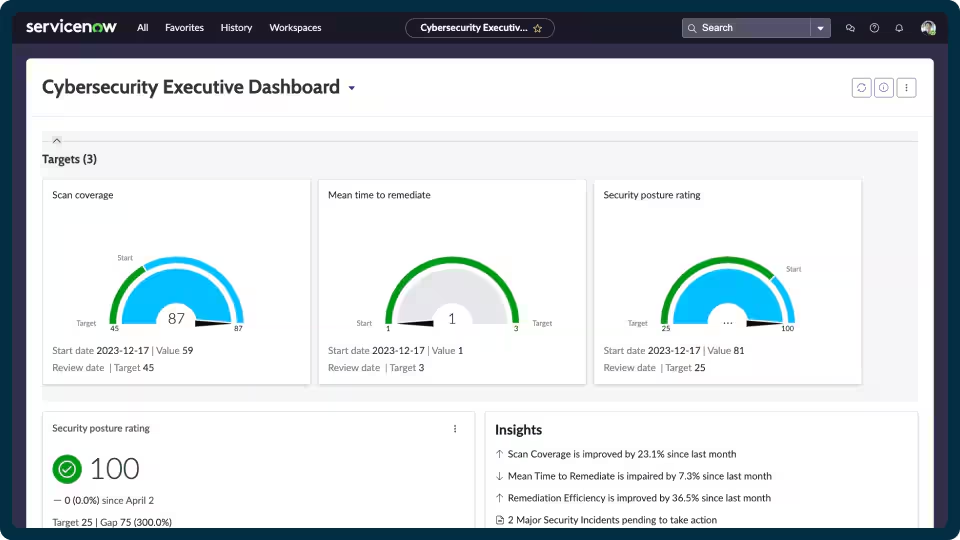
ServiceNow’s Cybersecurity Executive Dashboard gives OEM security leaders instant visibility into their organization’s security health and performance.
ServiceNow Modules Powering Automotive Cybersecurity:
1. ServiceNow SecOps (Security Operations)
ServiceNow SecOps allows automotives to detect, respond to, and resolve cybersecurity threats faster across vehicle systems, connected infrastructure, and the software development lifecycle. It breaks down silos between security, engineering, and operations teams, giving everyone a shared view of risk and a coordinated path to resolution.
According to Forrester, companies using the ServiceNow SecOps saw a 45% increase in security incident response speed, with tier-2 analysts handling 50% more incidents, without additional headcount.
Key Capabilities:
- Security Incident Response: Detect and respond to vehicle and infrastructure threats in real time. Manage threat exposure proactively with automated workflows, clear escalation paths, and full visibility into response metrics and SLA performance.
- Vulnerability Response: Identify and remediate vulnerabilities across ECUs, telematics systems, and cloud backends. Reduce attack surface exposure by prioritizing risks based on severity, asset criticality, and potential fleet-wide impact.
- Security Posture Control: Maintain a real-time inventory of all connected vehicle assets and infrastructure components. Automatically detect unmanaged or unauthorized assets and monitor for gaps in endpoint protection or vulnerability scanner coverage.
- Threat Intelligence Security Center: Centralize threat modeling and hunting operations in a purpose-built workspace. Apply automotive-relevant threat intelligence, including known V2X, CAN bus, and OTA attack patterns with automated playbooks scaled to your team’s capacity.
- Configuration Compliance: Detect and remediate misconfigurations across vehicle backend systems, cloud deployments, and telematics infrastructure. Prioritize issues using cloud metadata and automate remediation assignments across security and engineering teams.
- Data Loss Prevention Incident Response (DLPIR): Integrate with leading DLP solutions to monitor and manage data exfiltration risks, protecting sensitive vehicle design data, supplier contracts, and proprietary system specifications from internal and external threats.
2. ServiceNow GRC (Governance, Risk, and Compliance)
ServiceNow GRC helps automotive organizations build operational resilience and mitigate risk, addressing cybersecurity threats, supplier vulnerabilities, and vehicle data privacy across the enterprise. It helps meet evolving compliance mandates like UNECE WP.29, ISO/SAE 21434, and TISAX.
Key Capabilities:
- Business Continuity Management (BCM): Maintain operational resilience across vehicle connectivity platforms, ADAS systems, and manufacturing OT/IT environments. Conduct business impact analysis to prioritize critical automotive services, develop continuity and disaster recovery plans for cyber incidents, simulate automotive-specific attack scenarios (e.g., OTA compromise, supplier breach), and assess impact tolerance for safety-critical vehicle services.
- Integrated Risk Management (IRM): Unify compliance with automotive cybersecurity on a single AI-powered platform. Automate control testing, manage policy lifecycles, track regulatory changes, and streamline audit execution with real-time reporting and evidence collection.
- Privacy Management: Manage compliance with global vehicle data privacy regulations (GDPR, CCPA). Automate assessments, maintain ROPA for in-vehicle data collection (location, biometrics, driving behavior), manage DSARs, and accelerate breach notifications for connected vehicle data incidents.
- Third-Party Risk Management (TPRM): Assess and continuously monitor cybersecurity posture of Tier 1/Tier 2 automotive suppliers, ECU vendors, and software partners. Automate due diligence across the vehicle supply chain, centralize risk collaboration, and maintain full visibility into third-party engagements and associated cyber risks.
How We Helped a Global Manufacturer Transform Its Compliance with ServiceNow GRC:
Before ServiceNow GRC
- Evolving regulations with complex, scattered compliance controls
- Fragmented risk management across customer contracts & vendors
- Slow and labor-intensive assessments due to reliance on manual processes
After ServiceNow GRC:
- 85% automated responses handling high data volumes at scale
- 100% GRC activities managed on a single unified platform
- 360° risk visibility across customer, vendor, and enterprise ecosystems
- 75% faster control attestations enabling rapid audit cycles and reporting
- End-to-end oversight strengthening compliance accuracy and enterprise resilience
Read the detailed version: Global Electronics Manufacturer Unified Risk Visibility & Automated Compliance With ServiceNow GRC
Ready to build the same resilience into your automotive operations?
How We Help OEMs Operationalize Automotive Cybersecurity on ServiceNow
Automotive cybersecurity now stands as an active regulatory requirement. OEMs without a structured, continuous CSMS will face both fleet-level risk and market access barriers.
ServiceNow gives you the infrastructure to operationalize that CSMS, unifying SecOps, GRC, supplier risk, and incident response into a single, audit-ready platform. But along with the platform, implementation depth takes closing compliance gaps a step further.
At Aelum, we’ve helped automotives go from fragmented compliance operations to a fully compliant and secured organization in as little as 45 days, with measurable outcomes across risk visibility, supplier traceability and audit readiness.
Let’s map your core cybersecurity gaps as the first step and build your implementation roadmap. Book a 1:1 discussion with our ServiceNow experts today.