Industry 5.0 is the most sought-after response to the chaos and complexity facing modern manufacturers. Blending the digital strength of Industry 4.0 with a renewed focus on human-machine collaboration, customization, and sustainability.
But achieving it is not as simple as plugging in a few sensors. It demands a fundamental shift in how manufacturers manage the technology running their shop floors.
The reality is sobering. 92% of OT downtime events last more than an hour, costing up to $700,000 per incident. Most of that downtime is preventable. The root cause is almost always the same: outdated legacy systems, undocumented assets, unpatched vulnerabilities, and operational knowledge that lives in people rather than systems.
There is a better way to start. It does not begin with a platform or a transformation program. It begins with a discipline called Operational Technology Management, and it is the foundation that everything else in your roadmap depends on.
The Traditional View of Operational Technology Management and Why it Failed
For decades, Operational Technology operated in a comfortable silo.
PLCs, SCADA systems, HMIs, DCS platforms, industrial sensors, and legacy controllers were purpose-built, air-gapped, and managed by engineers who knew each machine intimately. Formal documentation was secondary. If the line ran, the system worked.
That model carried a hidden assumption: the engineers would always be there, the systems would stay isolated, and the environment would remain stable.
None of those assumptions hold anymore.
What Changed
| Then | Now |
| Air-gapped OT environments | OT connected to corporate networks and cloud platforms |
| Stable, long-tenured OT teams | Accelerating attrition and retirement |
| Minimal regulatory oversight | IEC 62443, NERC CIP, NIS2, and growing audit requirements |
| Low threat exposure | OT environments are active attack targets |
| Manual management at small scale | Multi-site operations with thousands of OT assets |
The Working Definition
OT Management is the discipline of systematically managing, monitoring, securing, and maintaining OT assets across their full lifecycle.
It applies the same rigor that IT management has brought to servers, software, and networks, adapted for industrial environments where uptime requirements are unforgiving and a misconfigured update can halt production.
Consultant’s perspective: Most organizations treat OT Management as a technology purchase. It is an operational discipline first. Technology makes discipline scalable. The discipline must exist before technology adds value.
The Eight Building Blocks of Effective OT Management
OT Management is a framework of interconnected disciplines, each addressing a distinct operational challenge. The order matters because each dimension builds on the one before it.
1. OT Asset Management
The majority of manufacturing organizations have significant gaps in their OT asset inventory. This is not a technology limitation. It is a process failure that has accumulated over years.
What does the gap look like in practice:
- Devices added to the production floor without formal documentation
- Legacy controllers running firmware versions that predate current support contracts
- Industrial IoT sensors proliferating across sites with no centralized registry
- Shadow OT assets: devices that exist on the network influence production, and carry security exposure, all outside any formal management structure
What structured OT Asset Management captures:
| Field | Why it Matters |
| Asset type and model | Determines patch compatibility and vendor support status |
| Physical location | Enables rapid response during incidents |
| Firmware version | Identifies vulnerability exposure |
| Ownership and responsible team | Closes the accountability gap |
| Network Connectivity | Maps attack surface and blast radius |
| Lifecycle status | Drives replacement planning before failure |
The downstream consequence of skipping this step:
Every other OT Management discipline operates on incomplete information without a clean asset inventory. Vulnerability management cannot find what is undocumented. Patch management cannot schedule what is uncatalogued. Incident response cannot trace a failure on an asset that appears in no record.
2. OT Visibility
An asset register tells you what you have. OT Visibility tells you what those assets are doing right now. Real-time OT Visibility means understanding, at any given moment:
- Which devices are active and communicating
- What network traffic patterns look like across OT zones
- Where anomalies form before they become incidents
- How operational health and security posture align or diverge
Why intuition-based monitoring no longer scales
Traditional OT environments relied on periodic manual checks and experienced engineer intuition. An operator hearing a machine run slightly differently. A technician noticing a temperature reading that was slightly off. That model worked at small scale with stable, experienced headcount.
It breaks down completely across multi-site operations with thousands of assets and increasing workforce turnover.
What good OT Visibility delivers:
- Continuous, passive monitoring of OT network traffic (passive to avoid crashing legacy devices)
- Active status polling for assets that support it
- Unified dashboards that surface operational health alongside security posture
- Anomaly detection in minutes rather than during the next shift handover
Why this matters to leadership: The time between anomaly formation and production impact is often measured in hours. With visibility, that window becomes a detection and response opportunity. Without it, that window closes before anyone knows it existed.
3. OT Security
Standard IT security frameworks were never designed for OT environments. Applying them without adaptation creates a false sense of coverage.
The OT security profile is fundamentally different:
- Systems run 24/7 with minimal tolerance for maintenance windows
- Default credentials on legacy devices often remain unchanged because vendor documentation warns that changing them could affect system behavior
- Network segmentation between IT and OT zones is frequently incomplete
- Remote vendor access for maintenance creates persistent exposure points
- Air-gap assumptions that were never fully true are now definitively false
What OT Security covers:
- Network segmentation: Isolating OT zones from IT networks and the internet to contain blast radius
- Access controls: Managing remote vendor connections with time-limited, audited sessions
- Identity management: Controlling who has physical and digital access to OT systems
- Lateral movement monitoring: Detecting attackers moving through OT networks after initial compromise
The threat landscape has validated the urgency
High-profile attacks on industrial infrastructure, targeting energy grids, water treatment facilities, and manufacturing plants, have confirmed that OT environments are deliberate targets. Attackers understand that operational disruption carries financial and safety consequences that create intense pressure to respond quickly.
Consultant’s perspective: Most manufacturers have invested in IT security while leaving OT security to informal practices and air-gap myths. The organizations that get attacked are rarely surprised in retrospect. The warning signs were visible. They just had no system to surface them.
4. OT Vulnerability Management
Every unpatched firmware version, every open port, every default credential is a vulnerability. OT environments have been accumulating them for years, often without anyone tracking the total exposure.
Why standard vulnerability management tools fall short in OT:
- Active scanning can crash legacy industrial devices, so passive discovery is required
- IT vulnerability databases have incomplete and delayed coverage of OT-specific firmware
- CVSS scores designed for IT software do not translate directly to OT operational context
The OT vulnerability management process:
- Discover: Passive asset and vulnerability discovery across OT networks
- Assess: Evaluate each vulnerability in operational context, not just severity score
- Prioritize: Rank by what the asset does, what happens if it fails, and how it is networked
- Remediate: Patch where possible and apply compensating controls where constrained
- Monitor: Continuous detection for active exploitation across the OT environment
The prioritization principle that separates mature programs from reactive ones:
A critical CVSS score on a test-environment server is lower priority than a medium-severity vulnerability on a PLC managing a safety-critical production process. Operational context drives remediation priority, not severity scores alone.
5. OT Patch Management
In IT, patches get tested and deployed on rolling schedules. An administrator pushes updates after hours, verifies functionality, and moves on.
In OT, the same action requires:
- Vendor certification testing to confirm the patch does not affect system behavior
- Compatibility verification with every connected system and controller
- A planned production maintenance window, often scheduled months in advance
- A tested rollback plan in place before the window opens
- Simultaneous sign-off from engineering, operations, and IT security
When all of those conditions align, patching proceeds. When they do not, the vulnerability stays open. In many manufacturing environments, that means open for years.
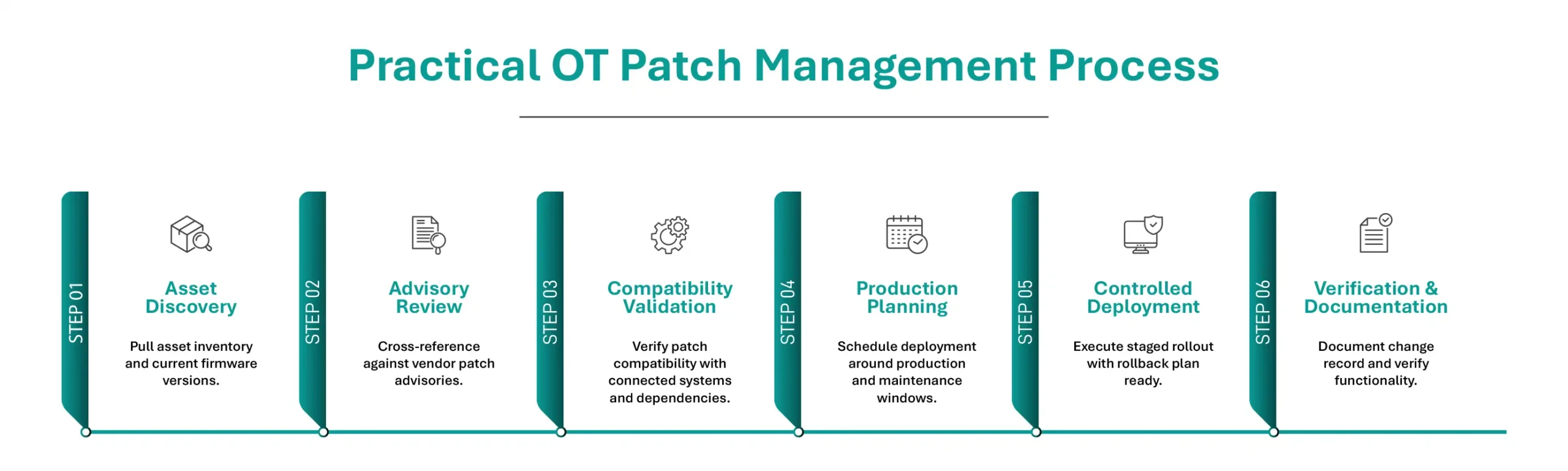
A practical OT patch management process:
When you genuinely cannot patch
Some OT assets cannot be patched on any reasonable schedule. This includes end-of-life devices, vendor-locked systems, and assets where any change risks production stability.
Compensating controls replace remediation in these cases:
- Network isolation to reduce reachability
- Enhanced monitoring to detect exploitation attempts
- Access restrictions to limit who can interact with the asset
- Accelerated replacement planning to retire the asset before the risk materializes
The audit implication: A documented patch record showing what was patched, when, by whom, and what compensating controls cover the gaps is the difference between a clean compliance review and a crisis. Most manufacturers have patches. They lack the records.
6. OT Risk Management
OT risk is operational risk, safety risk, compliance risk, and cybersecurity risk. All four are interconnected and all carry consequences that standard IT risk frameworks were never designed to quantify.
A vulnerability in a SCADA system is simultaneously:
- A cybersecurity risk that is exploitable by an attacker
- An operational risk that disrupts production if exploited
- A safety risk with physical consequences if the SCADA system manages process controls
- A compliance risk with regulatory exposure under IEC 62443, NERC CIP, or NIS2
What mature OT risk register captures:
- Every identified risk across OT assets
- Risk scoring in operational and safety context, not just CVSS
- Clear ownership for each risk item
- Remediation status and timeline
- Compensating controls where remediation is constrained
- Escalation thresholds that trigger leadership review
The hidden value of the risk register
The risk register is also the institutional memory that replaces tribal knowledge. When a senior engineer retires, the risk decisions they carried in their head are documented, reviewed, and owned by the organization. That knowledge stays with the business.
7. OT Service Management
When a server goes down in IT, the incident gets logged, triaged, and resolved through standard ITSM workflows. The SLA might be four hours. The resolution path is well-established.
When a PLC on a production line fails, the stakes are categorically different:
- The SLA is measured in minutes before the line stops
- Resolution requires OT engineers, production supervisors, and potentially the OEM
- Any change to fix the issue needs operational sign-off before a technician touches the system
- The financial impact of extended downtime is immediate and quantifiable
What OT Service Management provides:
- OT-specific incident categories with escalation paths that include operations leadership
- Change approval workflows that account for production schedules and vendor coordination
- SLAs calibrated to OT downtime consequences rather than standard IT response targets
- Problem management that surfaces recurring failure patterns on specific assets, driving proactive replacement before the next incident
The documentation dividend
OT Service Management converts informal fixes into institutional knowledge. The engineer who resolves a recurring PLC issue at 2 AM creates a knowledge article that helps the next technician resolve it in 20 minutes rather than two hours.
Over time, the incident history becomes the organization’s most valuable OT operational dataset. It feeds risk management, drives maintenance planning, and reduces mean time to repair.
8. OT Emergency Preparedness and Disaster Recovery
Standard IT disaster recovery assumes infrastructure that can be restored from backups to alternate environments on a timeline measured in hours or days.
OT disaster recovery operates under constraints that invalidate those assumptions entirely.
Why OT DR requires a different approach:
| IT DR | OT DR |
| Systems can failover to secondary environments | Physical production lines have no virtual equivalent |
| RTO measured in hours | Revenue loss per hour of OT downtime can reach six figures |
| Restore from backup images | PLC configurations must be restored to identical hardware |
| Incident is primarily a data or availability issue | OT incidents carry physical safety consequences |
What OT-specific emergency preparedness requires:
- Configuration backups for every PLC, SCADA system, and HMI, current enough to support hardware replacement without rebuilding from memory
- Manual fallback procedures for automated processes so production can continue at reduced capacity during recovery
- Safety system verification steps that confirm process safety before production resumes after any incident
- Cyber incident response integration because ransomware on an OT network is simultaneously a security breach, an operational disruption, and a potential safety event
The Three Failure Modes of Unmanaged OT Environments
Understanding the dimensions of OT Management makes the cost of operating without them easier to see. Organizations that have experienced OT management failures tend to encounter one of three patterns. Each is a direct consequence of treating OT management as informal, reactive, and secondary to production continuity.
1. Knowledge Cliff
A senior OT engineer with 20 years of institutional knowledge and retired.
The quirks of Line 3’s SCADA configuration. The PLC that needs a manual reset after every firmware cycle. The network segment was isolated three years ago for a reason nobody documented.
All of it leaves with them. The organization discovers the gap the next time something breaks, and nobody knows where to start.
What makes this a leadership problem and not a technical one:
Knowledge cliffs are predictable. Retirement timelines are visible. Organizations that lose institutional knowledge to attrition made an active choice, explicitly or by inaction, to let that knowledge stay informal.
2. Compliance Ambush
An audit arrives requiring evidence of patch history, change records, and vulnerability remediation across OT assets.
The informal fixes, the undocumented changes, the patches applied by vendor technicians during service visits: none of it is in a system. The audit becomes a crisis that consumes weeks of engineering time and leaves behind findings that take months to remediate.
3. The Incident That Compounds
A machine behaves strangely during a shift. An engineer investigates, adjusts a configuration setting, and the machine runs normally. The fix is never documented.
Three months later, during peak production, the same issue recurs. It is compounded by a subsequent configuration change that nobody knew was related. The line goes down for six hours. Root cause takes two days to trace because there is no incident history to reference.
The pattern across all three: Every one of these failures is preventable. Every one of them becomes exponentially more expensive the longer the underlying gap persists.
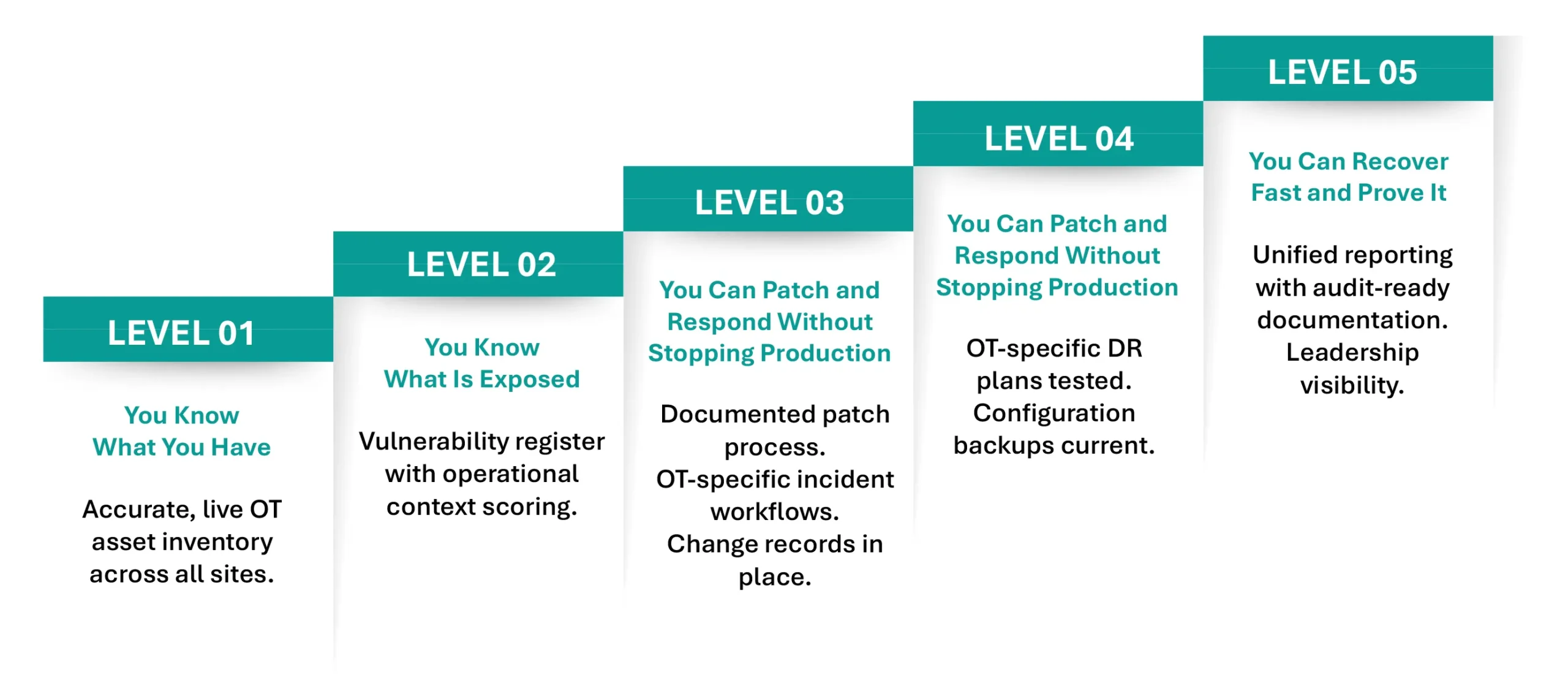
The OT Management Maturity Ladder: Where Does Your Organization Stand?
Most manufacturing organizations are somewhere on this progression. Knowing where you stand is the starting point for knowing what to build next.
OT Management Comes Before IT/OT Convergence, Not After
IT/OT convergence is the strategic direction for manufacturing. Predictive maintenance, AI-driven quality analytics, agentic automation, and digital twins all require OT data to be structured, accessible, and trustworthy.
The foundational problem:
OT data from undocumented assets, unmonitored networks, and informally managed systems is unreliable. Predictive models built on it produce unreliable outputs. Automation decisions based on it behave unpredictably. Digital transformation programs built on it stall.
Organizations that pursue convergence before OT Management discover this the expensive way.
The sequence that works:
- Build OT asset inventory
- Instrument visibility and monitoring
- Establish security, vulnerability, and patch management processes
- Create the risk register and service management workflows
- Pursue convergence with a data foundation worth building on
OT Management first. Convergence second. In that order, every time.
Where does your OT environment sit on the maturity ladder?
How ServiceNow Ties Every OT Management Dimension Together
Most manufacturers managing OT today are running four or five disconnected tools simultaneously. A CMDB for assets. A ticketing system for incidents. A GRC platform for risk. A spreadsheet for patch tracking. A separate security tool that has no context for what any OT asset does on the production floor.
Each tool captures a fragment. None of them connect the fragments into a view that operations and leadership can act together.
ServiceNow Operational Technology Management solves this by mapping OT assets directly to production processes on a single AI platform, then running service management, vulnerability management, and asset lifecycle management through the same connected workflows. IT and OT teams coordinate across all sites from one system rather than trading information across disconnected tools.
ServiceNow structures OT Management into four functional areas. Each one addresses a distinct operational need.
1. OT Visibility
ServiceNow builds and maintains a live OT asset inventory that goes well beyond a device list. It places each asset in the context of the production process it supports, so teams understand what an asset does, what it connects to, and what breaks if it fails.
This production context is what separates useful visibility from a spreadsheet with serial numbers. When an issue surfaces, teams trace it immediately to the affected production flow rather than spending hours mapping dependencies manually.
What this delivers:
- Real-time view of all production assets across every site
- Asset traits and dependency data maintained consistently across locations
- Standardized reporting across sites rather than site-specific spreadsheets
- Integration with third-party discovery tools for complete coverage
2. OT Asset Lifecycle
Unplanned failures happen most often on assets that were never actively managed. Hardware running past its useful life. Devices with no refresh plan. Equipment added to the floor without being entered into any formal record.
ServiceNow OT Asset Lifecycle Management monitors every OT asset from procurement through retirement. Hardware refresh cycles are planned proactively, balancing asset lifespan with production modernization goals. Teams can see which assets are approaching end of life, which are overdue for maintenance, and which carry the most operational risk if they fail unexpectedly.
What this delivers:
- Full asset lifecycle tracking from commissioning to decommission
- Hardware refresh planning integrated with production schedules
- Proactive replacement recommendations based on asset health and age
- Faster onboarding of new OT assets into the CMDB, with asset context built in from the start
3. OT Service Management
Standard IT service management was built for IT environments. Applying it without modification to OT creates workflows that do not account for how OT incidents behave, who needs to be involved, or how quickly a line stops when the response is too slow.
ServiceNow OT Service Management automates service workflows specifically for OT teams and coordinates them with IT workflows on the same platform. Incident categories, escalation paths, SLAs, and change approval workflows are configured for the operational constraints of production environments, not adapted from a generic ITSM template.
AI agents assist with documenting resolutions and building the knowledge base, so the fix one technician applies at 2 AM becomes the knowledge article that helps the next technician resolve the same issue in 20 minutes.
What this delivers:
- OT-specific incident management with escalation paths that include operations leadership
- Change management workflows built around production schedules and vendor coordination requirements
- SLAs calibrated to OT downtime consequences rather than standard IT response targets
- AI-assisted knowledge capture that converts informal fixes into institutional records
4. OT Exposure Management
Identifying vulnerabilities is the easy part. Prioritizing remediation in an environment where you cannot stop the line is where most organizations get stuck.
ServiceNow OT Vulnerability Response identifies and prioritizes cyber threats to OT systems in production context. A vulnerability on a PLC managing a safety-critical process ranks higher than the same vulnerability on a peripheral device. The platform applies logic automatically, surfacing the risks that carry the most consequence for production continuity and safety.
Patches are scheduled during planned maintenance windows rather than pushed reactively. Remediation happens without production disruption, and compliance documentation is generated automatically for audit readiness.
What this delivers:
- OT security monitoring with full visibility into the OT attack surface
- Vulnerability prioritization based on production impact, not severity scores alone
- Patch scheduling aligned to maintenance windows and production calendars
- Automated compliance tracking against frameworks including NERC CIP and IEC 62443
- Integration with Security Operations for end-to-end threat response
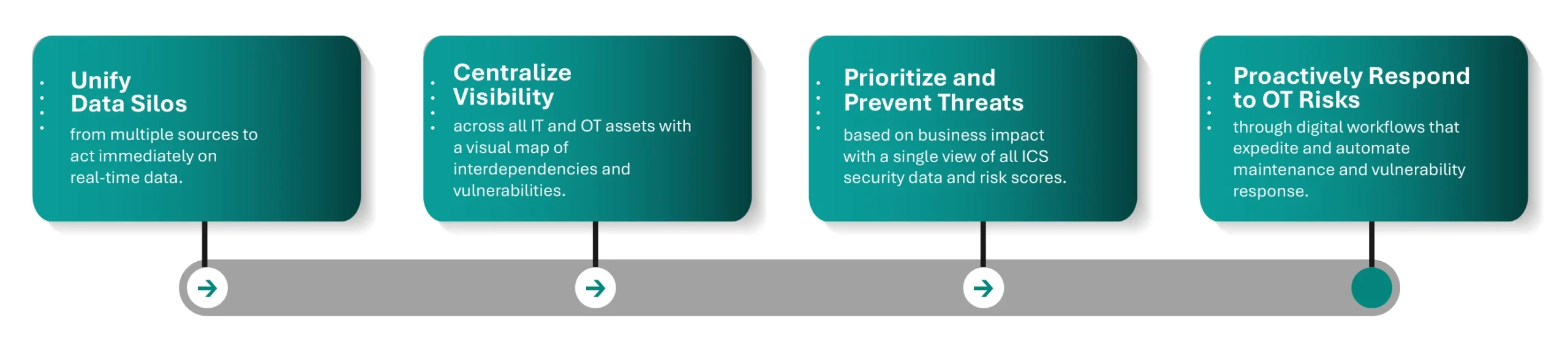
What ServiceNow Delivers Across the Business
ServiceNow OT Management is a capable platform. It is also one that requires OT-specific configuration to deliver its full value.
Strengthened industrial security: Full OT asset visibility, simplified regulatory compliance, and prioritized vulnerability remediation
Minimized production downtime: Proactive service management that addresses issues before they stop the line
Simplified IT/OT operations: A single platform that eliminates silos and brings IT best practices to OT without sacrificing operational context
Getting Started with OT Management on ServiceNow with Aelum
ServiceNow OT Management is available now, and Aelum is ready to implement it for your environment.
- Explore ServiceNow OT Management: Discover OT assets across your enterprise, prioritize vulnerabilities, and automate remediation workflows on a single platform
- See Aelum’s Industrial Edge Services: Connect your OT Management foundation to real-time telemetry, predictive analytics, and floor-level operational intelligence
- Read our IT/OT Convergence blog: Understand the strategic context before your next implementation conversation
- Talk to an Aelum consultant: For implementation scoping, OT environment assessments, or migration support from legacy tools, start the conversation here