Somewhere on your shop floor right now, a clipboard is sitting next to a $2 million machine. That’s the contradiction modern manufacturing is still living with.
Factories have invested heavily in IoT sensors, ERP platforms, automation, and connected systems, yet critical production data is still being written by hand, re-entered into spreadsheets, and stored in binders no one opens until audit season.
The cost goes far beyond inefficiency. It shows up in defects discovered too late, compliance records that fail under scrutiny, maintenance decisions made on yesterday’s data, and frontline knowledge that exists only in the heads of experienced operators, knowledge that walks out the door when they retire.
Going paperless is not a document management upgrade. It’s an operational shift that determines whether your factory can become intelligent, compliant, and competitive in 2026 and beyond.
In this exploration, we break down what the shift truly demands, the friction points that derail most efforts, the outcomes waiting on the other side, and a clear path to getting there.
What Is Paperless Manufacturing?
Paperless manufacturing is the complete digitization of shop floor operations, replacing physical SOPs, work orders, quality checklists, maintenance logs, and batch records with connected workflows accessible at the point of work.
But paperless does not mean scanning forms or storing PDFs. That only changes where information is kept, not how operations run. The real shift happens when data is captured directly from machines, operators, and enterprise systems, validated in real time, and shared instantly across teams.
When done right, paperless manufacturing turns information from a delayed record into a live operational asset that drives faster decisions, stronger traceability, and smarter factory execution.
The Common Challenges Manufacturers Struggle to Go Paperless
Most manufacturers do not struggle with going paperless because the technology is lacking. The real challenge lies in navigating the operational, cultural, and process changes that come with transforming long-established ways of working. Here are the friction points that derail most efforts.
1. Cultural Resistance and Workforce Adoption
Operators who have run production lines with clipboards for 20 years do not automatically trust what they cannot hold. Digital transformation in manufacturing often fails not because of technology, but for frontline adoption never fully happens. Without structured change management, on-floor coaching, and role-specific training, even the best digital tools get ignored, and paper quietly finds its way back into the process.
2. Legacy System Integration and Data Silos
Many manufacturers still rely on systems built decades ago. PLCs, SCADA environments, and legacy ERP platforms were never designed for real-time connectivity. Integrating them with modern digital platforms is often complex, expensive, and operationally risky. Without seamless integration, data stays fragmented, and real-time visibility remains out of reach.
3. Cybersecurity and Operational Technology Exposure
Every connected tablet, sensor, and machine interface expands the factory’s digital footprint. As manufacturing environments become more connected, they also become more vulnerable. Cyberattack in manufacturing does not just compromise data. It can disrupt production, impact safety, and bring critical operations to a standstill.
4. Regulatory Compliance and Digital Record Validity
In regulated industries, going paperless comes with strict compliance expectations. Standards like FDA 21 CFR Part 11, ISO 9001, and IATF 16949 require audit trails, electronic signatures, version control, and validated records. Simply digitizing forms is not enough. Without proper controls, a digital system can create more compliance risk than paper.
5. High Upfront Costs and ROI Uncertainty
Going paperless requires investment across software, hardware, integrations, training, and process redesign. While the long-term returns are significant, the value is not always immediate. For many manufacturers, especially SMEs, proving ROI upfront becomes the first challenge before implementation even begins.
6. Data Quality, Accuracy, and the “Digital Copy” Trap
Many manufacturers fall into the digital copy trap, simply taking a paper form and recreating it on a screen. The format changes, but the process stays the same. True transformation happens when workflows are redesigned, data is validated automatically, and unnecessary manual steps are removed. Without that shift, digital systems end up carrying the same inefficiencies paper always had.
Digitize your factory floor with Aelum.
The Business Value of Going Paperless
The shift away from paper is more about transforming how information moves, decisions are made, and operations run on the shop floor and less about just eliminating a material. Here is what manufacturers consistently gain when the transition is done right.
1. Real-Time Visibility and Faster Decision-Making
Paper slows down information flow. Production issues, quality deviations, and equipment failures often surface only after the shift is over, when the opportunity to act has already passed. Digital workflows give plant teams live access to production status, quality metrics, and asset health as events happen, enabling faster decisions, quicker escalations, and more proactive operations.
2. Higher Data Accuracy and Fewer Operational Errors
Every manual handoff introduces risk. Information can be written incorrectly, entered twice, or lost between teams. Digital data capture at the source eliminates repeated data entry, enforces validation automatically, and creates a clear record linked to the operator, machine, and timestamp. The result is cleaner data, fewer errors, and greater confidence in every decision.
3. Continuous Audit Readiness and Stronger Compliance
Compliance should not begin when an auditor walks in. Paperless operations embed audit trails, electronic signatures, version control, and approval histories into everyday workflows. Instead of spending days collecting records from folders and filing cabinets, teams can retrieve validated documentation instantly when it is needed.
4. A Strong Foundation for AI and Smart Manufacturing
Predictive maintenance, intelligent scheduling, and AI-driven process optimization all depend on clean, real-time operational data. Factories that still rely on paper create data gaps that limit automation and analytics. Going paperless is not just part of digital transformation. It is the foundation that enables truly intelligent manufacturing.
5. Measurable Cost Savings and Hidden Operational ROI
The business case for paperless manufacturing goes far beyond reducing paper consumption. The real savings come from labor recovered through automation, fewer defects and rework, faster issue resolution, reduced downtime, and better use of plant resources. Over time, these operational gains often deliver returns far greater than the initial investment.
How To Go Paperless: A Step-by-step Transition Roadmap
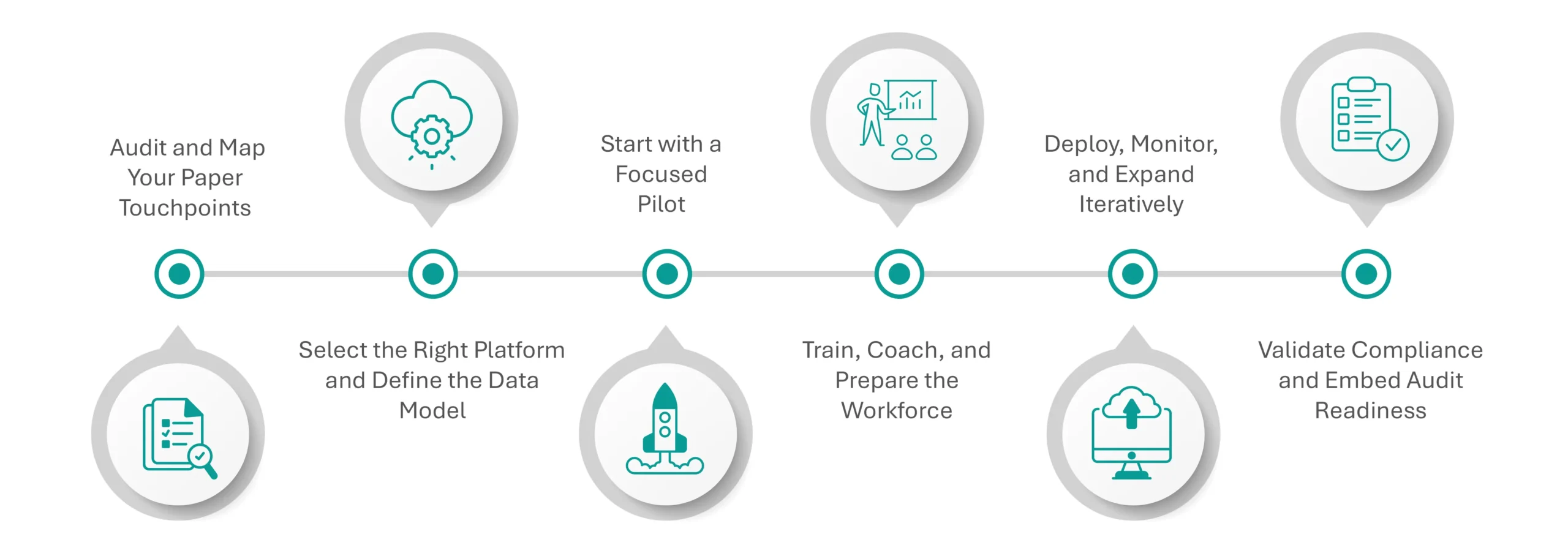
1. Audit and Map Your Paper Touchpoints
Before digitizing anything, identify exactly where paper exists across operations. Map SOPs, work orders, quality checklists, maintenance logs, and batch records to understand who uses them, how information flows, and where delays or errors occur. Prioritize processes with the highest operational or compliance impact first.
2. Select the Right Platform and Define the Data Model
Choose a platform that integrates smoothly with your ERP, SCADA, MES, and OT systems. More importantly, define a clear data model before implementation begins. Without a structured foundation, manufacturers often replace paper silos with disconnected digital systems. The goal is to capture data directly at the source, not manually re-enter it later.
3. Start with a Focused Pilot
Avoid attempting a plant-wide rollout immediately. Begin with one high-impact workflow such as a quality inspection, maintenance request, or production line process. Measure improvements in accuracy, turnaround time, and user adoption. A successful pilot builds internal confidence while exposing operational gaps early.
4. Train, Coach, and Prepare the Workforce
Technology adoption on the shop floor requires more than standard IT training. Operators, technicians, supervisors, and quality teams all need role-specific onboarding. Provide hands-on support during the initial rollout and focus communication on practical improvements such as reduced manual work, easier access to information, and faster issue resolution.
5. Deploy, Monitor, and Expand Iteratively
Once live, continuously monitor operational KPIs such as data accuracy, cycle times, downtime, and audit findings. Use those insights to refine workflows and identify the next processes to digitize. As more operational data becomes available, manufacturers can unlock deeper automation, analytics, and AI-driven optimization over time.
6. Validate Compliance and Embed Audit Readiness
Electronic records must align with the regulatory standards governing your industry, whether FDA 21 CFR Part 11, ISO 9001, or IATF 16949. Ensure the platform supports audit trails, electronic signatures, access controls, and record retention requirements from the start. Building compliance into the system early is far easier than retrofitting it later.
ServiceNow for Paperless Manufacturing Operations
ServiceNow enables paperless manufacturing by replacing manual, paper-driven processes with connected digital workflows across the shop floor. From SOPs and quality inspections to maintenance requests and incident response, it helps manufacturers capture and act on operational data in real time.
Most manufacturers already have the core systems in place, from ERP and MES platforms to IoT sensors and OT environments. The challenge is that these systems often operate in silos, leaving teams dependent on spreadsheets, emails, and manual coordination. ServiceNow acts as the AI-powered workflow layer that connects these disconnected systems, turning fragmented data into automated actions, real-time visibility, and standardized execution across the factory floor.
The ServiceNow Stack for Paperless Manufacturing
1. Manufacturing Commercial Operations: ServiceNow MCO helps manufacturers replace disconnected, paper-driven processes with connected digital workflows across production, service, support, and order operations. It centralizes operational data, automates exception handling, and enables real-time collaboration between frontline teams, back-office functions, dealers, suppliers, and customers.
Built on the ServiceNow AI Platform, MCO combines workflow automation, AI-powered experiences, and enterprise integrations to streamline manufacturing operations end to end. Manufacturers can digitize approvals, standardize execution, automate issue resolution, and improve visibility across the entire operational lifecycle.
2. Field Service Management: ServiceNow Field Service Management helps manufacturers digitize maintenance operations, technician workflows, and asset service management through connected, AI-powered field service workflows. It enables teams to automate work order management, streamline dispatching, and provide technicians with real-time access to asset history, operational data, and guided task execution.
Built on the ServiceNow AI Platform, FSM combines intelligent scheduling, mobile workforce enablement, and workflow automation to improve service efficiency across manufacturing operations. Manufacturers can reduce downtime, accelerate issue resolution, standardize maintenance execution, and eliminate manual paperwork across field and plant service activities.
Leave Paper Behind for the Future of Manufacturing
Going paperless in manufacturing is no longer a future-state ambition. It is a present-day operational decision and the gap between manufacturers who have made it and those still running on clipboards is widening fast.
The challenges are real. Legacy systems resist change, workforces need time, compliance demands precision, and the investment asks for justification. But none of these are reasons to wait. They are reasons to plan well and execute with the right platform.
The factories moving fastest share one thing in common: they are not just digitizing paper. They are redesigning how work happens, how data flows, and how decisions are made. That is the shift that compounds in fewer defects, faster audits, lower downtime, and a floor that can actually support AI-driven intelligence.
ServiceNow makes that shift executable. As a certified ServiceNow partner, Aelum brings the implementation depth and manufacturing process expertise to help your team move from paper-dependent to fully connected, without disruption to ongoing operations.
Ready to take the first step? Let’s talk. Schedule a free consultation with Aelum today.